Author: GRottmayer

  • Bore Log Examples From Real Jobs (Directional Drilling Field Scenarios)

    Bore Log Examples From Real Jobs (Directional Drilling Field Scenarios)

    A bore log is only as strong as the way it’s used in the field.

    A clean template doesn’t make a good bore log. A perfect PDF doesn’t make a good bore log. A neat spreadsheet doesn’t make a good bore log.

    What makes a good bore log is how the information is captured while the job is moving.

    Directional drilling is not a controlled environment. It’s not linear. It’s not predictable.

    Conditions shift. Ground changes. Utilities appear. Steering corrections happen. Production speeds up or slows down. Problems show up without warning.

    This is why most “example bore logs” online are useless, they show perfect conditions, perfect numbers, and perfect days. That’s not the real world.

    Real HDD work looks like:

    • clean shots
    • messy shots
    • unexpected rock
    • unmarked utilities
    • wet clay
    • steering drift
    • delays
    • adjustments
    • production swings

    A real bore log captures all of it, not just the parts that look good.

    The examples below show what real logging looks like when the job is actually happening, not when someone is trying to remember it later.

    These are the kinds of entries that:

    • defend your footage
    • justify your hours
    • explain your production
    • protect your invoice
    • shut down disputes

    And when these entries are captured in real time using Boreva, they become even stronger, because they’re not summaries. They’re records.

    Example 1: Straight Shot, Clean Conditions

    Scenario

    This is the type of shot every driller wishes they had all day long:

    • open ground
    • no congestion
    • predictable soil
    • no utilities in the way
    • no steering corrections
    • no environmental factors slowing production

    A clean shot doesn’t mean the log can be lazy. A clean shot means the log must be tight, because this is the baseline the GC will compare everything else against.

    If your clean shots are sloppy, the GC assumes your complicated shots are worse.

    Bore Log Entry

    Shot: 1

    Entry: STA 0+00

    Exit: STA 3+00

    Planned Length: 300 ft

    Actual Length: 298 ft

    Depth: 48 in

    Ground: Clay, dry

    Start: 8:00 AM

    End: 9:10 AM

    Issues: None

    Notes: Clean shot, no steering corrections

    Why This Entry Works

    This is exactly what a clean, professional bore log entry looks like. Here’s why:

    1. The Footage Is Exact, Not Rounded

    Most crews would write:

    • “300 ft”
    • “About 300 ft”
    • “~300 ft”

    Rounded numbers kill credibility.

    298 ft shows:

    • the crew counted rods
    • the crew tracked actual footage
    • the log reflects reality, not memory

    When the GC sees exact numbers, they trust the rest of the log.

    2. Conditions Are Logged Even When Nothing Changes

    A weak log would skip the ground conditions because “nothing happened.”

    A strong log still records:

    • Clay, dry

    Why?

    Because this becomes the baseline for the rest of the day.

    If the next shot slows down, the GC can see:

    • Shot 1: dry clay → fast
    • Shot 2: wet clay → slower
    • Shot 3: mixed soil → slower

    Without this baseline, the GC assumes the crew slowed down — not the ground.

    3. The Time Window Makes Sense

    Start: 8:00 AM End: 9:10 AM

    A 298‑ft shot in 70 minutes is:

    • believable
    • consistent
    • aligned with the conditions
    • aligned with the footage

    Nothing looks inflated. Nothing looks padded. Nothing looks suspicious.

    This is the kind of entry that never gets questioned.

    4. Notes Confirm the Shot Was Clean

    “Clean shot, no steering corrections.”

    Short. Direct. Field‑credible.

    This note tells the GC:

    • the crew was in control
    • the ground was predictable
    • the alignment held
    • no adjustments were needed

    This is exactly how a clean shot should be documented.

    5. No Issues Logged And That’s Important

    A lot of crews skip the “Issues” field when nothing happens.

    A strong log explicitly says:

    • Issues: None

    This matters because:

    • it shows the field actually reviewed the shot
    • it confirms nothing slowed production
    • it prevents the GC from inventing problems later

    A blank field creates doubt. A “None” entry creates clarity.

    What This Example Really Shows

    This example isn’t about the shot. It’s about the discipline.

    A clean shot is where most crews get lazy. A clean shot is where most logs fall apart. A clean shot is where inconsistencies start.

    But a clean shot is also:

    • the baseline for the day
    • the comparison point for later delays
    • the reference point for production
    • the anchor for the GC’s expectations

    If your clean shots are logged correctly, your complicated shots have a foundation to stand on.

    This is why this example matters.

    How Boreva Handles This Shot in the Field

    With Boreva, this entry is captured:

    • when the shot finishes
    • with exact footage
    • with the correct conditions
    • with timestamps
    • with notes added immediately

    The system removes:

    • rounding
    • guessing
    • rewriting
    • end‑of‑day reconstruction

    Example 2: Rock Encounter Mid‑Shot

    Scenario

    This shot starts in soft, predictable clay, the kind of ground where production is fast and steering is easy. But halfway through the alignment, the crew hits a rock seam.

    This is a classic HDD scenario:

    • the first half of the shot drills fast
    • the second half slows down
    • steering becomes harder
    • penetration rate drops
    • the crew must adjust the head
    • the timeline shifts

    If this isn’t documented correctly, the GC will assume the crew slowed down for no reason.

    This is where a bore log either protects you or exposes you.

    Bore Log Entry

    • Shot: 2
    • Entry: STA 3+00
    • Exit: STA 6+00
    • Planned Length: 300 ft
    • Actual Length: 312 ft
    • Depth: 52 in
    • Ground: Clay transitioning to rock at 140 ft
    • Start: 9:30 AM
    • End: 12:15 PM
    • Issues: Slowed drilling due to rock
    • Notes: Steering adjustments made after rock encounter

    Why This Entry Works

    This is a textbook example of how to document a condition change that affects production.

    Let’s break down why this entry is strong.

    1. The Ground Transition Is Documented at the Exact Point It Occurred

    “Clay transitioning to rock at 140 ft.”

    This single line does more than most contractors realize:

    • it explains the slowdown
    • it explains the extra footage
    • it explains the steering corrections
    • it explains the longer timeline
    • it proves the crew was paying attention

    If you simply wrote “rocky conditions,” the GC would challenge it.

    This note is specific. Specific notes hold up.

    2. The Actual Length Increased and the Log Explains Why

    Planned: 300 ft Actual: 312 ft

    Extra footage is a red flag to a GC unless it’s documented.

    Here, the extra footage makes sense because:

    • the rock seam forced a slight alignment adjustment
    • steering corrections added distance
    • maintaining depth and clearance required a longer path

    The log ties the footage to the conditions. That’s what makes it defensible.

    3. The Timeline Matches the Conditions

    Start: 9:30 AM End: 12:15 PM

    A 312‑ft shot taking 2 hours and 45 minutes is completely reasonable in mixed clay/rock.

    If the log didn’t mention the rock seam, the GC would assume:

    • the crew slowed down
    • the crew wasn’t efficient
    • the hours are inflated

    But with the condition change documented, the timeline becomes logical.

    4. The Issue Is Logged Clearly and Directly

    “Issues: Slowed drilling due to rock.”

    Short. Accurate. Field‑credible.

    This tells the GC:

    • the slowdown had a cause
    • the cause was geological
    • the crew didn’t create the delay
    • the production rate reflects the ground, not the crew

    This is exactly how issues should be logged.

    5. The Notes Explain the Crew’s Response

    “Steering adjustments made after rock encounter.”

    This note shows:

    • the crew recognized the change
    • the crew adjusted the head
    • the crew maintained the alignment
    • the crew stayed in control

    GCs want to see that the crew responded appropriately, not blindly drilled through it.

    This note proves that.

    What This Example Really Shows

    This example demonstrates the difference between:

    • a bore log that protects your production, and
    • a bore log that forces you to defend your production

    A rock seam is not a problem, it’s a condition. But if it’s not documented, it becomes a problem later.

    This entry:

    • explains the slowdown
    • explains the extra footage
    • explains the steering corrections
    • explains the timeline
    • explains the production rate

    Everything ties together.

    This is what a strong bore log looks like.

    How Boreva Handles This Shot in the Field

    With Boreva, this entry is captured:

    • the moment the rock seam is hit
    • with the exact footage
    • with the condition change logged immediately
    • with the steering adjustments noted
    • with timestamps that match the slowdown

    The system removes:

    • end‑of‑day guessing
    • vague notes
    • missing condition changes
    • unexplained production swings

    The log becomes a real‑time record, not a reconstruction.

    Example 3: Utility Conflict and Delay

    Scenario

    This is the shot that separates disciplined logging from “we’ll remember it later.”

    The crew is drilling through mixed soil, nothing unusual. Production is steady. Steering is controlled. Everything is on track.

    Then at 180 ft, the locator picks up something that wasn’t on the prints:

    • an unmarked utility
    • shallow
    • directly in the planned path
    • requiring immediate action

    This is a real HDD moment:

    • drilling stops
    • the crew potholes
    • the inspector gets involved
    • the alignment must be adjusted
    • the delay grows
    • the timeline shifts

    If this isn’t logged correctly, the GC will absolutely challenge the hours.

    This is where a bore log either protects your invoice — or destroys it.

    Bore Log Entry

    • Shot: 3
    • Entry: STA 6+00
    • Exit: STA 9+00
    • Planned Length: 300 ft
    • Actual Length: 287 ft
    • Depth: 60 in
    • Ground: Mixed soil
    • Start: 1:00 PM
    • End: 4:30 PM
    • Issues: Utility conflict at 180 ft, 1.5‑hour delay
    • Notes: Path adjusted to maintain clearance

    Why This Entry Works

    This is one of the strongest examples in the entire article because it shows how to document a delay in a way that cannot be disputed.

    Let’s break down why this entry is airtight.

    1. The Utility Conflict Is Logged at the Exact Footage

    “Utility conflict at 180 ft.”

    This is the difference between:

    • a believable delay
    • and a questionable delay

    This single detail proves:

    • the crew identified the conflict precisely
    • the conflict occurred mid‑shot
    • the delay had a real cause
    • the crew was paying attention
    • the log wasn’t filled out later

    GCs trust specifics. They attack generalities.

    This is specific.

    2. The Delay Is Quantified, Not Estimated

    “1.5‑hour delay.”

    Not:

    • “about an hour”
    • “roughly 90 minutes”
    • “some delay”

    A quantified delay shows:

    • the crew tracked the time
    • the delay was real
    • the delay was significant
    • the delay was not padded

    This is exactly how delay documentation should look.

    3. The Actual Length Is Shorter And the Log Explains Why

    Planned: 300 ft Actual: 287 ft

    Shorter footage is just as important to document as longer footage.

    Why?

    Because it shows:

    • the alignment was adjusted
    • the exit point shifted
    • the crew maintained clearance
    • the path changed due to the utility

    If the footage changed and the log didn’t explain it, the GC would assume:

    • the crew mis‑drilled
    • the footage is inaccurate
    • the log is unreliable

    This entry removes all doubt.

    4. The Timeline Matches the Delay

    Start: 1:00 PM End: 4:30 PM

    A 287‑ft shot taking 3.5 hours is completely reasonable with:

    • a utility conflict
    • potholing
    • inspector involvement
    • alignment adjustments

    The timeline aligns perfectly with the documented delay.

    This is what makes the entry defensible.

    5. The Notes Explain the Crew’s Response

    “Path adjusted to maintain clearance.”

    This note shows:

    • the crew made the correct decision
    • the crew followed safety and clearance requirements
    • the crew didn’t force the alignment
    • the crew maintained control
    • the crew acted professionally

    GCs want to see that the crew responded appropriately — not recklessly.

    This note proves that.

    What This Example Really Shows

    This example demonstrates the core purpose of a bore log:

    To explain why the day unfolded the way it did.

    A utility conflict is not a mistake. A utility conflict is not a crew problem. A utility conflict is not a production failure.

    A utility conflict is a condition.

    But if it’s not documented:

    • the GC will deny the delay
    • the GC will question the hours
    • the GC will challenge the footage
    • the GC will reduce the invoice

    This entry eliminates all of that.

    It ties:

    • the delay
    • the footage
    • the timeline
    • the adjustment
    • the conditions

    …into one clean, defensible record.

    This is exactly how a bore log protects your money.

    How Boreva Handles This Shot in the Field

    With Boreva, this entry is captured:

    • the moment the utility is detected
    • with the exact footage
    • with the delay timer running automatically
    • with the condition change logged immediately
    • with notes added in real time
    • with timestamps that match the slowdown

    The system removes:

    • forgotten delays
    • vague descriptions
    • missing footage changes
    • end‑of‑day reconstruction
    • “we think it was around an hour”

    The log becomes a real‑time record, not a memory exercise.

    This is the difference between:

    • a delay the GC denies
    • and a delay the GC pays

    Example 4: Wet Conditions and Steering Difficulty

    Scenario

    This shot starts like a normal clay shot, predictable, steady, and easy to control. But as the crew progresses, the ground moisture increases. The clay becomes slick. The head starts to skate. Steering corrections become more frequent. Penetration rate drops. The bore path becomes harder to hold.

    This is a classic HDD scenario where:

    • the ground doesn’t change type
    • the ground changes behavior

    And if the log doesn’t capture that shift, the GC will assume the crew simply slowed down.

    Moisture is invisible to the inspector unless you document it.

    Bore Log Entry

    • Shot: 4
    • Entry: STA 9+00
    • Exit: STA 12+00
    • Planned Length: 300 ft
    • Actual Length: 305 ft
    • Depth: 50 in
    • Ground: Wet clay
    • Start: 8:00 AM
    • End: 11:45 AM
    • Issues: Steering difficulty due to wet conditions
    • Notes: Slower advancement, additional corrections required

    Why This Entry Works

    This is exactly how to document moisture‑related production changes in a way that holds up under review.

    Let’s break down why this entry is strong.

    1. “Wet Clay” Is a Real Condition, Not a Throwaway Note

    Most crews write:

    • “Wet ground”
    • “Moist soil”
    • “Soft conditions”

    Those notes mean nothing to a GC.

    “Wet clay” is specific and meaningful because:

    • wet clay behaves differently than dry clay
    • steering becomes harder
    • the head slides instead of biting
    • corrections increase
    • production slows
    • the bore path becomes more sensitive

    This note tells the GC exactly what changed.

    2. The Timeline Reflects the Conditions

    Start: 8:00 AM End: 11:45 AM

    A 305‑ft shot taking 3 hours and 45 minutes is completely reasonable in wet clay.

    Without the moisture note, the GC sees:

    • long shot
    • slow production
    • no documented reason

    That’s when they start asking questions.

    With the moisture note, the timeline makes sense.

    3. The Actual Length Increased and the Log Explains Why

    Planned: 300 ft Actual: 305 ft

    Wet clay often forces:

    • micro‑corrections
    • slight path adjustments
    • small deviations to maintain depth
    • additional steering inputs

    Those adjustments add footage.

    If the log didn’t explain the moisture and steering difficulty, the GC would assume:

    • the crew drifted
    • the footage is inaccurate
    • the log is unreliable

    This entry ties the footage to the conditions.

    4. The Issue Is Logged Clearly and Directly

    “Issues: Steering difficulty due to wet conditions.”

    This is exactly how an issue should be documented:

    • cause
    • effect
    • impact

    It shows:

    • the crew identified the problem
    • the problem was environmental
    • the slowdown was justified
    • the production rate reflects the ground, not the crew

    GCs trust logs that show cause‑and‑effect.

    5. The Notes Explain the Crew’s Response

    “Slower advancement, additional corrections required.”

    This note shows:

    • the crew stayed in control
    • the crew adjusted their drilling approach
    • the crew maintained the alignment
    • the crew didn’t force the head
    • the crew worked safely

    GCs want to see that the crew responded appropriately — not recklessly.

    This note proves that.

    What This Example Really Shows

    This example demonstrates how to document behavioral ground changes, not just material changes.

    Wet clay is still clay, but it drills completely differently.

    This entry:

    • explains the slower production
    • explains the extra footage
    • explains the steering corrections
    • explains the timeline
    • explains the conditions

    Everything ties together.

    This is what a strong bore log looks like.

    How Boreva Handles This Shot in the Field

    With Boreva, this entry is captured:

    • the moment the steering difficulty starts
    • with the correct ground condition selected
    • with the slowdown timestamped
    • with notes added immediately
    • with footage tied to the shot in real time

    The system removes:

    • vague “wet ground” notes
    • forgotten steering issues
    • unexplained production swings
    • end‑of‑day reconstruction

    The log becomes a real‑time record, not a memory exercise.

    This is the difference between:

    • a moisture‑related slowdown the GC denies
    • and a moisture‑related slowdown the GC accept

    Example 5: Poor Logging vs Proper Logging

    This is the most important example in the entire article because it shows the truth:

    Most bore logs don’t fail because the job was complicated. They fail because the logging was weak.

    Two crews can drill the same shot. One produces a log that protects their invoice. The other produces a log that gets questioned, reduced, or denied.

    This example shows exactly why.

    🔴 Weak Entry

    “Drilled 300 ft. Slow conditions.”

    This is the kind of entry that gets contractors in trouble.

    Here’s why it fails:

    1. No Shot Number

    The GC can’t tie it to the alignment.

    2. No Entry/Exit Stations

    There’s no location reference.

    3. No Actual Footage

    “300 ft” is a rounded guess, not a measurement.

    4. No Ground Conditions

    The GC has no idea what the crew drilled through.

    5. No Depth

    Depth is critical for clearance, safety, and production.

    6. No Timeline

    Without start/end times, the GC will challenge the hours.

    7. No Issue Description

    “Slow conditions” is meaningless. Slow compared to what? Why slow? What caused it?

    8. No Notes

    Nothing explains the situation.

    This entry forces the GC to fill in the blanks — and they will always fill them in against the contractor.

    This is how disputes start.

    Strong Entry

    • Shot: 5
    • Entry: STA 12+00
    • Exit: STA 15+00
    • Actual Length: 296 ft
    • Ground: Mixed clay and sand
    • Issues: Steering drift at 200 ft, corrected
    • Notes: Additional time required to maintain path

    This is the exact same shot — but documented correctly.

    Let’s break down why this entry is bulletproof.

    Why This Entry Works

    1. Exact Footage (296 ft)

    Not rounded. Not estimated. Not “about 300.”

    Exact footage shows:

    • rods were counted
    • the crew tracked the shot
    • the log reflects reality

    GCs trust exact numbers.

    2. Entry and Exit Stations

    STA 12+00 → STA 15+00

    This ties the shot to:

    • the alignment
    • the plan
    • the as‑built
    • the inspector’s notes

    It proves the crew drilled where they were supposed to.

    3. Ground Conditions Are Specific

    “Mixed clay and sand.”

    This matters because:

    • mixed ground causes drift
    • drift requires corrections
    • corrections slow production

    The GC now understands the environment.

    4. The Issue Is Documented Clearly

    “Steering drift at 200 ft, corrected.”

    This shows:

    • the crew identified the problem
    • the problem had a specific cause
    • the crew corrected it
    • the alignment was maintained

    This is exactly what a GC wants to see.

    5. Notes Explain the Impact

    “Additional time required to maintain path.”

    This ties everything together:

    • the drift
    • the corrections
    • the slower production
    • the timeline

    The GC now understands why the shot took longer.

    What This Example Really Shows

    This example proves a simple truth:

    Weak logs create questions. Strong logs answer them.

    A weak log forces the GC to:

    • guess
    • assume
    • challenge
    • reduce
    • deny

    A strong log:

    • explains the conditions
    • explains the problems
    • explains the corrections
    • explains the timeline
    • explains the footage

    A strong log removes the GC’s leverage.

    This is the difference between:

    • a contractor who gets paid
    • and a contractor who gets picked apart

    How Boreva Handles This Shot in the Field

    With Boreva, the strong entry becomes the default because the system:

    • forces exact footage
    • forces shot‑by‑shot entries
    • forces condition selection
    • forces issue documentation
    • timestamps everything
    • ties notes to the moment they happen

    The weak entry becomes impossible.

    The strong entry becomes automatic.

    This is how Boreva eliminates disputes before they start.

    What All Strong Bore Logs Have in Common

    Every strong bore log — no matter the job, the ground, the crew, or the conditions — follows the same structure.

    It doesn’t matter whether the shot is:

    • clean
    • messy
    • long
    • short
    • in clay
    • in sand
    • in rock
    • in mixed ground
    • in wet conditions
    • in congested utilities

    The pattern is identical.

    Weak contractors think bore logs are “notes.” Strong contractors know bore logs are records.

    Here’s what every strong bore log has in common.

    1. Each Shot Is Logged Separately

    A weak log lumps the entire day into one line:

    “Drilled 900 ft today.”

    That’s not a bore log. That’s a summary.

    A strong bore log breaks the day into:

    • Shot 1
    • Shot 2
    • Shot 3
    • Shot 4
    • etc.

    Each shot has:

    • its own conditions
    • its own problems
    • its own timeline
    • its own footage
    • its own notes

    This is how you show the GC exactly what happened — and when.

    2. Footage Is Exact, Never Rounded

    Weak logs use:

    • “300 ft”
    • “~300 ft”
    • “about 300 ft”

    Rounded numbers scream:

    • guessing
    • memory
    • end‑of‑day reconstruction

    Strong logs use:

    • 298 ft
    • 312 ft
    • 287 ft
    • 296 ft

    Exact footage shows:

    • rods were counted
    • the crew tracked the shot
    • the log reflects reality

    GCs trust exact numbers. They attack rounded ones.

    3. Conditions Are Clear and Specific

    Weak logs say:

    • “hard ground”
    • “wet”
    • “slow drilling”

    These notes mean nothing.

    Strong logs say:

    • “Clay transitioning to rock at 140 ft.”
    • “Wet clay causing steering drift.”
    • “Mixed soil with sand pockets.”

    These notes:

    • explain production
    • explain delays
    • explain corrections
    • explain footage changes

    Conditions are the why behind the numbers.

    4. Problems Are Recorded When They Happen

    Weak logs say:

    • “some delays”
    • “equipment issues”
    • “slow conditions”

    These notes are useless.

    Strong logs say:

    • “Utility conflict at 180 ft — 1.5‑hour delay.”
    • “Steering drift at 200 ft — corrected.”
    • “Rock seam encountered — slowed penetration rate.”

    These notes:

    • document the cause
    • document the impact
    • document the timeline

    Problems don’t hurt you. Undocumented problems hurt you.

    5. Notes Explain the Situation, Not Just the Result

    Weak logs say:

    • “slow shot”
    • “tough ground”
    • “took longer than expected”

    Strong logs say:

    • “Additional corrections required due to wet clay.”
    • “Alignment adjusted to maintain clearance.”
    • “Steering adjustments made after rock encounter.”

    Notes are where the GC learns:

    • what happened
    • why it happened
    • how the crew responded

    Notes turn numbers into a story — and stories are defensible.

    Why This Pattern Matters

    This pattern is what makes a bore log:

    • credible
    • consistent
    • defensible
    • professional
    • impossible to argue with

    GCs don’t reduce strong logs. They reduce weak ones.

    A strong bore log:

    • explains the day
    • protects the hours
    • justifies the footage
    • documents the conditions
    • records the problems
    • shows the corrections
    • ties everything together

    This is how contractors stop losing money on paperwork.

    How Boreva Enforces This Pattern Automatically

    With Boreva, this pattern becomes the default because the system:

    • forces shot‑by‑shot entries
    • forces exact footage
    • forces condition selection
    • forces issue documentation
    • timestamps everything
    • ties notes to the moment they happen

    Weak logs become impossible. Strong logs become automatic.

    This is how Boreva eliminates disputes before they start.

    What This Looks Like in the Field

    Everything in the examples above has one thing in common:

    They only work if they’re logged when the work happens.

    A bore log is not a form. A bore log is not paperwork. A bore log is not something you “fill out later.”

    A bore log is a real‑time record of the shot.

    And that’s exactly how Boreva is built, not as a template, but as a field system that captures the job as it unfolds.

    Here’s what these examples look like when they’re actually happening in the field.

    1. Shots Are Logged the Moment They Finish

    In the field, the driller or locator doesn’t wait until the end of the day.

    The moment a shot is completed:

    • the footage is entered
    • the conditions are selected
    • the notes are added
    • the timestamp is captured automatically

    This eliminates:

    • rounded numbers
    • forgotten details
    • mismatched footage
    • “we’ll fill it out later” errors

    The bore log becomes a live record, not a reconstruction.

    2. Condition Changes Are Captured When They Happen

    When the ground shifts:

    • clay → rock
    • dry → wet
    • sand pockets appear
    • steering becomes harder
    • penetration rate changes

    The crew logs it immediately.

    This is critical because:

    • conditions explain production
    • conditions explain delays
    • conditions explain footage changes
    • conditions explain steering corrections

    If you wait until the end of the day, these details disappear.

    Boreva forces the crew to capture them in the moment.

    3. Problems and Delays Are Logged With Timestamps

    This is where most contractors lose money.

    Delays get forgotten. Problems get summarized. Timelines get rounded. GCs challenge everything.

    With Boreva, when a problem occurs:

    • the crew taps “Add Issue”
    • the delay timer starts
    • the description is added
    • the timestamp is locked
    • the duration is calculated automatically

    This turns:

    • “We had a delay” into
    • “Utility conflict at 180 ft — 1.5‑hour delay.”

    GCs don’t argue with timestamps.

    4. Notes Are Added During the Work, Not After

    Notes are where the context lives.

    In the field, notes get added:

    • when the inspector says something
    • when the customer gives direction
    • when the alignment changes
    • when the ground shifts
    • when the crew makes a correction

    These notes explain:

    • why the shot took longer
    • why the footage changed
    • why the production slowed
    • why the alignment shifted

    Boreva ties each note to:

    • the shot
    • the time
    • the conditions
    • the issue

    This is what makes the log defensible.

    5. The Daily Report Builds Itself Automatically

    By the time the crew clocks out:

    • every shot is logged
    • every condition is documented
    • every delay is timestamped
    • every note is tied to the moment it happened
    • every issue is recorded
    • every timeline is accurate

    The daily report is already complete.

    There is no:

    • rewriting
    • guessing
    • reconstructing
    • filling in blanks
    • “what time did that happen?”
    • “how long were we down?”

    The report is built from real‑time field entries, not memory.

    This is the difference between:

    • a report the GC questions
    • and a report the GC accepts

    Why This Matters

    The examples in this article are strong because they follow the rules of real‑time logging.

    Boreva makes those rules automatic.

    It turns:

    • clean shots
    • messy shots
    • rock encounters
    • utility conflicts
    • wet conditions
    • steering drift
    • delays
    • corrections

    …into structured, timestamped, defensible entries.

    This is what real HDD documentation looks like.

    This is what protects your hours. This is what protects your footage. This is what protects your invoice.
  • Construction Daily Report Template

    Construction Daily Report Template

    A daily report is supposed to show what actually happened on the job, not what someone remembers at the end of the day.

    Most templates fail for one simple reason:

    They get filled out after the work is done.

    And once that happens, the report stops being a record and becomes a reconstruction.

    That’s where everything starts breaking:

    • Details get missed
    • Problems get forgotten
    • Numbers get rounded
    • Times get estimated
    • Conditions get generalized
    • Notes get vague

    Now the daily report isn’t a defense document. It’s a summary based on memory.

    And memory is the weakest form of documentation you can bring into a dispute.

    This is exactly why HDD contractors get burned:

    • The bore log says one thing
    • The daily report says another
    • The inspector’s notes say something else
    • The GC chooses the version that benefits them

    A daily report only protects you when it is built during the work, not after it.

    That’s the shift Boreva was designed to create.

    Boreva HDD logging, profit, and prevention app for crews
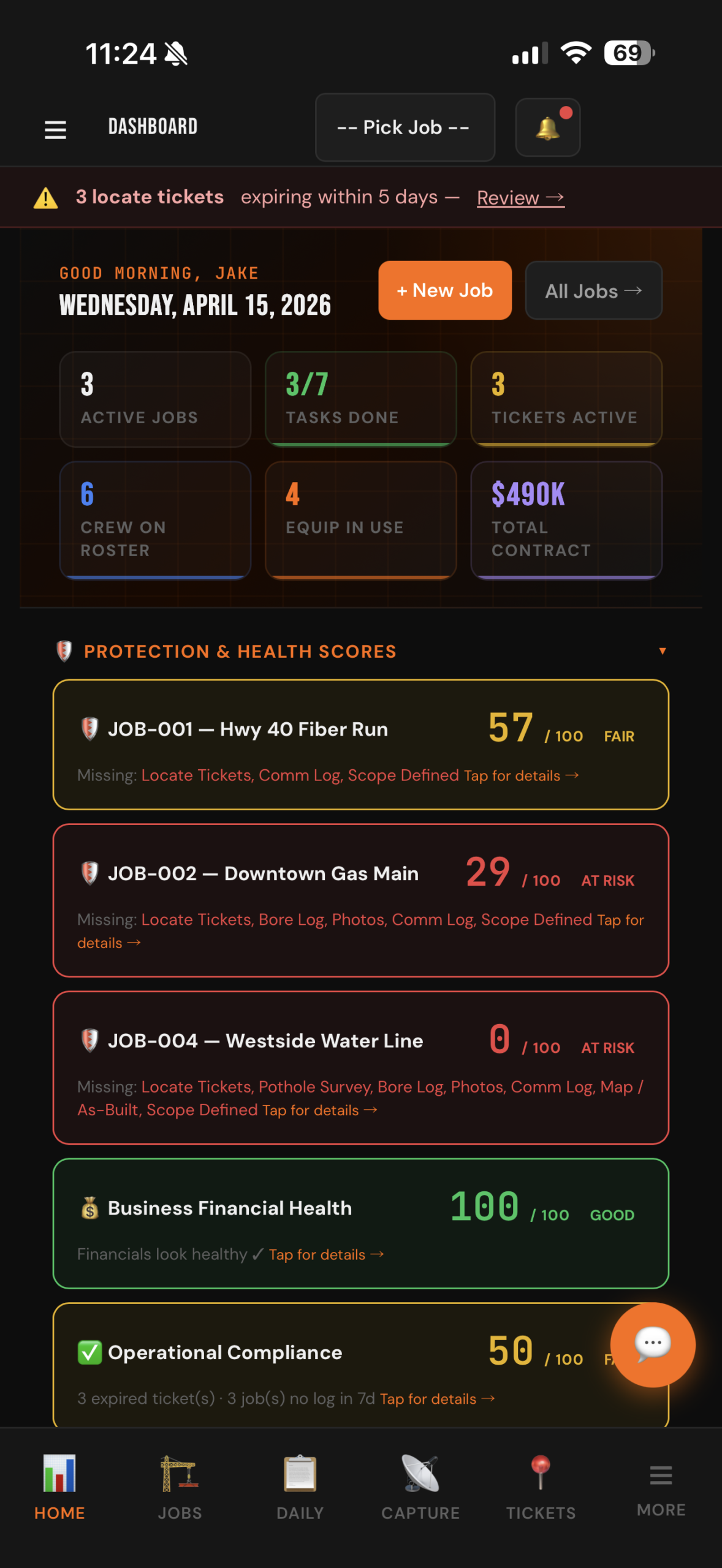
    Boreva Dashboard

    Instead of trying to remember the day, the system captures the day as it happens, shot by shot, issue by issue, note by note.

    By the time the crew clocks out, the report already exists.

    Nothing needs to be reconstructed. Nothing needs to be guessed. Nothing needs to be “filled in later.”

    This is what a real field‑ready daily reporting system looks like.

    What a Construction Daily Report Needs to Capture

    A daily report only has one job:

    Show exactly what happened on the job today.

    Not what the foreman remembers. Not what the inspector thinks. Not what the GC assumes. Not what someone reconstructs at 5:30 PM in the truck.

    A real daily report is a record, not a recap.

    And for HDD, that record must capture the five things that determine production, delays, and billing:

    1. Work Completed

    This is the backbone of the report.

    It must show:

    • Bore shots completed
    • Footage installed
    • Areas worked
    • What was started
    • What was finished
    • What was partially completed

    If this section is vague, the GC will assume:

    • Your production was low
    • Your hours were high
    • Your footage is questionable

    This is why Boreva ties the daily report directly to the bore log.

    When a shot is logged in the field, it automatically feeds the daily report. No rewriting. No re‑entering. No forgetting.

    The work completed section becomes exact, not estimated.

    2. Crew and Equipment

    The GC wants to know:

    • Who was on site
    • What equipment was used
    • What equipment failed
    • What equipment slowed production

    This section protects:

    • Labor hours
    • Equipment hours
    • Standby time
    • Delay justification

    If a drill went down for 42 minutes, that must be documented when it happens, not guessed later.

    Boreva captures:

    • Crew on site
    • Equipment used
    • Equipment issues
    • Timestamps

    …so the daily report reflects the real day, not the remembered day.

    3. Conditions

    Conditions explain production.

    If the ground changes, the production changes. If access changes, the timeline changes. If traffic changes, the pace changes.

    Conditions must capture:

    • Ground conditions
    • Site access
    • Traffic or environment
    • Weather impacts
    • Utility congestion

    Without conditions, the GC assumes:

    • Your crew was slow
    • Your hours are inflated
    • Your footage is padded

    With conditions, your production makes sense.

    Boreva forces condition notes at the shot level, not as an afterthought.

    4. Delays and Problems

    This is the section that protects your hours.

    If something slows the job down, it must be logged:

    • Utility conflicts
    • Equipment downtime
    • Weather delays
    • Waiting on approvals
    • Missing locates
    • Inspector delays
    • Traffic control issues

    The GC will not accept:

    • “We had delays.”
    • “We lost time.”
    • “We had issues.”

    They want:

    • What happened
    • When it happened
    • How long it lasted
    • What caused it
    • What the crew did

    Boreva logs delays with:

    • Timestamps
    • Descriptions
    • Photos (if needed)
    • Automatic placement in the daily report

    This is what protects you later.

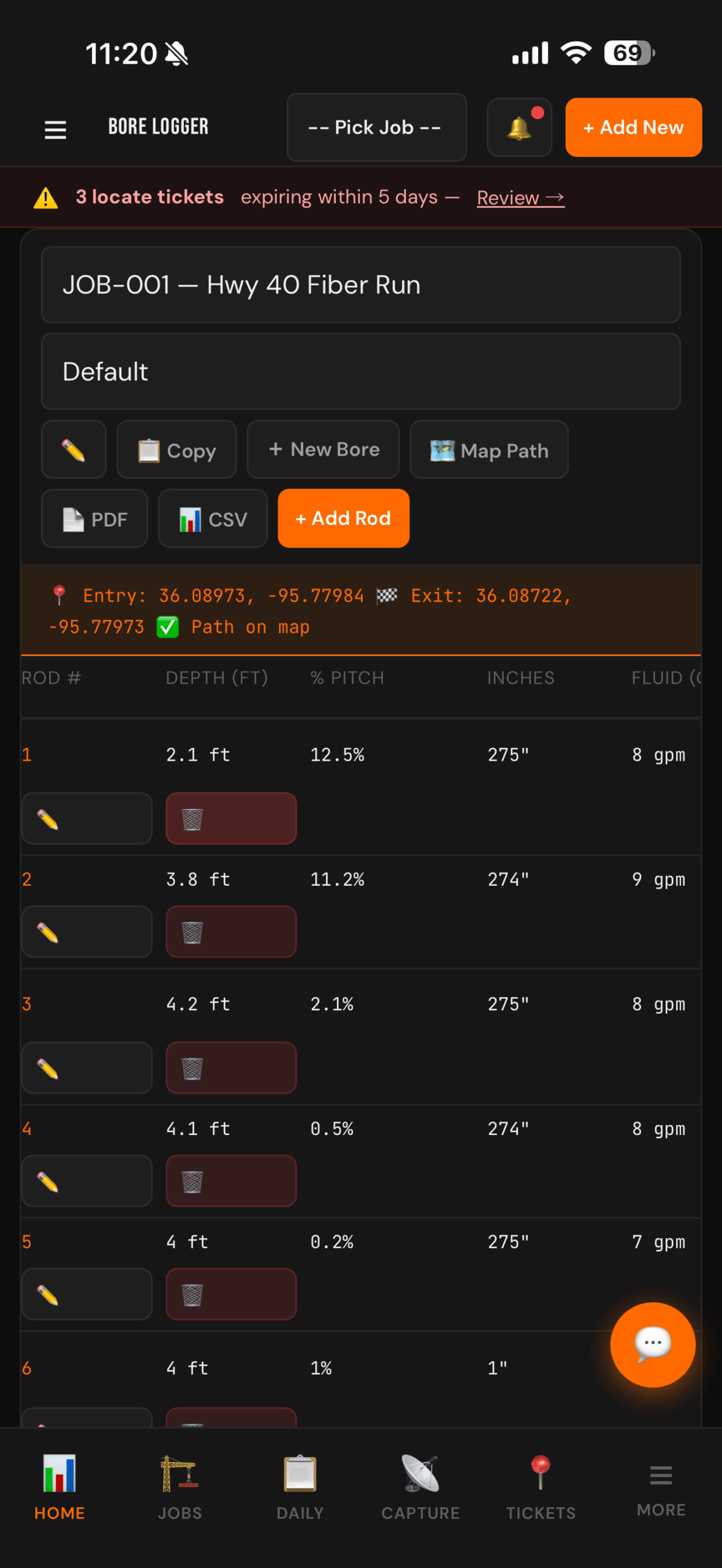
    Directional drilling bore entry in Boreva app
    Real-time bore log entry showing shot details, footage, conditions, and notes

    5. Notes

    Notes are where the context lives.

    This is where you capture:

    • Inspector conversations
    • Customer interactions
    • Scope changes
    • Verbal approvals
    • Safety issues
    • Unexpected events

    Notes are the difference between:

    “Why did this happen?” and “Oh, that makes sense.”

    Boreva lets crews add notes in real time, not at the end of the day when details are fuzzy.

    Construction Daily Report Template

    Most daily report templates are built for the office. This one is built for the field.

    A real HDD daily report must follow the flow of the work, not the flow of a spreadsheet. It needs to match how drilling actually happens:

    • Crews arrive
    • Equipment gets set
    • Shots get drilled
    • Problems occur
    • Conditions change
    • Notes get made
    • Work gets completed

    A good template mirrors that sequence.

    A great system captures that sequence automatically.

    This is the difference between a template you fill out and a system that builds the report for you.

    Below is the field‑proven layout, the structure that works on real HDD jobs, with real crews, under real pressure.

    And this is exactly the structure Boreva is built around.

    1. Job Information

    This section sets the context for the day.

    It must include:

    • Job name
    • Location
    • Date
    • Weather

    Weather matters because it affects:

    • Ground conditions
    • Production rate
    • Access
    • Safety
    • Delays

    Boreva captures weather automatically, so crews don’t have to guess or skip it.

    2. Crew and Equipment

    This section protects your labor and equipment hours.

    It must show:

    • Crew members on site
    • Equipment used
    • Equipment issues

    If a drill goes down, if a vac truck fails, if a locator stops working, it must be documented.

    This is where most contractors lose money:

    • Equipment downtime isn’t logged
    • Crew changes aren’t recorded
    • Standby time isn’t documented

    Boreva logs:

    • Who was on site
    • What equipment was used
    • What equipment failed
    • When it failed
    • How long it affected production

    This is what makes your hours defensible.

    3. Work Completed

    This is the heart of the daily report.

    It must show:

    • Bore shots completed
    • Footage installed
    • Areas worked

    And here’s the critical part:

    This section must match your bore log exactly.

    If the bore log says 742 ft and the daily report says 800 ft, the GC will assume:

    • Your documentation is inconsistent
    • Your footage is inflated
    • Your hours are questionable

    Boreva eliminates this problem by pulling footage directly from the bore log entries made in the field.

    No rewriting. No re‑entering. No mismatches.

    The daily report becomes a reflection of the bore log, not a separate document.

    4. Conditions

    Conditions explain production.

    They must capture:

    • Ground conditions
    • Site access
    • Traffic or environment

    If production slows, conditions must explain why.

    If the path changes, conditions must explain why.

    If the timeline shifts, conditions must explain why.

    Boreva forces condition notes at the shot level, so the daily report always has the context needed to defend your production.

    5. Delays and Problems

    This section protects your hours and your schedule.

    It must include:

    • Utility conflicts
    • Equipment downtime
    • Weather delays
    • Waiting on approvals
    • Missing locates
    • Inspector delays

    If it slows the job down, it goes here.

    And it must be logged when it happens, not after.

    Boreva logs delays with:

    • Timestamps
    • Descriptions
    • Photos (optional)
    • Automatic placement in the daily report

    This is what protects you when the GC asks:

    “Why did this take so long?”

    6. Notes

    Notes are where the story of the day lives.

    They capture:

    • Inspector conversations
    • Customer interactions
    • Scope changes
    • Verbal approvals
    • Safety issues
    • Unexpected events

    These notes often become the deciding factor in a dispute.

    Boreva lets crews add notes instantly, not at the end of the day when details are fuzzy.

    Construction daily report summary generate from field data
    Daily report automatically generated from real time field entries

    Why This Layout Works

    This layout works because it follows the natural flow of HDD work.

    It doesn’t force the crew to think like office staff. It lets them document the day the same way they live it.

    And Boreva takes it one step further:

    • The bore log feeds the daily report
    • The delay log feeds the daily report
    • The notes feed the daily report
    • The equipment log feeds the daily report

    By the time the crew clocks out, the daily report is already built.

    No reconstruction. No guessing. No gaps.

    Just a clean, defensible record of the day.

    Job Information

    Job information seems basic, almost too basic to matter.

    But this is the section that:

    • anchors the report
    • ties it to the correct job
    • establishes the conditions
    • sets the context for production
    • protects you when the GC compares days

    When job information is wrong, missing, or inconsistent, the GC immediately questions the rest of the report.

    This is why the first section of a daily report must be clean, accurate, and consistent every single day.

    Here’s what it needs to capture and why Boreva makes this effortless.

    1. Job Name

    This is the identifier that ties the report to the correct project.

    If the job name is wrong or inconsistent:

    • reports get mixed
    • quantities get misapplied
    • delays get questioned
    • production gets misaligned

    Crews often abbreviate or shorten job names differently each day:

    • “AT&T 12th St”
    • “ATT 12th”
    • “12th St AT&T”

    GCs hate this because it creates ambiguity.

    Boreva eliminates this by pulling the job name directly from the project setup. Crews don’t type it. They select it.

    No variations. No mistakes. No confusion.

    2. Location

    Location matters because:

    • inspectors change by location
    • conditions change by location
    • access changes by location
    • utilities change by location
    • production changes by location

    If the GC asks:

    “Where exactly was the crew working on this day?”

    Your daily report must answer that instantly.

    Boreva logs the location automatically based on the job and the shot entries. The daily report always reflects the correct work area.

    3. Date

    This seems obvious, until it isn’t.

    Crews sometimes:

    • forget to change the date
    • reuse yesterday’s template
    • enter the wrong day
    • fill out the report the next morning

    When the date is wrong, the GC assumes:

    • the report wasn’t filled out in real time
    • the details may not be accurate
    • the hours may not match the work
    • the footage may not match the day

    Boreva timestamps every entry automatically. The date is never wrong because the system records the day as the work happens.

    4. Weather

    Weather is not a filler field. It’s a production field.

    Weather affects:

    • ground conditions
    • drilling speed
    • mud performance
    • access
    • safety
    • downtime

    If production slows and the weather section is blank, the GC assumes:

    • the slowdown was the crew
    • not the conditions

    If weather is logged accurately, the GC sees:

    • rain
    • mud
    • freezing temps
    • wind
    • heat
    • lightning delays

    Boreva pulls weather automatically based on the job location and timestamp.

    No guessing. No skipping. No “sunny” written on a day it rained.

    Why This Section Matters More Than People Think

    Job information is the foundation of the daily report.

    If this section is sloppy:

    • the GC questions the entire report
    • the report looks like it was filled out later
    • the report loses credibility
    • the report loses defensive value

    If this section is clean and consistent:

    • the report looks professional
    • the GC trusts the documentation
    • the rest of the report carries more weight
    • your hours and footage become easier to defend

    Boreva ensures this section is always accurate because the system fills it in automatically as the day unfolds.

    The crew doesn’t have to think about it. The system handles it.

    Crew and Equipment

    If the GC is going to challenge your hours, this is the section they use to do it.

    Most contractors think the “Crew & Equipment” section is just a roll call. It’s not.

    It’s the section that:

    • justifies your labor hours
    • justifies your equipment hours
    • explains your production
    • explains your delays
    • protects your standby time
    • ties your costs to the work performed

    If this section is incomplete or inaccurate, the GC immediately questions:

    • your hours
    • your production
    • your delays
    • your invoice

    This is why the Crew & Equipment section must be clean, exact, and captured in real time, not reconstructed at the end of the day.

    Here’s what it needs to include, and how Boreva makes it bulletproof.

    1. Crew Members on Site

    This is not just a list of names. It’s the foundation of your labor hours.

    It must show:

    • who was on site
    • when they were on site
    • what role they performed
    • when they left
    • any crew changes

    If the GC sees:

    • a 4‑man crew listed
    • but only 3 people in the inspector’s notes

    …they assume your hours are inflated.

    If the GC sees:

    • a locator listed
    • but no locating activity documented

    …they assume your labor is padded.

    Boreva eliminates this by letting crews:

    • check in
    • check out
    • log roles
    • track changes

    …all from the field.

    The daily report reflects the actual crew, not the remembered crew.

    2. Equipment Used

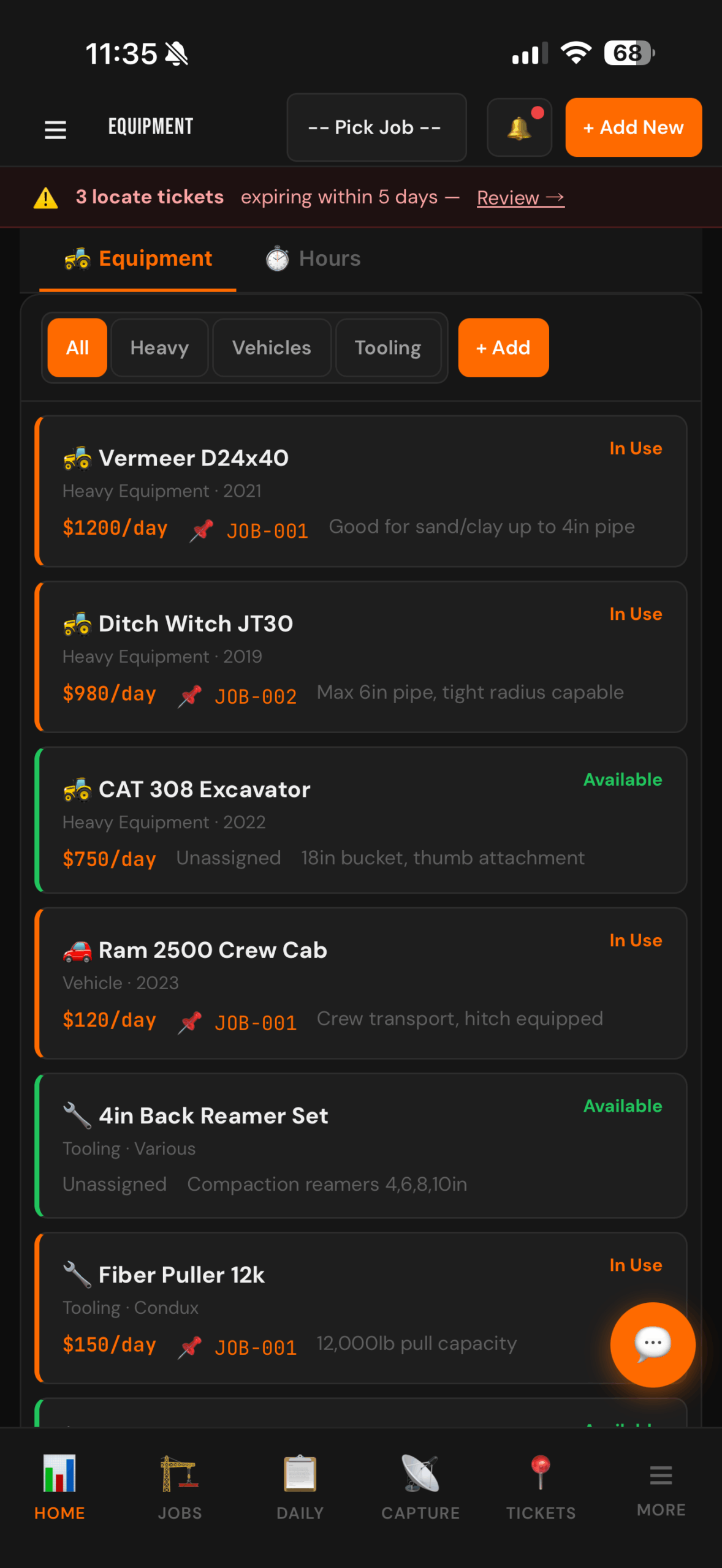
    Boreva equipment list that reflects daily cost, usage, hours, and whose operating it
    Boreva Equipment List

    Equipment hours are money.

    If equipment is on site, the GC wants to know:

    • what equipment
    • when it was used
    • how it was used
    • whether it was productive
    • whether it was down
    • whether it was on standby

    This protects:

    • drill hours
    • vac truck hours
    • locator hours
    • support equipment hours

    If equipment is listed but not tied to the work, the GC questions the hours.

    Boreva ties equipment usage directly to:

    • bore shots
    • delays
    • notes
    • timestamps

    The equipment section becomes a record, not a guess.

    3. Equipment Issues

    This is where most contractors lose money.

    If equipment goes down and it isn’t documented:

    • the GC will not pay standby
    • the GC will not accept delays
    • the GC will not justify lost production

    Equipment issues must capture:

    • what failed
    • when it failed
    • how long it was down
    • what caused it
    • what the crew did
    • how it affected production

    Examples:

    • “Locator battery failure — 14 minutes downtime”
    • “Drill head packed with clay — 22 minutes to clear”
    • “Vac truck hose split — 38 minutes repair”

    If this isn’t logged in real time, it becomes:

    • “We had some downtime.”
    • “The drill was acting up.”
    • “We lost about an hour.”

    GCs don’t pay for vague.

    Boreva logs equipment issues with:

    • timestamps
    • descriptions
    • optional photos
    • automatic placement in the daily report

    This is what makes your downtime defensible.

    Work Completed

    This is the section the GC looks at first.

    It’s the section they compare against:

    • their inspector’s notes
    • their expectations
    • the schedule
    • the bore log
    • the as‑built
    • your hours

    If this section is vague, incomplete, or inconsistent, the GC immediately questions:

    • your footage
    • your production
    • your hours
    • your delays
    • your invoice

    This is why the “Work Completed” section must be exact, not estimated and it must match your bore log perfectly.

    Here’s what it needs to capture, and how Boreva makes it airtight.

    1. Bore Shots Completed

    This is the backbone of HDD production.

    It must show:

    • each shot completed
    • the order they were drilled
    • the footage for each shot
    • the area or alignment
    • any partial shots

    If the GC sees:

    • 3 shots in the daily report
    • but 4 shots in the bore log

    …they assume your documentation is unreliable.

    If the GC sees:

    • a 310‑ft shot
    • but the inspector wrote 280 ft

    …they assume your footage is inflated.

    Boreva eliminates this by pulling shot data directly from the bore log entries made in the field.

    When a shot is logged:

    • the footage
    • the conditions
    • the notes
    • the timestamps

    …all flow into the daily report automatically.

    No rewriting. No re‑entering. No mismatches.

    2. Footage Installed

    This is the number that gets challenged the most.

    Footage must be:

    • exact
    • traceable
    • tied to shots
    • tied to rig readings
    • tied to rod count
    • tied to the as‑built

    If the daily report says:

    • 742 ft installed

    …but the bore log says:

    • 700 ft drilled

    …the GC will reduce your quantity to the lowest number.

    If the daily report says:

    • “About 800 ft”

    …you’ve already lost.

    Boreva removes the guesswork by:

    • pulling exact footage from the bore log
    • tying it to timestamps
    • tying it to the shot sequence
    • tying it to the rig readings

    The daily report becomes a mathematically defensible record, not a rounded estimate.

    3. Areas Worked

    This section shows:

    • where the crew worked
    • what alignment they were on
    • what segment was completed
    • what segment was started
    • what segment is next

    This matters because:

    • inspectors change by area
    • utilities change by area
    • conditions change by area
    • access changes by area
    • production changes by area

    If the GC asks:

    “Where exactly did the crew work today?”

    Your daily report must answer that instantly.

    Boreva ties each shot to a location, so the daily report always reflects the correct work area.

    Why This Section Must Match the Bore Log

    This is the #1 rule of HDD documentation:

    The daily report and the bore log must match exactly.

    If they don’t, the GC assumes:

    • the report was filled out later
    • the numbers were estimated
    • the footage is inflated
    • the hours are padded
    • the delays are questionable

    Boreva eliminates this risk by making the bore log the source of truth.

    The daily report is not a separate document. It is a reflection of the bore log.

    This is what makes your documentation defensible.

    Why Boreva Makes This Section Unbreakable

    Boreva turns “Work Completed” into a real‑time record by:

    • capturing shots as they happen
    • pulling footage directly from the field
    • tying everything to timestamps
    • aligning the daily report with the bore log
    • eliminating end‑of‑day reconstruction
    • removing human error
    • preventing mismatches

    By the time the crew clocks out, the “Work Completed” section is already finished and it’s accurate.

    No guessing. No rounding. No rewriting. No inconsistencies.

    Just a clean, defensible record of the day’s production.

    Conditions

    Conditions are the why behind your production.

    If the GC is going to challenge your footage, your hours, or your timeline, this is the section they look at to understand:

    • why production slowed
    • why the path changed
    • why the footage increased
    • why the timeline shifted
    • why the crew needed more time

    Most daily reports fail here because conditions get written at the end of the day and by then, the details are gone.

    Crews write things like:

    • “Hard ground”
    • “Bad access”
    • “Wet”
    • “Slow drilling”

    These notes don’t explain anything. They don’t defend anything. They don’t justify anything.

    Conditions must be specific, timed, and tied to the work.

    Here’s what this section needs to capture and how Boreva makes it automatic.

    1. Ground Conditions

    Ground conditions directly affect:

    • penetration rate
    • steering difficulty
    • tool wear
    • mud performance
    • production speed

    If the ground changes, the production changes.

    Examples of strong ground condition notes:

    • “Transition from clay to cobble at 110 ft — slowed penetration rate.”
    • “Wet sand pocket caused sloughing — required clearing.”
    • “Hardpan seam at 62 ft — reduced drilling speed.”

    Examples of weak notes:

    • “Hard ground.”
    • “Slow drilling.”

    Weak notes look like excuses. Strong notes look like documentation.

    Boreva forces condition notes at the shot level, so the daily report always reflects the real conditions that shaped the day.

    2. Site Access

    Access affects:

    • setup time
    • equipment movement
    • safety
    • production rate

    If access is restricted, production slows and the GC needs to see that.

    Examples:

    • “Traffic control delayed setup by 18 minutes.”
    • “Equipment staging limited, required additional repositioning.”
    • “Narrow easement slowed vac truck movement.”

    These details matter because they explain why the day unfolded the way it did.

    Boreva lets crews log access issues instantly, not hours later.

    3. Traffic or Environment

    Traffic and environmental factors can:

    • slow movement
    • delay setup
    • restrict equipment
    • impact safety
    • reduce production

    Examples:

    • “Heavy traffic on 4th St — slowed vac truck repositioning.”
    • “Pedestrian congestion required spotter — reduced drilling pace.”
    • “Wind gusts required slower rod handling.”

    These aren’t excuses, they’re conditions.

    And conditions explain production.

    Why Conditions Matter So Much

    Conditions are the bridge between:

    • the footage you drilled
    • the hours you logged
    • the production you achieved
    • the delays you recorded

    If conditions are vague, the GC assumes:

    • your crew was slow
    • your hours are inflated
    • your footage is padded
    • your delays are questionable

    If conditions are detailed, the GC sees:

    • the environment
    • the challenges
    • the adjustments
    • the impact

    This is what makes your daily report defensible.

    Why Boreva Makes This Section Bulletproof

    Boreva captures conditions:

    • at the shot level
    • in real time
    • tied to timestamps
    • tied to footage
    • tied to delays
    • tied to production

    This eliminates:

    • end‑of‑day guessing
    • vague notes
    • missing details
    • mismatched reports

    By the time the crew clocks out, the conditions section is already complete and it’s accurate.

    No reconstruction. No memory. No gaps.

    Just a clean, defensible record of the conditions that shaped the day.

    Delays and Problems

    If there is one section that protects your hours more than any other, it’s this one.

    Delays are the difference between:

    • getting paid for the time you spent
    • or eating the cost because the GC says “we don’t see it in your report”

    Most contractors lose delay disputes for one simple reason:

    Delays get logged at the end of the day.

    And when delays are logged at the end of the day:

    • times get rounded
    • durations get estimated
    • causes get simplified
    • details get forgotten
    • context gets lost
    • credibility disappears

    The GC doesn’t need to prove your delay didn’t happen. They only need to prove your documentation is weak.

    This is why the “Delays and Problems” section must be:

    • specific
    • timestamped
    • tied to the work
    • tied to the conditions
    • tied to the equipment
    • logged in real time

    Here’s what this section must capture and how Boreva makes it bulletproof.

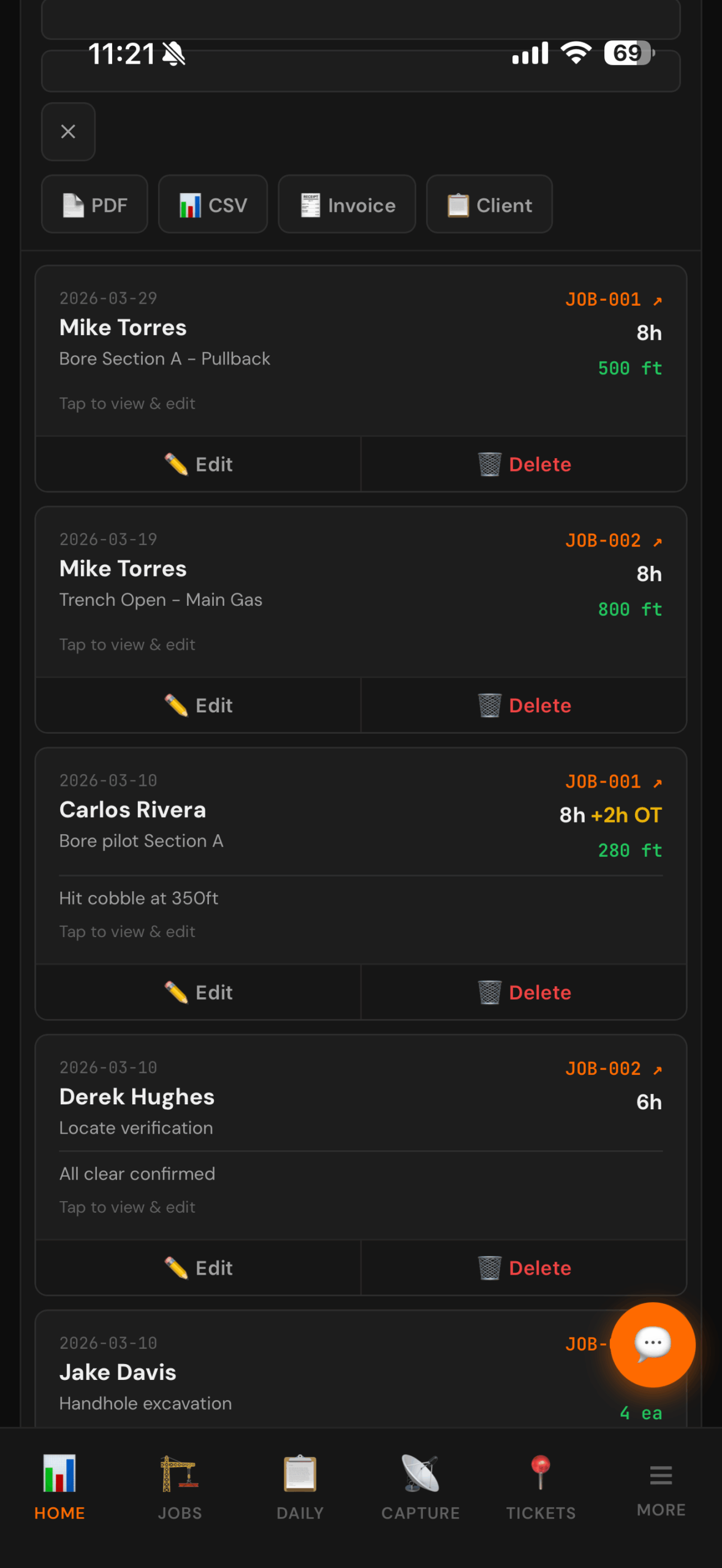
    Logging jobsite issues and delays in real time
    Real time logging of delays with timestamps and descriptions

    1. Utility Conflicts

    Utility conflicts are one of the most common and most expensive, sources of delay.

    Examples:

    • “Unmarked gas service encountered at 42 ft — drilling paused 31 minutes.”
    • “Fiber line depth inconsistent — required potholing before continuing.”
    • “Unknown duct bank — alignment shifted 6 ft right.”

    If this isn’t logged when it happens, the GC will say:

    • “We didn’t see that.”
    • “Our inspector didn’t note it.”
    • “We can’t justify the delay.”

    Boreva logs utility conflicts with:

    • timestamps
    • descriptions
    • optional photos
    • automatic placement in the daily report

    This is what makes your utility delays defensible.

    2. Equipment Downtime

    Equipment downtime is money, but only if it’s documented.

    If the drill goes down for 42 minutes and it isn’t logged, the GC will not pay for it.

    Downtime must capture:

    • what failed
    • when it failed
    • how long it was down
    • what caused it
    • what the crew did
    • how it affected production

    Examples:

    • “Drill head packed with clay — 22 minutes to clear.”
    • “Vac truck hose split — 38 minutes repair.”
    • “Locator battery failure — 14 minutes downtime.”

    If this is logged at the end of the day, it becomes:

    • “We had some downtime.”
    • “The drill was acting up.”
    • “We lost about an hour.”

    GCs don’t pay for vague.

    Boreva logs downtime in real time with exact timestamps.

    3. Weather Delays

    Weather delays are legitimate, but only if they’re documented correctly.

    Examples:

    • “Lightning delay — 27 minutes.”
    • “Heavy rain — drilling paused 18 minutes.”
    • “Wind gusts required slower rod handling — reduced production.”

    If weather delays aren’t logged when they happen, the GC assumes:

    • the crew was slow
    • not the conditions

    Boreva automatically pulls weather data and ties it to the delay.

    4. Waiting on Approvals

    This is one of the most common and most disputed, delays.

    Examples:

    • “Waiting on inspector approval — 19 minutes.”
    • “Waiting on traffic control — 26 minutes.”
    • “Waiting on locate verification — 34 minutes.”

    If this isn’t logged in real time, the GC will say:

    • “We don’t see that delay.”
    • “Our inspector didn’t note it.”
    • “We can’t justify the time.”

    Boreva timestamps these delays automatically.

    5. Any Event That Slows the Job Down

    If it slows the job down, it belongs in this section.

    Examples:

    • mud pump issues
    • vac truck repositioning delays
    • traffic congestion
    • site access restrictions
    • safety stand‑downs
    • material delivery delays

    If it costs you time, it must be documented.

    If it isn’t documented, it didn’t happen, at least in the GC’s eyes.

    Why This Section Is the Most Important for Protecting Your Hours

    Delays are where contractors lose the most money.

    Not because the delays didn’t happen. Because the delays weren’t documented correctly.

    A delay that is:

    • vague
    • estimated
    • rounded
    • written later
    • missing timestamps
    • missing context

    …is a delay the GC will deny.

    A delay that is:

    • specific
    • timestamped
    • tied to the work
    • tied to the equipment
    • tied to the conditions
    • logged in real time

    …is a delay the GC cannot argue with.

    This is the difference between:

    • getting paid
    • or getting reduced

    Boreva makes this section unbreakable by capturing delays:

    • in real time
    • with timestamps
    • with descriptions
    • with optional photos
    • automatically inserted into the daily report

    By the time the crew clocks out, the delay log is already complete and it’s accurate.

    No reconstruction. No guessing. No gaps.

    Just a clean, defensible record of every delay that affected the day.

    Notes

    Notes are the most underrated part of a daily report.

    Most crews treat notes like an optional field, something they fill in if they remember, or if something “big” happened.

    But in HDD, notes are the difference between:

    • a report that explains the day
    • and a report that leaves the GC guessing

    Notes are where the context lives. Context is what makes your documentation defensible.

    Without notes, your report is just numbers. With notes, your report becomes a story the GC can follow and verify.

    Here’s what this section must capture, and how Boreva makes it effortless.

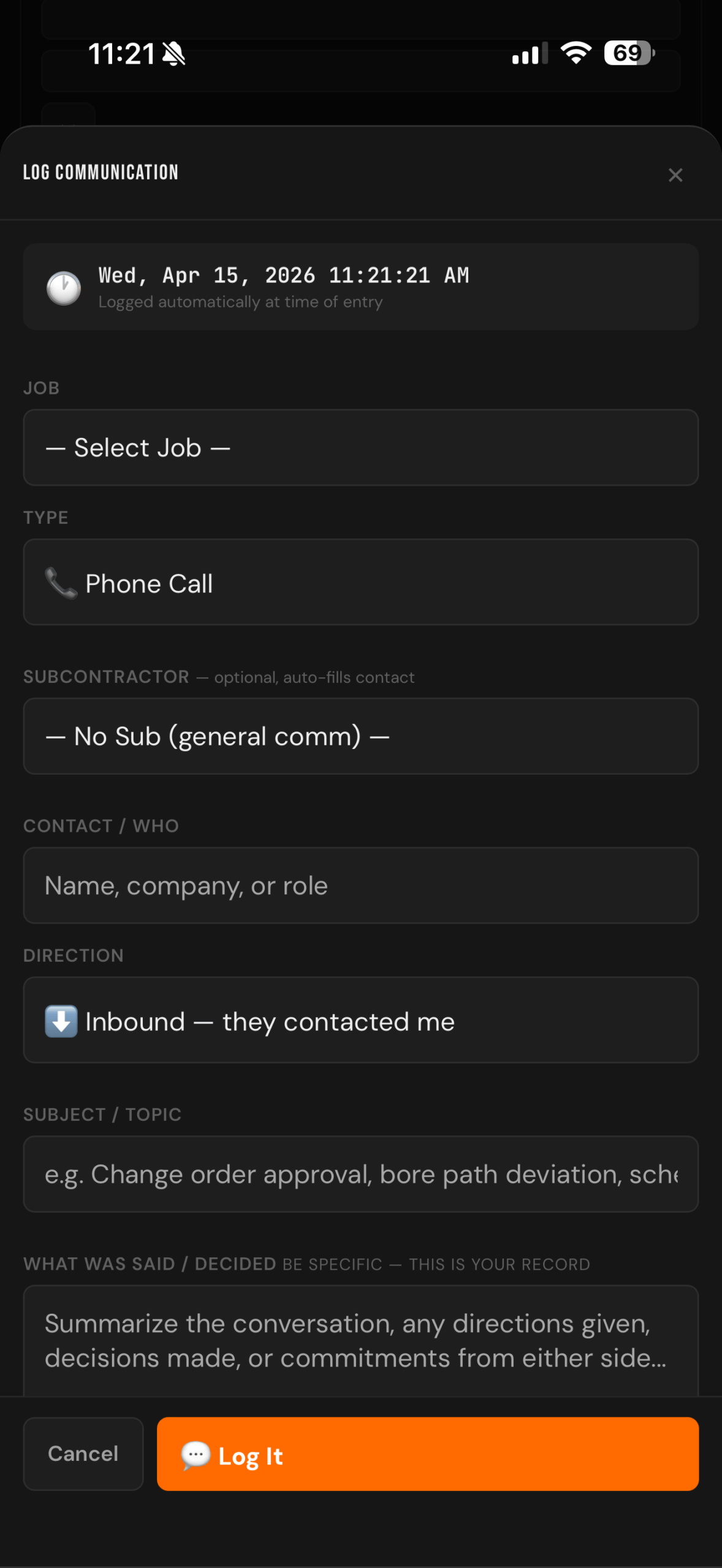
    1. Inspector Conversations

    This is one of the most important things to document.

    Inspectors:

    • give approvals
    • give instructions
    • change expectations
    • request adjustments
    • confirm footage
    • confirm alignment
    • confirm delays

    If you don’t document these conversations, the GC will default to the inspector’s version, not yours.

    Examples of strong notes:

    • “Inspector approved alignment shift at 10:42 AM.”
    • “Inspector confirmed depth at 162 ft mark.”
    • “Inspector requested pothole before continuing — 19‑minute delay.”

    These notes protect you when the GC asks:

    “Who told you to do that?”

    Boreva lets crews log these notes instantly, not hours later.

    2. Customer Interactions

    Customer interactions matter because they often:

    • change the plan
    • change the sequence
    • change the alignment
    • change the timeline

    Examples:

    • “Customer requested bore start moved 12 ft east.”
    • “Customer asked for additional pothole before continuing.”
    • “Customer approved extended working hours.”

    If you don’t document these, the GC will say:

    • “We didn’t authorize that.”
    • “We didn’t request that.”
    • “We didn’t approve that.”

    Boreva timestamps these notes so you always have proof.

    3. Scope Changes

    Scope changes are money, but only if they’re documented.

    Examples:

    • “Added second shot due to obstruction.”
    • “Extended bore path 48 ft to avoid duct bank.”
    • “Changed exit point per customer request.”

    If scope changes aren’t documented, the GC will say:

    • “That wasn’t part of the plan.”
    • “We didn’t approve additional footage.”

    Boreva makes scope changes easy to log in real time.

    4. Safety Issues

    Safety issues affect:

    • production
    • delays
    • crew movement
    • equipment use

    Examples:

    • “Safety stand‑down due to lightning — 27 minutes.”
    • “Spotter required due to pedestrian traffic.”
    • “Restricted access due to nearby excavation.”

    These notes explain why the day unfolded the way it did.

    5. Unexpected Events

    This is the catch‑all category for anything that doesn’t fit neatly into the other sections but still matters.

    Examples:

    • “City inspector arrived late — 14‑minute delay.”
    • “Traffic control arrived without proper signage — slowed setup.”
    • “Material delivery delayed — crew staged equipment.”

    These notes often become the deciding factor in a dispute.

    Why Notes Matter So Much

    Notes are the glue that holds the daily report together.

    They explain:

    • why production changed
    • why delays happened
    • why decisions were made
    • why the timeline shifted
    • why the footage is what it is

    Without notes, the GC fills in the blanks with their own assumptions.

    With notes, the GC sees the full picture.

    Why Boreva Makes Notes Unbreakable

    Boreva captures notes:

    • in real time
    • tied to shots
    • tied to delays
    • tied to conditions
    • tied to timestamps
    • tied to the daily report

    This eliminates:

    • forgotten details
    • vague summaries
    • end‑of‑day guessing
    • missing context
    • mismatched reports

    By the time the crew clocks out, the notes section is already complete and it’s accurate.

    No reconstruction. No memory gaps. No “I think this happened around noon.”

    Just a clean, defensible record of the day’s context.

    Why Most Daily Reports Fail

    Most daily reports don’t fail because the crew doesn’t care. They fail because the process is broken.

    The traditional daily report depends on one thing:

    Memory.

    And memory is the weakest, most unreliable, most inconsistent documentation method you can bring into a construction dispute.

    Here’s the truth:

    Crews don’t forget because they’re lazy. They forget because the job moves fast.

    • Shots get drilled
    • Conditions change
    • Problems happen
    • Equipment fails
    • Inspectors show up
    • Customers call
    • Traffic shifts
    • Utilities surprise you

    By the time the crew sits down to fill out the daily report, the details are already fading.

    This is why most daily reports fail and why they can’t defend anything when the GC starts asking questions.

    Let’s break down the real reasons.

    1. They’re Filled Out at the End of the Day

    This is the #1 failure.

    End‑of‑day reporting creates:

    • rounded numbers
    • vague notes
    • missing delays
    • incorrect times
    • mismatched footage
    • forgotten conversations
    • incomplete conditions

    The GC can spot an end‑of‑day report instantly.

    It looks like a summary, not a record.

    Boreva eliminates this by building the report during the work, not after.

    2. Details Get Missed Because the Day Moves Too Fast

    A foreman juggling:

    • drilling
    • locating
    • traffic
    • inspectors
    • customers
    • equipment
    • safety
    • crew questions

    …is not going to remember:

    • the exact time a delay started
    • the exact moment conditions changed
    • the exact footage at each shot
    • the exact conversation with the inspector

    It’s not realistic.

    Boreva captures these details in real time, so nothing depends on memory.

    3. Problems Get Forgotten Because They Don’t Seem Big at the Time

    Most delays don’t feel like delays when they happen.

    Examples:

    • clearing a packed drill head
    • swapping locator batteries
    • waiting for a vac truck to reposition
    • potholing an unexpected utility
    • waiting for an inspector to walk over

    Each one feels small.

    But add them up and you’ve lost:

    • 30 minutes
    • 45 minutes
    • an hour
    • more

    If these aren’t logged, the GC will say:

    “We don’t see any delays in your report.”

    Boreva logs delays with timestamps the moment they occur.

    4. Numbers Get Rounded Because Exact Numbers Aren’t Written Down

    When crews fill out reports later, they write:

    • “About 300 ft”
    • “Roughly 800 ft today”
    • “Around 4 hours drilling”

    Rounded numbers destroy credibility.

    GCs assume:

    • the report wasn’t filled out in real time
    • the footage is inflated
    • the hours are padded

    Boreva pulls exact numbers from the bore log and rig readings — no rounding, no guessing.

    5. Daily Reports Don’t Match the Bore Log

    This is the GC’s favorite leverage point.

    If the bore log says:

    • 742 ft

    …but the daily report says:

    • 800 ft

    …the GC will reduce your quantity to the lowest number.

    If the bore log says:

    • 3 shots

    …but the daily report says:

    • 2 shots

    …the GC will question your documentation.

    Boreva eliminates this because the bore log feeds the daily report automatically.

    No mismatches. No inconsistencies. No leverage for the GC.

    6. Notes Are Added Later and Lose Their Meaning

    Notes written at the end of the day become:

    • vague
    • generic
    • incomplete
    • inaccurate

    Examples of weak notes:

    • “Talked to inspector.”
    • “Had some issues.”
    • “Slow drilling.”

    These notes don’t defend anything.

    Boreva captures notes in real time, tied to:

    • shots
    • delays
    • conditions
    • timestamps

    Now the notes actually explain the day.

    7. The Report Doesn’t Tell a Story

    A daily report must tell a clear, traceable story:

    • what happened
    • when it happened
    • why it happened
    • how it affected production

    Most reports don’t tell a story. They list numbers.

    Numbers without context are easy to challenge.

    Boreva builds the story automatically because it captures the day as it unfolds.

    What Real Daily Reporting Looks Like in the Field

    Daily reporting fails when it’s treated like paperwork.

    Daily reporting works when it’s treated like part of the work.

    The job doesn’t happen at the end of the day. It happens throughout the day, minute by minute, shot by shot, problem by problem.

    A daily report should be built the same way.

    Real daily reporting is not:

    • sitting in the truck at 5:30 PM
    • trying to remember what happened
    • guessing at times
    • rounding footage
    • summarizing problems
    • filling in blanks

    Real daily reporting is:

    • capturing the day as it unfolds
    • logging shots when they’re drilled
    • logging delays when they occur
    • logging conditions when they change
    • logging notes when conversations happen

    This is the difference between:

    a summary and a record

    A summary can be questioned. A record cannot.

    This is exactly why Boreva exists.

    How Real Daily Reporting Works in the Field

    Here’s what it looks like when a crew uses a real‑time system instead of a template.

    1. Bore Shots Get Logged as They Happen

    The moment a shot is completed:

    • footage is entered
    • conditions are noted
    • notes are added
    • timestamps are captured

    This becomes the backbone of the daily report.

    No rewriting. No re‑entering. No mismatches.

    2. Problems Get Recorded When They Occur

    When something slows the job down:

    • equipment failure
    • utility conflict
    • weather delay
    • inspector delay
    • access issue

    …it gets logged immediately.

    Not later. Not “when we get a minute.” Not “we’ll remember it.”

    Real‑time logging turns delays into defensible documentation.

    3. Notes Get Added in Real Time

    When the inspector says something important, the crew logs it.

    When the customer gives direction, the crew logs it.

    When the alignment changes, the crew logs it.

    These notes become the context that protects your hours and footage.

    4. The Daily Report Builds Itself

    By the time the crew clocks out:

    • the bore log is complete
    • the delays are logged
    • the conditions are documented
    • the notes are captured
    • the footage is exact
    • the timeline is accurate

    And the daily report is already built.

    Nothing needs to be remembered. Nothing needs to be reconstructed. Nothing needs to be guessed.

    This is what real daily reporting looks like.

    Why Boreva Makes This Possible

    Boreva isn’t a template. It’s a field system.

    It captures:

    • shots
    • footage
    • conditions
    • delays
    • notes
    • equipment issues
    • timestamps

    …as the work happens.

    The daily report isn’t something the crew fills out. It’s something the system builds automatically from the day’s activity.

    This is why Boreva reports hold up when the GC challenges them.

    They aren’t summaries. They’re records.

  • How To Prove Bore Footage

    How To Prove Bore Footage

    In directional drilling, nothing affects billing more directly than footage. Footage is the quantity the GC uses to calculate:

    • Unit‑price pay
    • Production expectations
    • Schedule performance
    • Change order justification
    • Crew efficiency
    • Equipment utilization
    • Total invoice value

    It is the number every other number depends on.

    But here’s the part most contractors underestimate:

    The GC is not paying you for the footage you drilled. They’re paying you for the footage you can prove.

    There’s a difference.

    You can drill 1,200 feet perfectly, hit every mark, and finish the job exactly as planned, but if your documentation is weak, the GC has leverage to reduce your quantities.

    This is how it happens:

    • They question the total.
    • They ask how you measured it.
    • They ask for shot‑by‑shot detail.
    • They ask for entry and exit points.
    • They ask for supporting notes.
    • They ask for alignment with the daily report.

    If you can’t produce that information, they don’t assume you’re wrong, they assume your number is unverified.

    And unverified numbers get cut.

    This is why proving bore footage is not a single measurement. It’s a documentation process that shows:

    • What was drilled
    • Where it was drilled
    • How it was measured
    • How the total was built
    • How the data aligns across your logs and reports

    When you can show all of that, your footage becomes defensible. When you can’t, your footage becomes negotiable.

    And negotiated footage always goes down, never up.

    What “Proving Bore Footage” Actually Means

    Most contractors think proving footage means showing a total number.

    It doesn’t.

    A total number, by itself, is the weakest form of documentation you can present. It’s the equivalent of saying:

    “Trust me.”

    GCs don’t operate on trust. Auditors don’t operate on trust. Owners definitely don’t operate on trust.

    They operate on verifiable records.

    Proving bore footage means you can show, step‑by‑step, how the total was built. Not guessed. Not rounded. Not reconstructed later.

    A proven footage total is a supported number, not a standalone number.

    Here’s what that actually requires.

    1. Shot‑by‑Shot Footage: The Foundation of Proof

    Every bore is made up of individual shots. Each shot has:

    • A start point
    • An end point
    • A measured length
    • A drilling sequence
    • Conditions encountered
    • Time spent

    If you can’t show the GC how the total was built shot by shot, they assume the total is an estimate.

    A shot‑by‑shot breakdown turns your footage into a traceable quantity, not a lump sum.

    This is the difference between:

    “We drilled 1,200 feet.” and “Here are the four shots that make up the 1,200 feet, with exact measurements and notes.”

    One is a claim. One is proof.

    2. Entry and Exit Points: The Physical Evidence

    Footage is not just a number. It’s a physical path in the ground.

    To prove footage, you must show:

    • Where the shot started
    • Where the shot ended
    • How those points were measured
    • How they align with the plan
    • How they align with the as‑built

    Entry and exit points are the anchors that make your footage believable.

    If the GC can’t see where the shot began and ended, they can’t verify the length — and they won’t pay for what they can’t verify.

    3. Measured Totals: Not Rounded, Not Estimated

    A proven total is:

    • Measured
    • Documented
    • Repeatable
    • Verifiable

    A weak total is:

    • Rounded
    • Estimated
    • Recalled from memory
    • Written down later

    GCs can spot rounded numbers instantly. Rounded numbers tell them:

    • Rod count wasn’t tracked
    • Actual length wasn’t recorded
    • The log was filled out late
    • The total may be inflated

    A measured total is defensible. A rounded total is negotiable — and negotiated totals always go down.

    4. Supporting Notes: The Context Behind the Numbers

    Footage without context is incomplete.

    Supporting notes explain:

    • Why a shot took longer
    • Why production slowed
    • Why the path changed
    • Why the total increased
    • Why the bore deviated
    • Why the crew paused
    • Why the numbers look the way they do

    These notes turn your footage from a number into a narrative, a documented sequence of events that shows the GC exactly what happened.

    Without notes, the GC fills in the blanks. And they never fill them in your favor.

    5. Alignment With Other Documents: The Consistency Test

    A footage total is only as strong as the documents that support it.

    To be considered proven, your footage must align with:

    • The bore log
    • The daily report
    • The as‑built
    • The inspector notes
    • The schedule
    • The production expectations

    If any of these contradict your footage, the GC assumes your number is wrong, even if the drilling was perfect.

    Consistency is what makes your footage believable.

    Where Most Footage Disputes Come From

    Footage disputes rarely come from the drilling itself. They come from the gap between what was done and what was recorded.

    The GC isn’t questioning your ability to drill. They’re questioning your ability to prove what you drilled.

    When footage gets challenged, it’s almost always because the documentation has holes and those holes give the GC room to reduce quantities.

    Here’s where those holes come from.

    1. Rounded Numbers: The Fastest Way to Lose Credibility

    Rounded numbers tell the GC one thing:

    “We didn’t measure this.”

    When your bore log shows:

    • 300 ft
    • 250 ft
    • 200 ft
    • 100 ft

    …they know those aren’t measured lengths. They’re estimates.

    Rounded numbers signal:

    • Rod count wasn’t tracked
    • Actual length wasn’t recorded
    • The log was filled out later
    • The total may be inflated

    Once the GC doubts your footage, they doubt your entire invoice.

    Rounded numbers don’t just weaken your position, they destroy it.

    2. Missing Shots: The Gaps That Kill Your Total

    A bore log with missing shots is a bore log that cannot be defended.

    Missing shots create:

    • Unexplained footage
    • Unverifiable totals
    • Gaps in the sequence
    • Doubt about accuracy
    • Questions you can’t answer

    If you drilled four shots but only logged three, the GC assumes:

    • The missing shot was forgotten
    • The footage was guessed
    • The total is unreliable

    Missing shots don’t just weaken your documentation — they invalidate it.

    3. Combined Entries: The Shortcut That Backfires

    Crews sometimes combine multiple shots into one entry because:

    • The shots were short
    • The day was busy
    • The log was filled out late
    • They “knew the total”

    But combined entries eliminate:

    • Traceability
    • Shot‑level detail
    • Entry/exit accuracy
    • Condition tracking
    • Delay documentation

    A combined entry is impossible to defend because you can’t break it apart later.

    If the GC questions one part of the total, you have no way to isolate it.

    Combined entries save time in the field and cost money in billing.

    4. No Measurement Method: The GC Assumes Guesswork

    If you can’t show how footage was measured, the GC assumes it wasn’t.

    A defensible measurement method includes:

    • Rod count
    • Rig display readings
    • Entry/exit verification
    • As‑built alignment
    • Shot‑by‑shot totals

    A weak method includes:

    • Memory
    • Estimation
    • “We’ve done this enough to know”
    • “The crew said it was about…”

    Without a clear measurement method, the GC has every reason to reduce your footage.

    5. No Supporting Notes:The Missing Context That Creates Doubt

    Footage without notes is incomplete.

    Notes explain:

    • Why a shot took longer
    • Why production slowed
    • Why the path changed
    • Why the total increased
    • Why the bore deviated
    • Why the numbers look the way they do

    Without notes, the GC fills in the blanks and they never fill them in your favor.

    A number without context is a number that gets challenged.

    6. End‑of‑Day Logging: The Silent Killer of Accuracy

    When footage is logged at the end of the day:

    • Rod counts get forgotten
    • Conditions get blurred
    • Problems get minimized
    • Times get estimated
    • Sequence gets mixed up

    GCs can spot end‑of‑day logs instantly. They read like summaries, not evidence.

    Real‑time logging is the only way to produce defensible footage.

    7. Inconsistency Between Documents: The GC Assumes Error

    If your bore log says:

    • 742 ft drilled

    …but your daily report says:

    • 800 ft drilled

    …the GC doesn’t assume the daily report is wrong. They assume your documentation is wrong.

    Inconsistency creates doubt. Doubt creates reductions.

    Method 1: Shot‑by‑Shot Bore Log Tracking

    Shot‑by‑shot tracking is the core of proving bore footage. If you get this part right, every other method becomes supporting evidence. If you get this part wrong, every other method becomes irrelevant.

    Most contractors lose footage disputes because they try to defend a total instead of defending the components that make up the total.

    A total is easy to challenge. A shot‑by‑shot breakdown is almost impossible to challenge.

    Here’s what shot‑by‑shot tracking actually requires and why it’s the strongest form of proof you can produce.

    1. Each Shot Must Stand on Its Own

    A shot is not just a segment of drilling. It is a measurable unit of work with:

    • A defined start point
    • A defined end point
    • A measurable length
    • A drilling sequence
    • Conditions encountered
    • Time spent
    • Notes explaining what happened

    Each shot is its own “mini‑job.”

    If the GC questions your total footage, you don’t defend the total — you defend the shot they’re questioning.

    This is why shot‑by‑shot tracking is so powerful: it breaks the job into pieces the GC can verify individually.

    2. Every Shot Needs Exact Entry and Exit Points

    Entry and exit points are the physical anchors of your footage.

    For each shot, you must document:

    • Where the drill head entered
    • Where the drill head exited
    • How those points were measured
    • How they align with the plan
    • How they align with the as‑built

    These points eliminate guesswork.

    If the GC can see the start and end of each shot, they can’t argue the length.

    If you can’t show the start and end, they can argue everything.

    3. Actual Length: Not Rounded, Not Estimated

    Every shot must have an actual measured length, not:

    • “About 300 ft”
    • “Roughly 250 ft”
    • “Close to 200 ft”

    Those are estimates. Estimates get cut.

    Measured lengths come from:

    • Rod count
    • Rig display readings
    • Verification at exit
    • As‑built alignment

    A shot with a measured length is defensible. A shot with a rounded length is negotiable.

    And negotiated lengths always shrink.

    4. Shot‑Level Notes: The Context Behind the Numbers

    A shot is not just a number. It’s a sequence of events.

    Your notes must show:

    • Where production slowed
    • Why production slowed
    • What conditions were encountered
    • What adjustments were made
    • What delays occurred
    • What decisions were made
    • What impacted the footage

    These notes turn your footage into a story the GC can follow.

    Without notes, the GC fills in the blanks — and they never fill them in your favor.

    5. Shot‑Level Time Tracking: The Timeline That Proves Accuracy

    Time matters because:

    • Time explains production
    • Time explains delays
    • Time explains efficiency
    • Time explains cost

    For each shot, you need:

    • Start time
    • End time
    • Time spent drilling
    • Time lost to conditions
    • Time lost to delays

    This timeline is what ties your footage to your labor and equipment hours.

    If the timeline is clear, your hours are justified. If the timeline is vague, your hours are questioned.

    6. Shot‑by‑Shot Tracking Makes Your Total Unbreakable

    Here’s the real power of this method:

    If the GC challenges your total footage, you don’t defend the total, you defend the shot they’re questioning.

    Example:

    GC:

    “We don’t think you drilled 1,200 feet.”

    You:

    “Which shot do you want to review?”

    Shot 1: 287 ft — here’s the entry, exit, and rod count

    Shot 2: 162 ft — here’s the measurement and notes

    Shot 3: 310 ft — here’s the conditions and timestamps

    Shot 4: 441 ft — here’s the as‑built alignment

    Now the GC has to challenge four separate pieces of evidence, not one number.

    They won’t.

    Method 2: Drill Rig Measurement

    The drill rig is the first source of truth for footage. It’s the only tool on the job that tracks rod advancement in real time, and it gives you a running total as the bore progresses.

    But here’s the part most crews miss:

    Rig footage is only reliable when it’s captured correctly and supported by the bore log.

    If you rely on the rig alone, without documenting how that footage was built, the GC will treat it as an estimate, not a measurement.

    This section breaks down exactly how rig measurement works, how to use it properly, and how to avoid the mistakes that weaken your footage.

    1. The Rig Tracks Rod Advancement: Not “Footage” in the Billing Sense

    The rig doesn’t know:

    • Where the shot started
    • Where the shot ended
    • Whether you backed up
    • Whether you reamed
    • Whether you repositioned
    • Whether you drilled off‑line
    • Whether you drilled a correction loop

    The rig only knows:

    “How much rod has gone into the ground.”

    That’s it.

    This is why rig footage must be paired with:

    • Entry/exit points
    • Shot boundaries
    • Notes
    • Conditions
    • Daily reports

    The rig gives you the raw number. Your documentation gives that number meaning.

    2. Rig Footage Must Be Captured at the Right Moments

    The biggest mistake crews make is looking at the rig total after the shot is done or worse, at the end of the day.

    Rig footage must be captured:

    • At the start of each shot
    • At the end of each shot
    • Before any repositioning
    • Before any correction drilling
    • Before any reaming passes
    • Before any backtracking

    If you don’t capture these moments, the rig total becomes contaminated by:

    • Steering corrections
    • Backing out
    • Re-drilling
    • Repositioning
    • Reaming passes

    And once the number is contaminated, you can’t clean it up later.

    3. Rod Count Is the Most Reliable Part of Rig Measurement

    Every rod has a known length.

    If you track:

    • Rods pushed
    • Rods pulled
    • Partial rods
    • Rod changes
    • Rod swaps

    …you can calculate exact footage even if the rig display fails.

    Rod count is:

    • Simple
    • Verifiable
    • Repeatable
    • Impossible to argue

    If the GC challenges your footage, rod count is the cleanest, most defensible measurement you can present.

    4. Rig Measurement Must Be Written Into the Bore Log Immediately

    Rig footage is only accurate in the moment.

    If you wait until:

    • Lunch
    • End of day
    • When filling out paperwork
    • When the PM asks
    • When billing starts

    …you’ve already lost accuracy.

    Real‑time rig readings must be logged:

    • Shot by shot
    • With timestamps
    • With notes
    • With conditions
    • With entry/exit points

    This is what turns rig footage into evidence, not a memory.

    5. Rig Measurement Alone Is Not Enough: It Must Align With the Log

    GCs don’t accept rig totals by themselves.

    They check:

    • Does the rig total match the bore log?
    • Does the bore log match the daily report?
    • Do the shot lengths add up to the total?
    • Do the entry/exit points make sense?
    • Do the notes explain the timeline?

    If the rig total is 1,200 ft but your shot breakdown only adds up to 1,040 ft, the GC assumes:

    • The rig total is inflated
    • The log is incomplete
    • The documentation is unreliable

    Rig measurement is a component, not the whole system.

    6. Rig Measurement Strengthens Your Case When Used Correctly

    When rig footage is:

    • Captured at the right moments
    • Logged shot by shot
    • Supported by rod count
    • Paired with entry/exit points
    • Aligned with the daily report
    • Explained with notes

    …it becomes extremely difficult for the GC to challenge your footage.

    You’re not presenting a number, you’re presenting a measurement method.

    GCs don’t argue with methods. They argue with totals.

    7. What Rig Measurement Cannot Do

    This is where crews get burned.

    The rig cannot:

    • Prove where the bore went
    • Prove the path taken
    • Prove the entry/exit points
    • Prove the shot boundaries
    • Prove conditions
    • Prove delays
    • Prove production issues

    The rig only proves rod advancement.

    Method 3: As‑Built Verification

    As‑builts are not your primary measurement tool. They are your verification tool, the document that confirms your bore log and rig measurements are accurate.

    Most contractors misunderstand this. They try to use the as‑built as the source of footage, when in reality, the as‑built is the cross‑check that makes your footage defensible.

    Here’s how as‑builts actually fit into proving bore footage and how to use them correctly so they strengthen your documentation instead of exposing gaps.

    1. As‑Builts Confirm the Physical Path, Not the Exact Footage

    An as‑built shows:

    • The entry point
    • The exit point
    • The route taken
    • The depth profile
    • The horizontal alignment
    • The vertical alignment
    • The installed product location

    What it does not show:

    • Rod count
    • Rig footage
    • Corrections drilled
    • Backtracking
    • Steering loops
    • Re-drills
    • Reaming passes

    This is why as‑builts cannot be your primary measurement. They don’t capture the work, they capture the result.

    But they are extremely valuable for proving that your footage is reasonable, consistent, and physically accurate.

    2. As‑Builts Validate Entry and Exit Points

    Entry and exit points are the anchors of your footage.

    If your bore log says:

    • Shot 3: 310 ft
    • Entry at Station 12+40
    • Exit at Station 15+50

    …the as‑built should show the same start and end.

    If it does, your footage is validated.

    If it doesn’t, the GC will question:

    • Your measurement
    • Your shot boundaries
    • Your documentation
    • Your total footage

    As‑builts eliminate this doubt by confirming the physical endpoints of each shot.

    3. As‑Builts Confirm the Route Taken: Which Supports Your Total

    A straight 300‑ft shot and a curved 300‑ft shot are not the same length.

    Curves add distance.

    Depth changes add distance.

    Steering corrections add distance.

    The as‑built shows:

    • Horizontal curvature
    • Vertical curvature
    • Depth changes
    • Alignment adjustments

    This allows you to show the GC:

    “Here is the path we drilled, this path supports the footage we logged.”

    When the path matches the footage, the GC has no angle to challenge your total.

    4. As‑Builts Support Your Notes About Conditions

    If your bore log says:

    • “Hard transition at 110 ft”
    • “Steering corrections required around gas service”
    • “Depth increased to maintain clearance”

    …the as‑built should show:

    • A depth change
    • A deviation
    • A curve
    • A clearance adjustment

    This is where the GC sees that your notes weren’t excuses, they were documentation of real events.

    When your notes match the as‑built, your footage becomes even more defensible.

    5. As‑Builts Strengthen Your Case When the GC Questions Your Total

    If the GC says:

    “We don’t think this shot was 310 feet.”

    You can respond with:

    • The bore log
    • The rig measurement
    • The rod count
    • The entry/exit points
    • The as‑built path

    Now they’re not arguing with a number, they’re arguing with a measured path.

    GCs don’t win that argument.

    6. As‑Builts Expose Weak Documentation: Which Is Why You Must Get the Log Right

    If your bore log is weak:

    • Rounded numbers
    • Missing shots
    • No notes
    • No timestamps
    • No entry/exit points

    …the as‑built will expose those gaps instantly.

    The as‑built is a truth document. It shows what actually happened underground.

    If your documentation doesn’t match reality, the GC will use the as‑built against you.

    This is why the bore log must be accurate before the as‑built is ever created.

    7. As‑Builts Are the Final Layer of Proof: Not the First

    Your footage proof stack should look like this:

    1. Shot‑by‑shot bore log → Primary evidence → Shows how the footage was built

    2. Rig measurement + rod count → Technical measurement → Shows the footage in real time

    3. As‑built verification → Physical confirmation → Shows the path matches the footage

    When all three align, your footage becomes unbreakable.

    Method 4: Daily Report Alignment

    Daily reports are not “extra paperwork.” They are the second half of your footage proof.

    A bore log shows what you drilled. A daily report shows what happened on the job while you drilled it.

    When the two documents match, your footage becomes extremely difficult to challenge. When they don’t match, the GC has immediate leverage to reduce your quantities.

    This section breaks down exactly how daily reports support your footage — and how misalignment creates doubt that costs you money.

    1. Daily Reports Must Match the Bore Log: Line for Line

    The GC will compare:

    • Total footage
    • Shot count
    • Production for the day
    • Delays
    • Conditions
    • Crew hours
    • Equipment hours
    • Timeline

    If your bore log says:

    • 742 ft drilled

    …but your daily report says:

    • 800 ft installed

    You’ve just created a contradiction.

    The GC doesn’t assume the daily report is wrong. They assume your documentation is unreliable.

    Once they doubt your documentation, they doubt your footage. Once they doubt your footage, they reduce your quantities.

    Alignment is not optional, it’s mandatory.

    2. Daily Reports Provide the Operational Context Behind Your Footage

    Your bore log might show:

    • Shot 2: 162 ft
    • Production slowed at 10:14 AM
    • Delay from 11:03–11:28 AM

    The daily report must show:

    • Weather conditions
    • Inspector arrival/departure
    • Utility conflicts
    • Traffic control delays
    • Equipment issues
    • Crew activities
    • Conversations with GC

    This is what ties your footage to the real events of the day.

    If the bore log shows a slowdown but the daily report says “normal production,” the GC assumes:

    • The slowdown didn’t happen
    • The footage is inflated
    • The delay is unverified

    Daily reports validate the story your bore log is telling.

    3. Daily Reports Confirm the Timeline: Which Protects Your Hours

    Footage and hours are always reviewed together.

    If your bore log shows:

    • 742 ft drilled
    • 10 hours on site

    …but your daily report shows:

    • 742 ft drilled
    • 6 hours of productive time
    • 4 hours of delays

    …your hours are justified.

    If the daily report doesn’t show the delays, the GC assumes:

    • Your hours are inflated
    • Your production was slow
    • Your footage is questionable

    Daily reports protect your labor and equipment hours by explaining the timeline behind the footage.

    4. Daily Reports Capture Events That Don’t Belong in the Bore Log

    A bore log is technical. A daily report is operational.

    The daily report captures:

    • Late locates
    • Missing inspectors
    • Access issues
    • Traffic control delays
    • Material shortages
    • Customer conversations
    • Safety meetings
    • Crew changes
    • Equipment swaps

    These events affect:

    • Production
    • Schedule
    • Footage
    • Billing

    But they do not belong in the bore log.

    The daily report fills in the gaps the bore log cannot cover.

    5. Daily Reports Protect You When the GC’s Notes Are Incomplete

    GC inspectors often keep their own notes, but:

    • They miss things
    • They arrive late
    • They leave early
    • They don’t see every shot
    • They don’t track footage
    • They don’t track delays
    • They don’t track conditions

    When your bore log and daily report match each other and the GC’s notes don’t, your documentation becomes the authoritative record.

    Two aligned documents beat one incomplete document every time.

    6. Daily Reports Make Your Footage Look Intentional, Not Accidental

    A bore log by itself can look like:

    • A form
    • A habit
    • A requirement
    • A task

    But when paired with a daily report, it looks like:

    • A controlled documentation system
    • A consistent workflow
    • A deliberate method of tracking production
    • A professional standard

    GCs trust systems. They question isolated documents.

    Daily reports turn your bore log into part of a system — and systems are hard to challenge.

    7. Daily Report Alignment Is One of the Strongest Forms of Footage Proof

    When the GC reviews your footage, they’re looking for:

    • Consistency
    • Traceability
    • Verification
    • Alignment

    If your bore log says:

    • 742 ft drilled
    • 3 shots completed
    • Delay from 11:03–11:28
    • Hard transition at 110 ft

    …and your daily report says:

    • 742 ft installed
    • 3 shots completed
    • Inspector delay at 11:00
    • Hard ground conditions

    Your documentation is airtight.

    The GC has no angle to challenge your footage.

    Why Single Numbers Fail

    A single footage total, by itself, is the weakest form of documentation you can present in a billing dispute.

    It doesn’t matter if the number is accurate. It doesn’t matter if the crew drilled it. It doesn’t matter if everyone on site knows it’s correct.

    If you can’t show how the number was built, the GC treats it as an estimate.

    And estimates get cut.

    Here’s exactly why single numbers fail — and why totals without structure give the GC all the leverage.

    1. A Single Number Has No Origin: It’s Just a Claim

    When you say:

    “We drilled 1,200 feet.”

    The GC immediately asks:

    • From where to where?
    • How many shots?
    • How long was each shot?
    • How was it measured?
    • What conditions affected it?
    • What delays occurred?
    • What documentation supports it?

    A single number answers none of these questions.

    It’s a claim, not a record.

    GCs don’t pay claims. They pay proven quantities.

    2. A Single Number Cannot Be Verified

    A total like “1,200 ft” has no internal structure.

    There’s nothing to check.

    There’s nothing to compare.

    There’s nothing to validate.

    The GC can’t:

    • Trace it
    • Break it down
    • Match it to the daily report
    • Match it to the as‑built
    • Match it to the inspector notes
    • Match it to the timeline

    A number that cannot be verified is a number that can be reduced.

    3. A Single Number Fails the Consistency Test

    GCs look for alignment across documents.

    If your bore log says:

    • 1,200 ft drilled

    …but your daily report says:

    • 1,140 ft installed

    …and your as‑built shows:

    • 1,180 ft path

    …and your notes don’t explain the difference…

    Your number collapses.

    A single number cannot survive inconsistency because it has no supporting structure.

    4. A Single Number Cannot Explain Production

    Footage is not just distance, it’s production.

    If you drilled 1,200 ft in a day, the GC wants to know:

    • How many shots?
    • How long each shot took?
    • What slowed production?
    • What conditions were encountered?
    • What delays occurred?
    • What decisions were made?

    A single number cannot explain:

    • Why the day took 10 hours
    • Why the crew slowed down
    • Why the bore deviated
    • Why the path changed
    • Why the timeline looks the way it does

    Without explanation, the GC assumes inefficiency.

    5. A Single Number Cannot Be Defended When Challenged

    If the GC says:

    “We don’t think you drilled 1,200 feet.”

    And all you have is:

    “That’s what the crew recorded.”

    You’ve already lost.

    But if you have:

    • Shot 1: 287 ft
    • Shot 2: 162 ft
    • Shot 3: 310 ft
    • Shot 4: 441 ft

    …with:

    • Entry/exit points
    • Rig readings
    • Rod count
    • Notes
    • Conditions
    • Delays
    • Daily report alignment
    • As‑built confirmation

    Now the GC has to challenge four separate pieces of evidence, not one number.

    They won’t. Because they can’t.

    6. A Single Number Looks Like It Was Written After the Fact

    GCs can spot “end‑of‑day totals” instantly.

    They look like:

    • Rounded numbers
    • Clean totals
    • No shot boundaries
    • No timestamps
    • No notes
    • No conditions
    • No delays
    • No sequence

    These totals scream:

    “We filled this out later.”

    And once the GC believes the documentation was created after the work, they assume:

    • The number is unreliable
    • The number may be inflated
    • The number cannot be trusted

    A single number looks like a guess, even when it isn’t.

    7. A Single Number Gives the GC All the Leverage

    When you present a single number, the GC can:

    • Reduce it
    • Question it
    • Delay it
    • Challenge it
    • Compare it to their expectations
    • Compare it to their inspector’s notes
    • Compare it to the schedule
    • Compare it to the as‑built

    You have no defense because you have no structure.

    A single number is easy to attack. A shot‑by‑shot breakdown is hard to attack.

    GCs always attack the easy target.

    The Role of Conditions in Proving Footage

    Most contractors treat conditions as “extra notes.” GCs treat conditions as the explanation behind your footage.

    Footage doesn’t exist in a vacuum. It’s shaped by:

    • The ground you drilled through
    • The depth you maintained
    • The utilities you avoided
    • The corrections you made
    • The steering challenges you encountered
    • The transitions you hit
    • The problems you solved

    If your footage looks different than expected, longer, shorter, slower, faster, conditions are what explain why.

    Without conditions, your footage looks random. With conditions, your footage looks logical, traceable, and defensible.

    Here’s exactly how conditions support your footage and why they must be documented shot by shot.

    1. Conditions Explain Production: Which Protects Your Hours

    If a 300‑ft shot took longer than the GC expected, they want to know:

    • Why did production slow?
    • What changed underground?
    • What forced the crew to adjust?
    • What caused the delay?

    If your bore log says:

    • “Hardpan at 110 ft — slowed penetration rate”
    • “Lost returns — paused to regain flow”
    • “Cobbles — required steering corrections”

    …your production makes sense.

    If your bore log says nothing, the GC assumes:

    • The crew was slow
    • The footage is inflated
    • The hours are padded

    Conditions protect your time, which protects your money.

    2. Conditions Explain Path Changes: Which Protects Your Footage

    Footage increases when:

    • You steer around a utility
    • You adjust depth
    • You correct alignment
    • You avoid an obstruction
    • You follow a revised path

    If your footage is longer than the plan, the GC wants to know why.

    Conditions provide the answer.

    Example:

    Without conditions: “Shot ended up 40 ft longer.”

    GC response: “Why? Reduce it.”

    With conditions: “Shifted alignment 6 ft right to avoid unmarked gas service at 142 ft. Added curvature increased total length by 38 ft.”

    GC response: “Understood.”

    Conditions turn a questionable number into a justified number.

    3. Conditions Explain Deviations: Which Protects Your As‑Built

    As‑builts often show:

    • Curves
    • Depth changes
    • Horizontal shifts
    • Vertical adjustments

    If your bore log doesn’t document the conditions that caused those deviations, the GC assumes:

    • Poor drilling
    • Poor planning
    • Poor documentation

    But if your bore log shows:

    • “Soft pocket — dropped depth to maintain cover”
    • “Rock seam — adjusted alignment to maintain clearance”
    • “Unmarked duct — shifted path to avoid conflict”

    …the as‑built deviations make sense.

    Conditions connect the physical path to the documented footage.

    4. Conditions Explain Delays: Which Protects Your Timeline

    Delays are not just time issues, they affect footage.

    Examples:

    • Lost returns slow drilling
    • Hard transitions require tool changes
    • Cobbles force steering corrections
    • Wet clay causes sloughing
    • Sand pockets collapse the hole
    • Rock seams require slower advancement

    If your bore log shows:

    • “Delay: 11:03–11:28 — lost returns, regained flow”

    …and your daily report shows:

    • “Lost returns — 25‑minute delay”

    …and your footage shows:

    • “Shot 2: 162 ft — slower production due to returns loss”

    Your timeline, footage, and conditions all align.

    This is what makes your documentation bulletproof.

    5. Conditions Explain Why Your Footage Is Real: Not Inflated

    GCs assume inflated footage when they see:

    • Longer‑than‑expected totals
    • Slower‑than‑expected production
    • Deviations from the plan
    • Higher‑than‑expected hours

    Conditions eliminate that assumption.

    They show:

    • The ground dictated the pace
    • The utilities dictated the path
    • The transitions dictated the adjustments
    • The environment dictated the timeline

    Conditions prove your footage wasn’t inflated — it was earned.

    6. Conditions Must Be Logged in Real Time, Not Reconstructed Later

    Conditions change fast.

    If you wait until the end of the day:

    • You forget the exact location
    • You forget the exact impact
    • You forget the exact sequence
    • You forget the exact timing
    • You forget the exact severity

    GCs can spot “after‑the‑fact” condition notes instantly.

    Real‑time condition notes:

    • Match the footage
    • Match the timeline
    • Match the as‑built
    • Match the daily report

    This is what makes them credible.

    7. Conditions Turn Your Footage Into a Story the GC Can Follow

    A bore log without conditions is just numbers.

    A bore log with conditions is a narrative:

    • “We hit this.”
    • “It caused this.”
    • “We adjusted like this.”
    • “It added this much time.”
    • “It changed the footage like this.”

    GCs don’t argue with a story that matches:

    • The as‑built
    • The daily report
    • The timeline
    • The production
    • The footage

    Conditions make your footage make sense

    What Happens When You Cannot Prove Footage

    When you can’t prove your footage, the GC doesn’t argue with you. They don’t debate you. They don’t try to understand your side.

    They simply take control of the number.

    And once they take control of the number, they take control of the money.

    Here’s exactly what happens, step by step, when your footage is unproven.

    1. The GC Immediately Assumes the Number Is Inflated

    GCs don’t assume missing documentation is an honest mistake. They assume:

    • The number is rounded
    • The number is estimated
    • The number is padded
    • The number is unsupported
    • The number is unreliable

    They don’t need proof you’re wrong. They only need proof you can’t prove you’re right.

    Unproven footage is treated as inflated footage.

    And inflated footage gets cut.

    2. The GC Reduces the Quantity to the Lowest Defensible Number

    If you can’t defend your number, the GC defaults to:

    • Their inspector’s notes
    • Their expectations
    • Their plan sheets
    • Their as‑built
    • Their assumptions
    • Their “standard production rates”

    They choose the number that benefits them, not you.

    Examples:

    Your total: 1,200 ft GC’s inspector wrote: 1,050 ft GC pays: 1,050 ft

    Your total: 742 ft Daily report says: 700 ft GC pays: 700 ft

    Your total: 310 ft As‑built shows: 280 ft GC pays: 280 ft

    When you can’t prove your number, the GC uses the lowest number available.

    3. The GC Delays Payment While They “Review Documentation”

    This is the GC’s favorite move.

    When your footage is unproven, they say:

    • “We’re reviewing quantities.”
    • “We need more detail.”
    • “We need clarification.”
    • “We need to compare with our notes.”
    • “We’ll get back to you.”

    This delay is not accidental. It’s leverage.

    Delays:

    • Push your cash flow out
    • Slow your billing cycle
    • Increase your carrying cost
    • Put pressure on your PM
    • Put pressure on your owner
    • Put pressure on your crew

    The GC knows this. They use it.

    Unproven footage gives them the opening.

    4. The GC Questions Your Hours, Not Just Your Footage

    Footage and hours are tied together.

    If your footage is questionable, the GC assumes:

    • Your hours are inflated
    • Your production was slow
    • Your delays were unnecessary
    • Your timeline is unreliable

    Now you’re not just defending footage, you’re defending:

    • Labor hours
    • Equipment hours
    • Standby time
    • Delay time
    • Production rate

    One weak number infects the entire invoice.

    5. The GC Questions Your Entire Documentation System

    When footage is unproven, the GC starts looking at everything else:

    • Daily reports
    • Bore logs
    • Notes
    • Timestamps
    • Conditions
    • Inspector sign‑offs
    • As‑builts
    • Crew consistency

    If one part of your documentation is weak, they assume the rest is weak.

    This is how a small gap becomes a full audit.

    6. The GC Takes Control of the Narrative

    When you can’t prove your footage, the GC rewrites the story:

    • “They drilled less than they claimed.”
    • “Their logs don’t match.”
    • “Their numbers aren’t reliable.”
    • “Their documentation is inconsistent.”
    • “We need to adjust their quantities.”

    You lose control of:

    • The footage
    • The timeline
    • The production story
    • The delay justification
    • The invoice value

    Once the GC controls the narrative, you’re negotiating from behind.

    And contractors who negotiate from behind always lose money.

    7. You Lose Leverage and Leverage Is Everything

    When your footage is unproven, you lose:

    • The ability to defend your invoice
    • The ability to justify your hours
    • The ability to justify your delays
    • The ability to justify your production
    • The ability to push back
    • The ability to demand payment
    • The ability to close the job cleanly

    You become reactive instead of proactive.

    The GC dictates the terms. You accept them.

    Not because you’re wrong — but because you can’t prove you’re right.

    8. The GC Reduces Your Pay and You Have No Defense

    This is the final outcome.

    When you cannot prove your footage:

    • Quantities get reduced
    • Hours get questioned
    • Delays get denied
    • Change orders get rejected
    • Payments get delayed
    • Retainage gets held
    • Closeout gets dragged out

    You lose money you already earned.

    Not because the work wasn’t done. Not because the footage wasn’t drilled. Not because the crew didn’t perform.

    You lose because the documentation wasn’t strong enough to defend the work.

    How to Build Proof Into the Process

    Most contractors try to “prove” footage after the job is done.

    That’s the mistake.

    By the time billing starts, the GC already has:

    • Their inspector’s notes
    • Their expectations
    • Their as‑built
    • Their assumptions
    • Their production standards

    If your documentation isn’t airtight, you’re not proving anything, you’re defending yourself.

    And defense is always weaker than preparation.

    The only way to win footage disputes consistently is to build proof into the process, not into the argument.

    Here’s exactly how that works.

    1. Log Every Shot Immediately, Not Later

    Real‑time logging is the single most important habit in HDD documentation.

    When you log a shot immediately:

    • The footage is exact
    • The rod count is accurate
    • The conditions are fresh
    • The delays are precise
    • The notes are real
    • The timeline is correct
    • The sequence is intact

    When you log a shot later:

    • Footage gets rounded
    • Rod counts get forgotten
    • Conditions get blurred
    • Delays get estimated
    • Notes get vague
    • Sequence gets mixed up

    GCs can spot “end‑of‑day logs” instantly.

    Real‑time logging is what turns your bore log into evidence, not a reconstruction.

    2. Record Exact Footage, Never Round, Never Estimate

    Exact footage is:

    • Measured
    • Repeatable
    • Verifiable
    • Defensible

    Rounded footage is:

    • Estimated
    • Questionable
    • Suspicious
    • Vulnerable

    If your bore log shows:

    • 300 ft
    • 250 ft
    • 200 ft

    …the GC knows those are guesses.

    If your bore log shows:

    • 287 ft
    • 162 ft
    • 310 ft

    …the GC knows those are measurements.

    Exact numbers build credibility. Rounded numbers destroy it.

    3. Define Shot Boundaries Clearly, Start and End Must Be Obvious

    Every shot must have:

    • A clear start point
    • A clear end point
    • A timestamp
    • A rig reading
    • A rod count
    • Notes explaining the sequence

    Shot boundaries are what allow you to defend your footage piece by piece.

    If the GC questions your total, you don’t defend the total, you defend the shot they’re questioning.

    Shot boundaries turn your footage into a structure the GC can verify.

    4. Keep Daily Reports Aligned, No Contradictions, No Gaps

    Your bore log and daily report must match:

    • Footage
    • Shot count
    • Production
    • Delays
    • Conditions
    • Timeline

    If the bore log says:

    • 742 ft drilled

    …and the daily report says:

    • 800 ft installed

    …your documentation collapses.

    Alignment is what makes your system look controlled, consistent, and credible.

    Misalignment is what gives the GC leverage.

    5. Capture Notes That Explain Conditions, Not Just “Hard Ground”

    Weak notes:

    • “Hard ground”
    • “Slow drilling”
    • “Bad conditions”

    Strong notes:

    • “Transition from clay to cobble at 110 ft — reduced penetration rate”
    • “Lost returns at 11:03 — regained flow at 11:28”
    • “Shifted alignment 6 ft right to avoid unmarked gas service”

    Weak notes look like excuses. Strong notes look like documentation.

    Notes are what turn your footage into a story the GC can follow.

    6. Use the Rig as a Measurement Tool, Not a Memory Aid

    The rig gives you:

    • Real‑time footage
    • Rod advancement
    • Running totals

    But only if you capture the readings:

    • At the start of each shot
    • At the end of each shot
    • Before corrections
    • Before reaming
    • Before backing out

    If you wait until the end of the day, the rig total is contaminated.

    Rig measurement must be part of the process — not part of the memory.

    7. Build Documentation as You Drill, Not After You Drill

    This is the mindset shift most contractors never make.

    You don’t “fill out paperwork.” You build evidence.

    You don’t “track footage.” You prove footage.

    You don’t “write notes.” You document conditions.

    You don’t “complete logs.” You protect your invoice.

    When documentation becomes part of the drilling process — not an afterthought — your footage becomes unbreakable.

    8. Remove Every Gap the GC Could Exploit

    GCs look for:

    • Missing shots
    • Rounded numbers
    • Vague notes
    • Inconsistent totals
    • Unexplained delays
    • Unclear boundaries
    • End‑of‑day entries

    Every gap is leverage.

    Every gap is a reason to reduce your footage.

    Every gap is a reason to delay your payment.

    Building proof into the process eliminates the gaps before the GC ever sees them.

    Where Most Crews Go Wrong

    Most crews don’t lose footage disputes because they drilled poorly. They lose because they documented poorly.

    The drilling is almost never the problem. The documentation discipline is.

    Here’s exactly where crews go wrong, the real, on‑the‑ground behaviors that create the gaps GCs exploit.

    1. They Rely on Memory Instead of Measurement

    This is the #1 failure.

    Crews think they’ll remember:

    • Rod count
    • Conditions
    • Delays
    • Start times
    • End times
    • Corrections
    • Transitions
    • Production slowdowns

    But memory is not documentation.

    Memory:

    • Rounds numbers
    • Blurs details
    • Mixes sequences
    • Forgets conditions
    • Misses timestamps
    • Fills in blanks
    • Creates inconsistencies

    GCs can spot “memory‑based logs” instantly.

    They look like summaries, not evidence.

    2. They Fill Out Logs at the End of the Day

    End‑of‑day logging is the silent killer of accuracy.

    When logs are filled out later:

    • Footage gets rounded
    • Rod counts get guessed
    • Conditions get generalized
    • Delays get shortened
    • Notes get vague
    • Timestamps get invented
    • Sequence gets scrambled

    The GC doesn’t need to prove the log is wrong. They only need to prove it wasn’t filled out in real time.

    Once they believe that, your footage is exposed.

    3. They Treat the Bore Log as “Paperwork,” Not Evidence

    When the bore log is treated like a form:

    • Entries get rushed
    • Notes get skipped
    • Details get ignored
    • Shots get combined
    • Numbers get rounded
    • Times get estimated

    But the bore log is not a form. It’s the primary evidence that protects your invoice.

    Crews who understand this document differently produce logs that are:

    • Detailed
    • Accurate
    • Traceable
    • Defensible

    Crews who treat it like paperwork produce logs that get challenged.

    4. They Combine Shots to Save Time

    This is one of the most damaging habits.

    When crews combine shots:

    • You lose entry/exit points
    • You lose shot boundaries
    • You lose condition changes
    • You lose delay locations
    • You lose production detail
    • You lose traceability

    A combined entry cannot be defended.

    If the GC questions one part of the total, you have no way to isolate it.

    Combined shots save minutes in the field and cost thousands in billing.

    5. They Don’t Capture Rig Readings at the Right Moments

    Crews often check the rig:

    • After the shot
    • After corrections
    • After reaming
    • After backing out
    • After repositioning

    By then, the number is contaminated.

    Rig readings must be captured:

    • At the start of the shot
    • At the end of the shot
    • Before corrections
    • Before reaming
    • Before backing out

    If you miss these moments, you lose the ability to prove the footage cleanly.

    6. They Don’t Document Conditions in Real Time

    Crews often write:

    • “Hard ground”
    • “Slow drilling”
    • “Bad conditions”

    These notes are useless.

    Real condition notes must include:

    • Location
    • Impact
    • Duration
    • Adjustment
    • Result

    Example of a weak note: “Hard ground.”

    Example of a strong note: “Transition from clay to cobble at 110 ft, slowed penetration rate and required steering corrections.”

    Weak notes look like excuses. Strong notes look like evidence.

    7. They Don’t Align the Bore Log With the Daily Report

    This is where most disputes start.

    If the bore log says:

    • 742 ft drilled

    …but the daily report says:

    • 800 ft installed

    …the GC assumes:

    • Your documentation is inconsistent
    • Your footage is unreliable
    • Your hours are questionable

    Crews often fill out these documents separately, without cross‑checking.

    That’s how contradictions happen.

    And contradictions are the GC’s favorite leverage point.

    8. They Don’t Understand That DocumentationIs Production

    Crews think:

    • Drilling is production
    • Logging is paperwork

    But in HDD, documentation is part of production.

    If you drill perfectly but document poorly, the GC will reduce your footage.

    If you drill average but document perfectly, the GC will pay your footage.

    Documentation is not optional. It’s not secondary. It’s not “extra.”

    It’s the difference between:

    • Getting paid
    • Getting reduced
    • Getting delayed
    • Getting audited

    Crews who understand this win disputes. Crews who don’t lose them.

    Avoid the Mistakes

    Most footage disputes don’t come from the drilling. They come from avoidable documentation failures, the same failures that show up on job after job, crew after crew, company after company.

    These mistakes aren’t random. They’re predictable. They’re repeatable. And they’re expensive.

    Every time a GC reduces your footage, delays your payment, or questions your hours, it’s almost always tied back to one of a handful of operational breakdowns.

    Here’s what those breakdowns look like in the real world and why you need to eliminate them before they cost you money.

    1. Rounding Footage Instead of Measuring It

    Rounded numbers tell the GC:

    • “We didn’t track this.”
    • “We filled this out later.”
    • “We estimated.”

    Rounded numbers are the fastest way to lose credibility and lose footage.

    2. Missing Shots That Break the Sequence

    A missing shot is a missing piece of evidence.

    When a shot is missing:

    • The total becomes questionable
    • The timeline becomes unclear
    • The path becomes untraceable
    • The GC gains leverage

    One missing shot can invalidate an entire day’s footage.

    3. Combining Shots to Save Time

    Combined shots destroy:

    • Entry/exit accuracy
    • Condition tracking
    • Delay documentation
    • Shot‑level verification

    A combined entry cannot be defended. Period.

    4. Logging at the End of the Day Instead of in Real Time

    End‑of‑day logs create:

    • Rounded numbers
    • Vague notes
    • Missing timestamps
    • Incorrect sequences
    • Inconsistent totals

    GCs can spot these logs instantly and they use them against you.

    5. Weak Notes That Don’t Explain Anything

    Notes like:

    • “Hard ground”
    • “Slow drilling”
    • “Bad conditions”

    …are useless.

    They don’t explain:

    • Why production slowed
    • Why the path changed
    • Why the footage increased
    • Why the timeline shifted

    Weak notes make your footage look random. Strong notes make your footage look justified.

    6. Daily Reports That Don’t Match the Bore Log

    This is the GC’s favorite leverage point.

    If the bore log says:

    • 742 ft

    …and the daily report says:

    • 800 ft

    …the GC assumes:

    • Your documentation is unreliable
    • Your footage is inflated
    • Your hours are questionable

    Inconsistency is the #1 reason quantities get reduced.

    7. Treating Documentation as “Paperwork” Instead of Evidence

    When crews treat the bore log like a form:

    • Entries get rushed
    • Details get skipped
    • Notes get ignored
    • Accuracy drops
    • Gaps appear

    But the bore log isn’t paperwork. It’s proof.

    It’s the document that protects your invoice.

    Use Logs to Defend Billing

    Most contractors think bore logs are for tracking production. They are, but that’s only half the story.

    The real purpose of a bore log is defense.

    A bore log is the document that protects your invoice when the GC:

    • Questions your footage
    • Challenges your hours
    • Pushes back on delays
    • Compares your totals to their inspector’s notes
    • Claims your numbers don’t match the as‑built
    • Tries to reduce your quantities

    When a GC disputes your billing, they’re not attacking your drilling. They’re attacking your documentation.

    And the bore log is the first line of defense.

    Here’s exactly how a strong bore log protects your billing and why it’s the most important document you produce on a directional drilling job.

    1. Bore Logs Turn Your Footage Into Evidence

    A total like “1,200 ft drilled” is a claim. A bore log turns that claim into:

    • Shot‑by‑shot entries
    • Exact measurements
    • Entry/exit points
    • Rig readings
    • Rod counts
    • Notes
    • Conditions
    • Timestamps

    Now your footage isn’t a number, it’s a documented sequence of events.

    GCs don’t argue with sequences. They argue with totals.

    2. Bore Logs Shut Down the GC’s Leverage

    When the GC challenges your footage, they’re looking for:

    • Gaps
    • Rounding
    • Missing shots
    • Weak notes
    • Inconsistent totals
    • End‑of‑day entries

    A strong bore log eliminates every one of those openings.

    If the GC says:

    “We don’t think this shot was 310 feet.”

    You respond with:

    • Entry point
    • Exit point
    • Rod count
    • Rig reading
    • Notes
    • Conditions
    • Timeline
    • Daily report alignment

    Now the GC has nothing to attack.

    A strong bore log removes their leverage before they can use it.

    3. Bore Logs Protect Your Hours by Explaining Production

    GCs always compare:

    • Footage
    • Hours
    • Production rate

    If your footage is solid but your hours look high, the GC wants to know why.

    Your bore log explains:

    • Slowdowns
    • Transitions
    • Steering corrections
    • Lost returns
    • Hard ground
    • Utility conflicts
    • Delays

    Without these notes, the GC assumes:

    • Your crew was slow
    • Your hours are inflated
    • Your production was inefficient

    With these notes, your hours are justified.

    4. Bore Logs Protect You When the GC’s Inspector Misses Things

    GC inspectors:

    • Arrive late
    • Leave early
    • Miss shots
    • Miss conditions
    • Miss delays
    • Miss transitions
    • Miss corrections

    Your bore log fills in the gaps.

    When your documentation is complete and theirs isn’t, your documentation becomes the authoritative record.

    GCs don’t argue with the more complete document.

    5. Bore Logs Align With Daily Reports, Creating a Unified Defense

    A bore log by itself is strong. A bore log that matches the daily report is unbreakable.

    When both documents show:

    • The same footage
    • The same delays
    • The same conditions
    • The same timeline
    • The same production

    …the GC has no angle to challenge your billing.

    Two aligned documents beat one inspector note every time.

    6. Bore Logs Make Your Billing Look Professional, Not Opportunistic

    GCs trust:

    • Systems
    • Processes
    • Consistency
    • Structure

    A detailed bore log shows:

    • You track production seriously
    • You document in real time
    • You measure accurately
    • You understand billing
    • You run a disciplined operation

    GCs pay disciplined contractors faster, because disciplined contractors are harder to dispute.

    7. Bore Logs Are the Backbone of Billing Dispute Defense

    When a billing dispute happens, the GC will ask for:

    • Bore logs
    • Daily reports
    • As‑builts
    • Inspector notes
    • Rig readings
    • Rod counts
    • Condition notes

    The bore log is the document that ties all of these together.

    It’s the centerpiece of your defense.

    If the bore log is strong, everything else falls into place. If the bore log is weak, everything else collapses.

    Tools That Strengthen Proof

    Paper logs work, but only when the crew is disciplined, consistent, and trained to document in real time.

    Most crews aren’t.

    Not because they’re lazy. Because the job moves fast. Because drilling demands attention. Because conditions change constantly. Because the foreman is juggling ten things at once.

    Paper logs depend on perfect human behavior. And perfect human behavior doesn’t exist on a drilling job.

    That’s why digital tools matter.

    Digital systems don’t replace the crew, they remove the failure points that cost contractors money.

    Here’s exactly how the right tools strengthen your footage proof and eliminate the gaps GCs use to reduce your quantities.

    1. Digital Bore Logs Remove Guesswork

    Paper logs rely on:

    • Memory
    • Handwriting
    • End‑of‑day entries
    • Rounding
    • Estimation
    • Interpretation

    Digital logs rely on:

    • Real‑time inputs
    • Structured fields
    • Required entries
    • Automatic timestamps
    • Consistent formatting
    • Instant validation

    Digital logs don’t “forget” a shot. They don’t “round” numbers. They don’t “skip” notes.

    They force accuracy.

    2. Digital Tools Capture Rig Readings Automatically

    One of the biggest weaknesses in HDD documentation is missing rig readings.

    Digital systems can:

    • Capture rig totals
    • Track rod count
    • Log footage automatically
    • Timestamp each reading
    • Sync readings to shots

    This eliminates:

    • Contaminated totals
    • Missed readings
    • End‑of‑day estimates
    • “I think it was around…”

    When rig data is captured automatically, your footage becomes mathematically defensible.

    GCs don’t argue with math.

    3. Digital Tools Align Bore Logs and Daily Reports Automatically

    The #1 cause of footage disputes is inconsistency between:

    • Bore logs
    • Daily reports
    • Inspector notes
    • As‑builts

    Digital systems eliminate this by:

    • Linking the bore log to the daily report
    • Pulling footage directly into the report
    • Syncing conditions and delays
    • Matching timestamps
    • Preventing contradictory entries

    When your documents match automatically, the GC loses their favorite leverage point.

    4. Digital Tools Force Real‑Time Documentation

    Paper logs allow:

    • End‑of‑day entries
    • Missing shots
    • Vague notes
    • Rounded numbers

    Digital tools force:

    • Real‑time entries
    • Required fields
    • Exact numbers
    • Condition notes
    • Timestamped events

    Real‑time documentation is what makes your footage credible.

    Digital tools make real‑time documentation unavoidable.

    5. Digital Tools Create a Single Source of Truth

    Without a system, you end up with:

    • Paper logs
    • Text messages
    • Photos
    • Emails
    • Inspector notes
    • Crew notes
    • Daily reports
    • As‑builts

    All separate. All inconsistent. All vulnerable.

    Digital systems consolidate everything into:

    • One log
    • One timeline
    • One record
    • One source of truth

    When the GC asks for documentation, you don’t scramble. You show them the system.

    Systems win disputes. Loose paperwork loses them.

    6. Digital Tools Make Your Documentation Look Professional

    GCs trust:

    • Structure
    • Consistency
    • Organization
    • Systems
    • Repeatability

    Digital tools make your documentation look:

    • Controlled
    • Standardized
    • Professional
    • Auditable
    • Reliable

    When your documentation looks professional, the GC assumes your numbers are professional.

    That assumption alone protects your footage.

    7. Boreva Connects All the Proof Into One Workflow

    This is where you introduce the platform naturally and credibly.

    Systems like Boreva connect:

    • Bore logs
    • Daily reports
    • Rig readings
    • Footage tracking
    • Condition notes
    • Delay logs
    • As‑built alignment
    • Crew timelines

    Instead of scattered documents, you get:

    • A unified record
    • A traceable sequence
    • A defensible timeline
    • A complete story

    When everything is connected, your footage becomes undeniable.

    GCs don’t fight unified documentation. They fight gaps.

    Boreva removes the gaps.

  • Bore Log for Billing Disputes: How to Prove Your Work and Protect Your Invoice

    Bore Log for Billing Disputes: How to Prove Your Work and Protect Your Invoice

    When a contractor thinks about a billing dispute, they usually think in terms of effort:

    • “We drilled the footage.”
    • “We fought through bad ground.”
    • “We dealt with utilities and delays.”
    • “We stayed on the job until it was done.”

    All of that may be true. None of it wins the dispute by itself.

    A billing dispute is not a conversation about how hard the job was. It is a conversation about what you can prove.

    That’s the part most contractors miss.

    You can have:

    • The best crew on the job
    • The toughest conditions on the project
    • The longest days and the hardest pushes

    …but if the only record of that is what people remember, you’re walking into a dispute with no weapon.

    The GC, PM, or auditor on the other side of the table is not interested in stories. They are interested in documentation:

    • What was drilled
    • When it was drilled
    • How long it took
    • What changed the plan
    • What slowed production
    • What caused delays
    • What justified extra cost

    If you can’t show those things in writing, they assume they didn’t happen.

    That’s where the bore log comes in.

    The bore log is not just a technical record of drilling. In a billing dispute, it becomes the primary evidence file:

    • It shows the exact footage you’re billing for.
    • It shows the conditions that explain why production changed.
    • It shows the problems and delays that justify extra time and cost.
    • It shows the sequence of events that backs up your story.

    Without that, your invoice is just a number and your explanation is just an opinion.

    With it, your invoice is tied to a documented record of work.

    That’s why, in a dispute, it’s not an exaggeration to say:

    The bore log decides who gets paid.

    Not because the log is magic, but because it’s the only thing in the room that can turn:

    “We did the work.”

    into:

    “Here is the proof of the work, shot by shot, with conditions, problems, and time documented as they happened.”

    Everything else in the article builds on that idea.

    Section 2: What Happens During a Billing Dispute

    A billing dispute doesn’t start with conflict. It starts with a question.

    And that question is always the same:

    “Can you show me where this number came from?”

    That’s the moment the entire conversation shifts. It stops being about the work you performed and becomes about the documentation you can produce.

    Here’s how the process actually unfolds — step by step — and why the bore log becomes the center of the discussion.

    1. The Contractor Explains What Happened

    Every dispute begins with the contractor giving their version of the job:

    • “We drilled the footage.”
    • “Production slowed because of rock.”
    • “We had to adjust for utilities.”
    • “We lost time waiting on approvals.”
    • “The ground conditions changed.”

    All of this may be accurate. None of it is enough.

    Verbal explanations don’t carry weight in a dispute. They’re treated as opinions, not evidence.

    2. The GC or PM Asks for Documentation

    This is the turning point.

    The GC, PM, or auditor will ask:

    • “Where is this shown in your bore log?”
    • “Do you have documentation of the delay?”
    • “Can you show the exact footage per shot?”
    • “Where did production slow down?”
    • “What conditions caused the change?”
    • “Do you have timestamps?”

    They’re not trying to be difficult. They’re following their process.

    If you can’t produce documentation, the conversation is already moving against you.

    3. Memory-Based Explanations Lose Credibility Immediately

    If your response sounds like:

    • “I think it was around 300 feet.”
    • “We hit rock somewhere in the middle.”
    • “We had a delay but I don’t remember the exact time.”
    • “The crew said they slowed down because of utilities.”

    …you’ve already lost leverage.

    Memory is not admissible in a billing dispute. Documentation is.

    The GC will default to:

    • The contract
    • The plan sheets
    • Their own inspector notes
    • Their own assumptions

    Without documentation, your version of events carries no weight.

    4. A Detailed Bore Log Changes the Entire Tone of the Conversation

    When you present a bore log that shows:

    • Exact footage per shot
    • Entry and exit points
    • Depth changes
    • Ground transitions
    • Steering corrections
    • Utility conflicts
    • Lost returns
    • Equipment issues
    • Time stamps
    • Production slowdowns
    • Real-time notes

    …the conversation shifts instantly.

    You’re no longer explaining. You’re demonstrating.

    You’re no longer defending. You’re presenting evidence.

    You’re no longer hoping they believe you. You’re showing them why they have to.

    A strong bore log removes doubt. And removing doubt removes pushback.

    5. The GC or PM Cross-Checks Your Documentation

    Once you provide the bore log, they compare it against:

    • Their inspector’s notes
    • Their daily reports
    • Their schedule
    • Their expectations
    • Their cost model
    • Their footage assumptions

    If your bore log is:

    • Detailed
    • Consistent
    • Time-stamped
    • Shot-separated
    • Condition-specific

    …it aligns with their process and becomes the authoritative record.

    If your bore log is:

    • Vague
    • Rounded
    • Missing details
    • Filled out late
    • Inconsistent

    …it becomes ammunition against your invoice.

    6. The Decision Is Made Based on Documentation, Not Discussion

    At the end of the dispute, the GC or PM doesn’t decide based on:

    • How hard the job was
    • How good your crew is
    • How convincing your explanation sounds

    They decide based on:

    • What is documented
    • What is verifiable
    • What is defensible
    • What matches their records
    • What holds up under audit

    The bore log becomes the deciding factor because it is the only document that shows:

    • What happened
    • When it happened
    • Why it happened
    • How it affected production
    • How it affected cost

    That’s why the bore log is not paperwork, it is your primary defense file.

    How a Bore Log Defends Your Invoice

    A bore log doesn’t defend your invoice because it exists. It defends your invoice because of what it contains and how it answers the exact questions raised in a dispute.

    When a GC or PM challenges your billing, they’re not looking for a story. They’re looking for a technical record that explains:

    • What was drilled
    • How it was drilled
    • What changed the plan
    • What slowed production
    • What justified additional time or cost

    A strong bore log does this automatically because it captures the job in a way that aligns with how disputes are evaluated.

    Here’s how a bore log becomes your strongest piece of evidence.

    1. It Shows Exact Footage, Shot by Shot

    Billing disputes almost always start with footage.

    The GC wants to know:

    • “How did you get this total?”
    • “Where is each shot documented?”
    • “Why does this number differ from the plan?”

    A strong bore log answers all of that without debate.

    It shows:

    • The planned length
    • The actual length
    • The entry and exit points
    • The rod count
    • The footage per shot
    • The total footage for the day

    There’s no guessing. No rounding. No “about 300 feet.”

    It’s precise.

    And precision is what makes your footage defensible.

    2. It Explains Why Production Changed

    Production never drops for no reason. But if you don’t document the reason, the GC assumes the crew slowed down.

    A strong bore log shows:

    • Where ground conditions changed
    • Where steering became difficult
    • Where utilities forced a path adjustment
    • Where returns were lost
    • Where the crew had to back up or re‑drill
    • Where the bore slowed due to rock, cobble, or wet clay

    This is the context behind your numbers.

    Without context, production looks inconsistent. With context, production looks justified.

    3. It Documents Delays in Real Time, Not After the Fact

    Delays are the most expensive part of any HDD job.

    They include:

    • Waiting on locates
    • Waiting on inspectors
    • Waiting on traffic control
    • Waiting on approvals
    • Utility conflicts
    • Equipment issues
    • Weather impacts

    If these delays aren’t logged as they happen, they become your responsibility.

    A strong bore log:

    • Time‑stamps the delay
    • Describes the cause
    • Shows the impact
    • Connects the delay to the production change

    This is the difference between:

    “We lost time.” and “At 10:42 AM, drilling stopped due to unmarked gas service. Inspector notified. Clearance confirmed at 11:28 AM. Total delay: 46 minutes.”

    One is an excuse. The other is evidence.

    4. It Creates a Timeline That Matches the Job

    A billing dispute is ultimately a timeline review.

    The GC wants to know:

    • What happened
    • When it happened
    • How long it took
    • Why it took that long

    A strong bore log creates a clear, chronological record:

    • Start time
    • End time
    • Time per shot
    • Time lost to conditions
    • Time lost to delays
    • Time spent adjusting the path
    • Time spent resolving conflicts

    This timeline is what auditors and PMs rely on when validating your invoice.

    If your timeline is clear, your invoice is clear. If your timeline is vague, your invoice is vulnerable.

    5. It Connects the Technical Work to the Billing Number

    This is the part most contractors never think about.

    Your invoice is a number. Your bore log is the explanation behind that number.

    A strong bore log ties the two together:

    • Footage → Billing
    • Conditions → Production rate
    • Problems → Delays
    • Delays → Time
    • Time → Cost

    When the GC asks:

    “Why does this day cost more?”

    You don’t explain it. You show it.

    The bore log becomes the bridge between the work performed and the money owed.

    6. It Removes Doubt And Doubt Is What Causes Pushback

    GCs don’t push back because they think you’re lying. They push back because they don’t have enough information to approve the invoice confidently.

    A strong bore log removes:

    • Ambiguity
    • Guessing
    • Assumptions
    • Memory gaps
    • Inconsistencies

    When the log is clear, the GC has no reason to question the invoice.

    When the log is weak, they have every reason to.

    What Your Bore Log Must Show to Hold Up

    A bore log doesn’t win a billing dispute because it exists. It wins because it contains the specific, verifiable details that eliminate doubt and answer every question the GC, PM, or auditor will raise.

    A weak bore log creates uncertainty. Uncertainty creates questions. Questions create pushback.

    A strong bore log removes uncertainty. Removing uncertainty removes pushback.

    To hold up in a billing dispute, your bore log must show exactly what happened — not the simplified version, not the “we’ll fill it out later” version, and not the rounded‑off version.

    Here’s what a dispute‑ready bore log must include.

    1. Exact Footage for Every Shot, No Rounding, No Estimating

    Footage is the foundation of your invoice. If the footage is questionable, the invoice is questionable.

    Your bore log must show:

    • Rod count per shot
    • Actual measured length
    • Planned vs actual length
    • Entry and exit points
    • Total footage for the day
    • Total footage for the job

    This is the first thing the GC checks.

    If your footage is rounded, estimated, or inconsistent, they assume the rest of the log is unreliable.

    Precision is non‑negotiable.

    2. Entry and Exit Points That Match the Plan and the Field

    Billing disputes often involve:

    • Alignment questions
    • Path deviations
    • Unexpected changes
    • Conflicts with utilities
    • Differences between plan sheets and field reality

    Your bore log must show:

    • Exact entry point location
    • Exact exit point location
    • Any adjustments made
    • Why adjustments were required
    • How adjustments affected footage or time

    This is how you prove the bore was completed where and how you said it was.

    3. Time Spent Per Shot, The Timeline That Justifies Cost

    Auditors and PMs think in timelines.

    They want to know:

    • When drilling started
    • When drilling stopped
    • When production slowed
    • When delays occurred
    • How long each shot took
    • How long each problem lasted

    Your bore log must include:

    • Start time
    • End time
    • Time per shot
    • Time lost to conditions
    • Time lost to delays
    • Time spent adjusting the path

    This is what ties your labor and equipment hours to the work performed.

    Without a timeline, your hours look inflated.

    4. Ground Conditions, The Context Behind Every Production Change

    Production doesn’t change randomly. It changes because the ground changes.

    Your bore log must document:

    • Soil transitions
    • Rock encounters
    • Wet clay
    • Sand pockets
    • Cobbles
    • Mixed conditions
    • Hardpan
    • Ground instability
    • Loss of returns

    These details explain:

    • Why footage slowed
    • Why drilling took longer
    • Why the crew had to adjust
    • Why the job cost more

    Without conditions, production looks inconsistent. With conditions, production looks justified.

    5. Problems and Delays, Logged When They Happen, Not After

    This is the most important part of the entire bore log.

    Delays are where disputes happen.

    Your bore log must show:

    • Utility conflicts
    • Unmarked services
    • Incorrect locates
    • Lost returns
    • Steering issues
    • Equipment failures
    • Weather impacts
    • Traffic control delays
    • Waiting on inspectors
    • Waiting on approvals
    • Material delays

    And it must show them in real time, not reconstructed at the end of the day.

    A delay logged at the moment it happens is evidence. A delay written down later is a story.

    Auditors approve evidence. They challenge stories.

    6. Notes That Explain Decisions, Not Just Data

    A bore log is not just numbers. It’s the narrative behind the numbers.

    Your notes must show:

    • Why the crew changed the path
    • Why drilling slowed
    • Why a shot took longer
    • Why the bore deviated
    • Why production dropped
    • Why the crew stopped
    • Why the crew waited

    These notes are what connect the technical data to the operational reality.

    Without notes, the GC fills in the blanks. And they never fill them in your favor.

    7. Consistency, The Silent Factor That Makes or Breaks Your Case

    A bore log can be detailed, accurate, and honest and still fail, if it’s inconsistent.

    Consistency means:

    • Same format every day
    • Same level of detail every shot
    • Same terminology
    • Same structure
    • Same accuracy
    • No gaps
    • No “light days”
    • No missing entries

    Inconsistency creates doubt. Doubt creates pushback.

    A consistent bore log looks credible. A credible bore log gets approved.

    Why Most Contractors Lose Billing Disputes

    Contractors rarely lose billing disputes because they drilled the wrong footage or performed the wrong work. They lose because their documentation collapses under pressure.

    A billing dispute is not a test of effort. It’s a test of accuracy, consistency, and detail.

    When the GC or PM reviews your invoice, they’re not comparing your work to other contractors — they’re comparing your documentation to their internal standards. If your bore log doesn’t meet those standards, the GC has every reason to push back.

    Here’s why most contractors lose disputes, even when they’re right.

    1. Logs Filled Out at the End of the Day: Details Are Lost

    End‑of‑day logging is the single biggest reason contractors lose disputes.

    When logs are filled out hours after the work:

    • Footage gets rounded
    • Conditions get forgotten
    • Problems get minimized
    • Delays get blurred
    • Times get estimated
    • Sequence gets mixed up

    The GC can spot this instantly.

    A log filled out later reads like a summary. A log filled out in real time reads like evidence.

    When the GC sees vague entries like:

    • “Hit rock”
    • “Slow production”
    • “Utility issue”

    …they know the log wasn’t written when the event happened.

    And if the log wasn’t written in real time, they assume the details are unreliable.

    2. Rounded Footage: The Fastest Way to Lose Credibility

    Rounded numbers are a red flag.

    If your bore log shows:

    • 300 ft
    • 250 ft
    • 200 ft
    • 100 ft

    …on every shot, the GC knows the footage wasn’t measured.

    Rounded numbers tell them:

    • Rod count wasn’t tracked
    • Actual length wasn’t recorded
    • The log was filled out later
    • The totals may be inflated

    Once the GC doubts your footage, they doubt your entire invoice.

    Footage is the foundation of billing. If the foundation is shaky, everything built on it collapses.

    3. Missing Conditions: Production Looks Unexplained

    Production never changes without a reason.

    But when conditions aren’t documented, the GC sees:

    • A slow day
    • A short day
    • A low‑footage day
    • A day that doesn’t match expectations

    Without conditions, the GC assumes:

    • The crew slowed down
    • The crew was inefficient
    • The contractor overbilled
    • The invoice doesn’t match the work

    Missing conditions don’t just weaken your case — they make your numbers look suspicious.

    4. Unrecorded Problems: Delays Become Your Fault

    Problems are the justification behind:

    • Extra time
    • Extra labor
    • Extra equipment hours
    • Extra cost

    If problems aren’t logged:

    • They didn’t happen
    • They didn’t slow you down
    • They didn’t justify extra time
    • They didn’t justify extra cost

    In the GC’s eyes, unlogged problems become:

    Your responsibility.

    And if the problem is your responsibility, the cost is your responsibility.

    This is how contractors lose thousands of dollars in disputes — not because the problem didn’t happen, but because it wasn’t documented.

    5. Inconsistent Entries: The GC Questions Everything

    Inconsistency is the silent killer of credibility.

    Examples of inconsistency:

    • One day detailed, one day vague
    • One shot documented, the next skipped
    • One delay logged, the next ignored
    • One day with times, one day without
    • One day with conditions, one day blank

    Inconsistency tells the GC:

    • The process isn’t controlled
    • The data isn’t reliable
    • The log wasn’t taken seriously
    • The contractor can’t defend the numbers

    Even if the work was done perfectly, inconsistent documentation makes it look sloppy.

    And sloppy documentation loses disputes.

    6. Logs That Don’t Match Daily Reports: The GC Assumes Error

    When the bore log and daily report don’t align:

    • Footage doesn’t match
    • Times don’t match
    • Conditions don’t match
    • Problems don’t match
    • Delays don’t match

    The GC doesn’t assume the GC’s records are wrong. They assume your records are wrong.

    Mismatch = doubt. Doubt = pushback.

    This is why the bore log and daily report must support each other — not contradict each other.

    7. Logs That Look Like Paperwork: Not Documentation

    A bore log that looks like it was filled out “because the office wants it” is easy to challenge.

    A bore log that looks like it was filled out to protect the contractor is hard to challenge.

    The GC can tell the difference immediately.

    Weak logs:

    • Short
    • Vague
    • Rounded
    • Missing details
    • Missing times
    • Missing conditions
    • Missing problems

    Strong logs:

    • Detailed
    • Precise
    • Time‑stamped
    • Condition‑specific
    • Problem‑documented
    • Shot‑separated
    • Consistent

    Weak logs invite negotiation. Strong logs shut it down.

    Real Example of How a Bore Log Changes the Outcome

    Two contractors can drill the exact same job, encounter the exact same conditions, lose the exact same production, and still end up with completely different billing outcomes.

    The difference isn’t the work. The difference is the documentation.

    Here’s a real‑world scenario that shows exactly how this plays out.

    The Job

    • Planned footage: 1,200 ft
    • Mixed ground with known rock pockets
    • Multiple utilities crossing the path
    • Tight schedule with daily production expectations

    Both contractors hit the same rock layer around the same location. Both lose production. Both need additional time to complete the shot.

    But the way they document the day determines who gets paid for that time.

    Contractor One: Weak Documentation

    Contractor One submits an invoice with a short note:

    “Drilled 1,200 ft. Delayed due to conditions.”

    This is the kind of entry that shows up in thousands of disputes.

    Here’s what the GC sees:

    • No footage per shot
    • No record of where production slowed
    • No documentation of the rock layer
    • No time stamps
    • No delay duration
    • No explanation of impact
    • No evidence the delay wasn’t caused by the crew
    • No connection between the delay and the cost

    The GC has no reason to approve additional time or cost.

    From their perspective:

    • The contractor drilled the footage
    • The contractor claims a delay
    • The contractor provided no proof
    • The contractor wants more money

    This is how disputes start and how invoices get cut.

    Contractor Two: Strong Documentation

    Contractor Two submits a bore log with real‑time entries:

    Shot 3 — Planned: 260 ft / Actual: 287 ft

    • 10:14 AM: Drilling slowed at 110 ft due to rock transition.
    • 10:22 AM: Steering corrections required to maintain clearance from marked gas service.
    • 10:41 AM: Lost returns for 7 minutes; mud adjustments made.
    • 11:03 AM: Progress resumed at reduced rate due to hard formation.
    • Total delay: 2 hours, 6 minutes.
    • All entries logged at time of occurrence.

    This is not a story. This is evidence.

    Here’s what the GC sees:

    • Exact footage
    • Exact location of the slowdown
    • Exact conditions that caused it
    • Exact time lost
    • Exact operational impact
    • Exact adjustments made
    • Exact sequence of events
    • Exact justification for additional cost

    The GC doesn’t have to guess. They don’t have to assume. They don’t have to question.

    The documentation answers every question before it’s asked.

    How the GC Responds

    Contractor One: “Your invoice doesn’t match your documentation. We can’t approve the additional time.”

    Contractor Two: “Your bore log clearly shows the delay, the cause, the impact, and the timeline. Approved.”

    Same job. Same conditions. Same production loss. Different outcome.

    The difference is not the drilling. The difference is the documentation.

    Why This Example Matters

    This scenario repeats itself across the industry every day.

    Contractors think disputes are about:

    • Who’s right
    • Who worked harder
    • Who had the tougher job

    They’re not.

    Disputes are about:

    • What’s documented
    • What’s verifiable
    • What’s defensible
    • What aligns with the GC’s process

    Contractor One loses because the GC has no evidence to support the claim. Contractor Two wins because the GC has no evidence to deny it.

    That’s the power of a strong bore log.

    The Role of Consistency in Disputes

    Consistency is the quiet factor that decides whether your bore log is trusted or challenged. It’s not dramatic. It’s not technical. It’s not complicated.

    But it is the difference between:

    • A GC approving your invoice
    • A GC questioning your invoice
    • An auditor validating your documentation
    • An auditor flagging your documentation

    Consistency is what makes your bore log look like a controlled process instead of a collection of guesses.

    Here’s why consistency matters — and how it directly affects the outcome of a billing dispute.

    1. Consistency Shows Control: Inconsistency Shows Chaos

    When a GC reviews your bore log, they’re not just looking at the numbers. They’re evaluating the process behind the numbers.

    A consistent bore log tells them:

    • The contractor has a system
    • The crew follows the system
    • The data is captured the same way every day
    • The documentation is reliable
    • The numbers can be trusted

    An inconsistent bore log tells them:

    • The contractor logs when they remember
    • The crew fills it out differently each day
    • The data is incomplete
    • The documentation is unreliable
    • The numbers may be inflated

    GCs don’t approve invoices based on trust. They approve invoices based on confidence.

    Consistency creates confidence.

    2. Consistency Eliminates Doubt And Doubt Is What Causes Pushback

    A GC doesn’t need proof you’re wrong to push back. They only need doubt.

    Inconsistency creates doubt instantly:

    • One day has detailed notes, the next day has none
    • One shot has exact footage, the next shot is rounded
    • One delay is documented, the next delay is missing
    • One day has time stamps, the next day doesn’t
    • One day shows conditions, the next day is blank

    When the GC sees inconsistency, they assume:

    • The log was filled out late
    • The details are unreliable
    • The numbers may be inaccurate
    • The invoice may be inflated

    They don’t need proof. They only need a reason to question you.

    Inconsistency gives them that reason.

    3. Consistency Makes Your Story Match the Data

    A billing dispute is a comparison between:

    • What you say happened
    • What your documentation shows happened

    If your bore log is consistent, your story and your data align. If your bore log is inconsistent, your story and your data conflict.

    When the GC sees a conflict, they assume:

    • The story is wrong
    • The log is wrong
    • The invoice is wrong

    Even if the work was done perfectly, inconsistent documentation makes it look like you’re hiding something — or worse, guessing.

    4. Consistency Makes Your Log Match the Daily Report

    The bore log and daily report must support each other.

    If the bore log says:

    • “Hit rock at 110 ft, slowed production.”

    …but the daily report says:

    • “Normal production, no issues.”

    You’ve just created a contradiction.

    Contradictions kill credibility.

    A consistent bore log:

    • Matches the daily report
    • Matches the timeline
    • Matches the conditions
    • Matches the delays
    • Matches the inspector notes

    When everything aligns, the GC has no angle to challenge you.

    5. Consistency Makes Your Documentation Audit‑Ready

    Auditors don’t look for fraud. They look for inconsistency.

    Inconsistency is the trigger that makes them dig deeper.

    A consistent bore log:

    • Uses the same format every day
    • Uses the same terminology
    • Uses the same structure
    • Uses the same level of detail
    • Has no gaps
    • Has no missing shots
    • Has no missing times
    • Has no missing conditions

    This is what makes your documentation “clean” in an audit.

    Clean documentation gets approved. Messy documentation gets flagged.

    6. Consistency Protects You Months Later

    Billing disputes rarely happen the same week. They happen:

    • At the end of the month
    • At the end of the job
    • During closeout
    • During audit
    • During retention release
    • During legal review

    By then:

    • The crew doesn’t remember
    • The foreman doesn’t remember
    • The PM doesn’t remember
    • The inspector doesn’t remember

    The only thing that remembers is the documentation.

    If your documentation is consistent, it holds up. If it’s inconsistent, it collapses.

    How to Build a Bore Log That Holds Up

    You don’t win billing disputes by fixing documentation later. You win them by building the bore log correctly while the work is happening.

    A dispute‑ready bore log isn’t complicated. It’s disciplined.

    It’s built on habits, not memory. On real‑time entries, not end‑of‑day summaries. On specifics, not generalities.

    Here’s the exact structure and behavior required to build a bore log that holds up under scrutiny — every time.

    1. Log Every Shot Immediately: Real-Time or Nothing

    The single most important rule:

    If it’s not logged in real time, it’s not reliable.

    Real-time logging captures:

    • Exact rod count
    • Exact footage
    • Exact conditions
    • Exact problems
    • Exact delays
    • Exact timestamps
    • Exact sequence of events

    When logs are filled out later:

    • Footage gets rounded
    • Conditions get blurred
    • Problems get minimized
    • Times get estimated
    • Details get lost
    • The sequence gets mixed up

    GCs and auditors can spot “end-of-day logs” instantly. They read like summaries, not evidence.

    A dispute-ready bore log is built as the work happens, not after.

    2. Record Exact Footage: No Rounding, No Estimating

    Footage is the backbone of your invoice.

    To make it defensible, you must:

    • Count rods
    • Record actual length
    • Document planned vs actual
    • Capture entry and exit points
    • Log total footage per shot
    • Log total footage per day

    Every shot must have its own line. Every line must have exact numbers.

    Rounded footage is the fastest way to lose credibility.

    Exact footage is the fastest way to gain it.

    3. Capture Conditions Honestly: Even When They Make You Look Slow

    Crews sometimes avoid logging conditions because they think it makes them look inefficient.

    In reality, conditions are what justify your production.

    Document:

    • Rock transitions
    • Wet clay
    • Sand pockets
    • Cobbles
    • Hardpan
    • Lost returns
    • Steering difficulty
    • Ground instability
    • Congested utilities

    Conditions explain:

    • Why production slowed
    • Why drilling took longer
    • Why the shot deviated
    • Why the job cost more

    If you don’t document conditions, the GC assumes the crew slowed down.

    Honest conditions protect you. Missing conditions expose you.

    4. Write Down Problems as They Happen, Not After

    Problems are the justification behind:

    • Extra time
    • Extra labor
    • Extra equipment hours
    • Extra cost

    But only if they’re documented when they occur.

    Log:

    • Utility conflicts
    • Unmarked services
    • Incorrect locates
    • Lost returns
    • Equipment failures
    • Weather impacts
    • Traffic control delays
    • Waiting on inspectors
    • Waiting on approvals
    • Material delays

    A problem logged in real time is evidence. A problem logged later is a story.

    Evidence wins disputes. Stories lose them.

    5. Keep Entries Consistent, Same Format, Same Detail, Every Day

    Consistency is what makes your bore log look controlled and credible.

    Use the same:

    • Format
    • Structure
    • Terminology
    • Level of detail
    • Shot separation
    • Time tracking
    • Condition categories

    Every day. Every shot. Every crew.

    Inconsistency creates doubt. Doubt creates pushback.

    A consistent bore log looks like a system. A system is hard to challenge.

    6. Document the Timeline, Start, Stop, Slowdowns, Delays

    A billing dispute is ultimately a timeline review.

    Your bore log must show:

    • Start time
    • End time
    • Time per shot
    • Time lost to conditions
    • Time lost to delays
    • Time spent adjusting the path
    • Time spent resolving conflicts

    This timeline is what ties your labor and equipment hours to the work performed.

    Without a timeline, your hours look inflated. With a timeline, your hours look justified.

    7. Write Notes That Explain Decisions, Not Just Data

    Numbers alone don’t win disputes. Numbers with context do.

    Your notes should explain:

    • Why drilling slowed
    • Why the path changed
    • Why a shot took longer
    • Why the crew stopped
    • Why the crew waited
    • Why the bore deviated
    • Why production dropped

    These notes connect the technical data to the operational reality.

    They turn your bore log from a spreadsheet into a defensible record.

    8. Use a System That Forces Real-Time Accuracy

    Paper logs fail because they rely on memory. Memory fails because the job moves too fast.

    Digital systems like Boreva solve this by:

    • Forcing real-time entries
    • Standardizing format
    • Eliminating rounding
    • Capturing timestamps automatically
    • Syncing with daily reports
    • Preventing missing data
    • Creating a consistent record

    You don’t fix disputes later. You prevent them with a system that removes human error.

    Where Daily Reports Fit In

    A bore log is the technical record of drilling. A daily report is the operational record of the job.

    Individually, each document tells part of the story. Together, they create the complete, defensible narrative that billing disputes are decided on.

    Most contractors treat these documents as separate tasks. In a dispute, they function as a linked evidence chain.

    Here’s how daily reports support the bore log and why you need both to protect your invoice.

    1. The Bore Log Shows the Drilling: The Daily Report Shows the Day

    A bore log answers technical questions:

    • How much footage was drilled
    • Where production slowed
    • What conditions were encountered
    • What problems occurred
    • How long each shot took

    A daily report answers operational questions:

    • Who was on site
    • What equipment was used
    • What the weather was
    • What access issues existed
    • What inspections occurred
    • What conversations happened
    • What delays affected the crew

    When the GC reviews your invoice, they don’t just want to know what was drilled. They want to know what happened on the job.

    The bore log gives them the drilling. The daily report gives them the context.

    2. Daily Reports Validate the Timeline in the Bore Log

    A bore log may show:

    • A slowdown at 10:14 AM
    • A delay at 11:03 AM
    • A restart at 11:28 AM

    But without a daily report, the GC can still question:

    • Why the crew stopped
    • Why the delay occurred
    • Whether the delay was justified
    • Whether the crew was actually working

    A strong daily report confirms:

    • The weather that caused the slowdown
    • The inspector who caused the delay
    • The utility conflict that required a pause
    • The equipment issue that needed repair
    • The traffic control that arrived late

    When the timeline in the bore log matches the timeline in the daily report, the GC has no angle to challenge your hours.

    3. Daily Reports Document the Delays That Bore Logs Reference

    A bore log might say:

    “Lost 46 minutes waiting on inspector.”

    A daily report should show:

    • Inspector arrival time
    • Inspector departure time
    • Notes from the conversation
    • Any direction given
    • Any approvals or rejections
    • Any safety or compliance checks

    This is what turns a delay from:

    “We waited.” into “Here is the documented delay, the cause, the duration, and the impact.”

    The bore log identifies the delay. The daily report proves it.

    4. Daily Reports Capture Events That Don’t Belong in the Bore Log

    A bore log is not the place for:

    • Customer conversations
    • Scope changes
    • Visitor logs
    • Safety meetings
    • Traffic control issues
    • Material shortages
    • Crew changes
    • Equipment swaps

    But these events absolutely affect:

    • Production
    • Cost
    • Schedule
    • Billing

    The daily report captures everything that influences the job but doesn’t belong in the technical drilling record.

    This is why the two documents must be used together — they cover different parts of the same story.

    5. Daily Reports Protect You When the GC’s Records Don’t Match Yours

    GC inspectors often keep their own notes. Sometimes those notes are incomplete. Sometimes they’re wrong. Sometimes they’re written hours later. Sometimes they’re written by someone who wasn’t present for the entire day.

    When your bore log and daily report match each other — and the GC’s notes don’t — your documentation becomes the authoritative record.

    Two aligned documents beat one incomplete document every time.

    6. Daily Reports Make Your Bore Log Look Intentional, Not Accidental

    A bore log by itself can look like:

    • A technical form
    • A crew habit
    • A requirement
    • A task

    But when paired with a daily report, it looks like:

    • A controlled process
    • A consistent documentation system
    • A deliberate method of tracking work
    • A professional standard

    GCs trust systems. They question isolated documents.

    Daily reports turn your bore log into part of a system — and systems are hard to challenge.

    7. Together, They Create a Complete Defense File

    In a billing dispute, the GC is looking for:

    • Footage
    • Time
    • Conditions
    • Problems
    • Delays
    • Decisions
    • Conversations
    • Inspections
    • Weather
    • Access issues
    • Crew presence
    • Equipment usage

    A bore log covers some of these. A daily report covers the rest.

    Together, they create a complete, defensible record that answers every question before it’s asked.

    This is how you win disputes:

    • Not with explanations
    • Not with arguments
    • Not with memory

    But with documentation that matches, supports, and reinforces itself.

    The Real Outcome

    When a billing dispute finally reaches the decision point, the outcome has nothing to do with how hard the job was or how confident you are in your explanation. It comes down to one thing:

    What can be proven.

    Not what the crew remembers. Not what the foreman intended. Not what the PM believes. Not what “everyone knows” happened.

    The GC, the auditor, or the owner reviewing the invoice is not evaluating your effort — they’re evaluating your record.

    Here’s how the decision is actually made.

    1. The Reviewer Looks for Documentation, Not Explanations

    When the GC opens your invoice packet, they’re looking for:

    • Footage
    • Time
    • Conditions
    • Problems
    • Delays
    • Notes
    • Sequence
    • Consistency

    They’re not looking for:

    • Stories
    • Verbal explanations
    • Memory-based details
    • “We think”
    • “We remember”
    • “The crew said”

    If the documentation is strong, the explanation doesn’t matter. If the documentation is weak, the explanation doesn’t help.

    The decision is made on paper, not in conversation.

    2. The Bore Log Becomes the Primary Evidence File

    In disputes involving directional drilling, the bore log becomes the central document because it contains the technical truth:

    • Exact footage
    • Exact conditions
    • Exact problems
    • Exact delays
    • Exact timestamps
    • Exact sequence of events

    If the bore log is detailed, consistent, and real-time, it becomes the authoritative record.

    If the bore log is vague, inconsistent, or filled out late, it becomes a liability.

    The GC doesn’t need to prove you’re wrong — they only need to show your documentation is incomplete.

    3. The Daily Report Confirms or Contradicts the Bore Log

    The reviewer checks:

    • Do the times match?
    • Do the delays match?
    • Do the conditions match?
    • Do the notes match?
    • Do the events match?

    If the daily report and bore log support each other, the GC has no angle to challenge your invoice.

    If they contradict each other, the GC has every reason to question it.

    Alignment = approval. Contradiction = pushback.

    4. The Decision Is Made Based on Confidence, Not Sympathy

    GCs and auditors don’t approve invoices because:

    • They feel bad
    • They trust you
    • They know the job was tough
    • They like your crew
    • They believe your explanation

    They approve invoices because:

    • The documentation is clear
    • The timeline is consistent
    • The footage is exact
    • The delays are justified
    • The conditions are documented
    • The notes are specific
    • The records match

    Confidence is what gets invoices approved. Documentation is what creates confidence.

    5. The Contractor With the Stronger Record Wins

    In every dispute, one contractor has:

    • A detailed bore log
    • A consistent daily report
    • Real-time entries
    • Exact footage
    • Documented conditions
    • Logged delays
    • Clear notes
    • A defensible timeline

    The other contractor has:

    • A summary
    • Rounded numbers
    • Missing details
    • Memory-based explanations
    • Gaps in the record
    • Contradictions
    • Vague notes
    • Inconsistent entries

    The first contractor gets paid. The second contractor gets questioned.

    The difference is not the work. The difference is the documentation.

    6. Documentation Decides the Money, Every Time

    When the dispute is closed, the GC doesn’t say:

    • “Who worked harder?”
    • “Who had the tougher day?”
    • “Who drilled the most rock?”
    • “Who had the best crew?”

    They say:

    • “Which contractor has the clearest record?”
    • “Which documentation aligns with our standards?”
    • “Which timeline is verifiable?”
    • “Which log is defensible?”

    The contractor with the strongest documentation wins the dispute — even if both contractors did the same work.

    That’s the real outcome.

    Crew Takeaway

    A bore log isn’t paperwork. It’s not a form the office wants. It’s not something you fill out because “that’s the process.”

    A bore log is the document that decides whether the work you did gets paid for — or written off.

    Here’s what every crew member needs to understand, clearly and without interpretation.

    1. Billing Disputes Are Won With Proof, Not Explanations

    When a GC questions your invoice, they don’t want to hear:

    • “We drilled it.”
    • “We had problems.”
    • “The ground was bad.”
    • “We lost time.”

    They want to see:

    • Footage
    • Conditions
    • Problems
    • Delays
    • Times
    • Notes

    If it’s not written down, it doesn’t exist in the dispute.

    Your bore log is the proof — not your memory.

    2. Every Missing Detail Becomes a Problem Later

    A missing note today becomes:

    • A questioned delay tomorrow
    • A reduced invoice next week
    • A denied change order next month
    • A dispute during closeout
    • A loss during audit

    The GC doesn’t assume missing details were honest mistakes. They assume missing details mean the event didn’t happen.

    Every blank line is leverage for the other side.

    3. Real-Time Logging Protects Your Invoice

    End‑of‑day logging is where disputes are born.

    When logs are filled out later:

    • Footage gets rounded
    • Conditions get forgotten
    • Problems get minimized
    • Times get estimated
    • Delays get blurred
    • Sequence gets mixed up

    Real-time entries eliminate all of that.

    If it happened at 10:14 AM, it needs to be logged at 10:14 AM — not at 4:30 PM in the truck.

    Real-time logging is not a preference. It’s protection.

    4. Consistency Builds Credibility

    A bore log that looks different every day looks unreliable.

    Consistency means:

    • Same format
    • Same detail
    • Same terminology
    • Same structure
    • Same accuracy
    • No gaps
    • No “light days”
    • No missing shots

    When your log is consistent, the GC sees a controlled process. When it’s inconsistent, they see a guessing game.

    Credibility is built through repetition — not explanation.

    5. The Bore Log Is Your Defense, Not Paperwork

    When a dispute happens, the bore log becomes:

    • Your timeline
    • Your evidence
    • Your justification
    • Your record
    • Your protection

    It’s the only document that shows:

    • What happened
    • When it happened
    • Why it happened
    • How it affected production
    • How it affected cost

    If the bore log is strong, the dispute is short. If the bore log is weak, the dispute is long and expensive.

  • Why Bore Log Mistakes Cost Contractors Money

    Why Bore Log Mistakes Cost Contractors Money

    Crews don’t lose money because they can’t drill. They lose money because they can’t prove what they drilled.

    That difference is everything.

    Directional drilling is one of the few trades where the most important part of the job is the part nobody can see. The entire operation happens underground, out of sight, out of reach, and out of the GC’s understanding.

    And when work is invisible, documentation becomes the only evidence that work was done correctly.

    That’s why bore log mistakes are so expensive.

    They don’t show up while you’re drilling. They don’t show up when the crew is packing up. They don’t show up when the inspector signs off.

    They show up later, when the job is being closed out and the money is on the line.

    This is where the problems hit:

    • Billing gets questioned
    • Footage totals don’t match
    • Production looks inconsistent
    • Change orders get denied
    • Delays can’t be justified
    • GCs push back on invoices
    • Cities ask for proof you don’t have

    And once you’re in that position, you’re not negotiating from strength. You’re defending yourself with weak documentation.

    A bore log mistake is not a paperwork mistake. It’s a financial mistake.

    It’s the difference between:

    • Getting paid in full
    • Getting paid late
    • Getting paid less
    • Or not getting paid at all

    The crews don’t feel this immediately. The contractor feels it weeks later, when the GC starts asking questions and the only thing you have to stand on is the log your crew filled out.

    That’s why this article matters.

    Because every mistake in a bore log becomes a weakness in your billing. And every weakness in your billing becomes leverage for someone else.

    This section sets the tone: If you want to protect your money, you must eliminate these mistakes.

    Mistake 1: Filling It Out at the End of the Day

    This is the most common bore log mistake in the industry and the most expensive.

    Crews think they’re being efficient by “just filling it out later.” They think they’ll remember the details. They think the day was simple enough to reconstruct.

    But directional drilling is not simple. And memory is not documentation.

    When you fill out a bore log at the end of the day, you’re not recording what happened, you’re reconstructing a story from fragments.

    Here’s what actually happens when crews wait:

    1. Shots blend together

    Every shot feels the same when you’re tired. You forget which one had the steering correction. You forget which one hit wet ground. You forget which one slowed down.

    Now your log is vague. Vague logs get questioned.

    2. Problems get forgotten

    Crews don’t forget the big problems. They forget the small ones, the ones that matter.

    • The 12‑minute steering correction
    • The unexpected clay pocket
    • The rod that bound up
    • The locator swap
    • The slow returns
    • The utility that forced a depth change

    These are the details that justify production changes. When they’re missing, your numbers look inconsistent.

    Inconsistent numbers get challenged.

    3. Times get rounded

    Nobody remembers exact start and stop times eight hours later. So crews guess.

    Guessing turns into rounding. Rounding turns into inaccuracy. Inaccuracy turns into doubt.

    And doubt is the enemy of billing.

    4. Conditions get oversimplified

    When you log later, you write whatever you think the ground was like.

    But conditions change shot to shot:

    • Dry to wet
    • Sand to clay
    • Clay to rock
    • Clean to mixed

    Those changes explain production. Without them, your footage looks slow for no reason.

    Slow for no reason looks like a crew problem, not a ground problem.

    5. The log becomes a story, not a record

    A bore log filled out at the end of the day is not a log. It’s a narrative.

    And narratives fall apart under pressure.

    When a GC, inspector, or PM asks:

    • “Why did production drop here?”
    • “Why did depth change?”
    • “Why did this shot take longer?”

    You won’t have an answer, because the log doesn’t have the answer.

    6. You lose your defense before the fight even starts

    The bore log is your shield. It protects your billing, your footage, your decisions, and your production.

    But a log filled out at the end of the day is a shield full of holes.

    When the GC pushes back, you have nothing solid to stand on.

    And once you’re defending yourself with weak documentation, you’ve already lost leverage.

    The Real Cost of This Mistake

    This mistake doesn’t cost you money today. It costs you money weeks later when:

    • Your footage totals don’t match
    • Your delays can’t be justified
    • Your production looks inconsistent
    • Your change orders get denied
    • Your invoice gets reduced
    • Your credibility gets questioned

    All because the log wasn’t filled out when the work happened.

    The Fix

    There is only one solution:

    Log every shot in real time.

    Not later. Not at lunch. Not at the end of the day.

    Real time is the only time accuracy exists.

    Mistake 2: Rounding Footage

    Rounding footage is one of the smallest mistakes crews make, and one of the most expensive.

    It feels harmless. It feels efficient. It feels like “close enough.”

    But directional drilling is not a “close enough” business. It is a measured business.

    And every time a crew rounds footage, they are giving money away.

    Here’s why this mistake destroys accuracy and costs contractors real dollars.

    1. Rounding Turns Precision Into Estimation

    Directional drilling is built on exact numbers:

    • Exact rod count
    • Exact footage drilled
    • Exact path taken
    • Exact depth changes

    When a crew rounds:

    • 287 becomes 300
    • 162 becomes 150
    • 413 becomes 400

    They are no longer documenting the job. They are estimating it.

    And estimates fall apart the moment someone checks the math.

    2. Small Rounding Errors Compound Into Big Financial Losses

    One rounded shot doesn’t hurt you. Twenty rounded shots do.

    Here’s what rounding looks like over a job:

    • 10 feet rounded here
    • 15 feet rounded there
    • 8 feet rounded on another shot
    • 12 feet rounded on the next

    By the end of the project, you’re off by hundreds, sometimes thousands, of feet.

    And when your totals don’t match:

    • The GC questions your invoice
    • The PM questions your production
    • The inspector questions your accuracy
    • The city questions your compliance

    You lose leverage because your numbers don’t line up.

    3. Rounding Creates Mismatches With Daily Reports

    Daily reports track:

    • Hours
    • Labor
    • Equipment
    • Production

    If your bore log says 300 feet but your daily report shows 287 feet worth of time and effort, the GC sees a mismatch.

    Mismatches create doubt. Doubt creates pushback. Pushback creates delays in payment.

    4. Rounding Makes Your Crew Look Inconsistent

    When footage is rounded, production looks erratic:

    • One day looks fast
    • One day looks slow
    • One day looks perfect
    • One day looks off

    But the truth is simple:

    The production wasn’t inconsistent, the documentation was.

    And when documentation looks inconsistent, the GC assumes the crew is inconsistent.

    That’s how you lose credibility.

    5. Rounding Makes It Impossible to Defend Delays or Change Orders

    If you claim:

    • Hard ground
    • Steering issues
    • Slow returns
    • Utility conflicts
    • Weather impacts

    …but your footage is rounded, the GC will say:

    “If you didn’t record the footage accurately, how do we know the problems are accurate?”

    You lose the argument before it starts.

    6. Rounding Footage Is a Sign of a Weak Process

    Rounding doesn’t happen because crews are lazy. It happens because:

    • The log is filled out too late
    • The template is too complex
    • Nobody owns the log
    • The crew doesn’t understand the financial impact
    • The system doesn’t enforce accuracy

    Rounding is a symptom. The real problem is the process behind it.

    7. The Fix: Record Exact Rod Count, Every Time

    The solution is simple:

    Record the exact footage, not the convenient footage.

    • 287 stays 287
    • 162 stays 162
    • 413 stays 413

    Exact numbers protect you. Rounded numbers expose you.

    The Bottom Line

    Rounding footage is not a small mistake. It is a billing mistake, a credibility mistake, and a documentation mistake.

    And it costs contractors money every single day.

    Mistake 3: Combining Multiple Shots Into One Entry

    This mistake looks harmless on paper. It feels efficient. It feels like “keeping the log clean.”

    But combining multiple shots into one entry is one of the most damaging documentation mistakes a crew can make.

    Because the moment you merge shots, you erase the details that explain:

    • Why production changed
    • Why depth changed
    • Why time changed
    • Why conditions changed
    • Why problems happened

    A bore log is only as strong as its detail. Combining shots removes the detail and removes your defense.

    Here’s why this mistake costs contractors money.

    1. Each Shot Has Its Own Story

    Every bore shot is its own event.

    It has its own:

    • Entry point
    • Exit point
    • Path
    • Depth profile
    • Ground conditions
    • Steering corrections
    • Time spent
    • Problems encountered

    When you combine shots, you erase the story of each one.

    And when the story disappears, so does your ability to justify anything.

    2. Combining Shots Makes Production Look Inconsistent

    Here’s what happens when you merge multiple shots:

    • A fast shot gets averaged with a slow shot
    • A clean shot gets averaged with a problem shot
    • A shallow shot gets averaged with a deep shot
    • A dry shot gets averaged with a wet shot

    Now your production numbers look erratic.

    Erratic production raises questions:

    • “Why did this take so long?”
    • “Why did depth change here?”
    • “Why did footage drop?”
    • “Why did the crew slow down?”

    You know the answer, but the log doesn’t.

    And the GC only sees what’s on the log.

    3. Combining Shots Destroys Your Ability to Defend Delays

    If you hit:

    • Rock
    • Clay pockets
    • Slow returns
    • Utility conflicts
    • Steering issues
    • Weather impacts

    …but you combine the shot with a clean one, the problem disappears.

    And when the problem disappears, so does your justification for:

    • Extra time
    • Extra labor
    • Extra cost
    • Change orders
    • Delays

    You lose the argument before it starts.

    4. Combining Shots Makes the Crew Look Sloppy

    When a GC or inspector sees combined shots, they assume:

    • The crew wasn’t paying attention
    • The crew didn’t track the job
    • The crew didn’t care about accuracy
    • The contractor doesn’t control documentation

    This hurts your credibility and credibility is currency in construction.

    Lose credibility, lose leverage. Lose leverage, lose money.

    5. Combining Shots Creates Mismatches With Daily Reports

    Daily reports track:

    • Hours
    • Labor
    • Equipment
    • Production

    If the bore log shows one big combined shot, but the daily report shows multiple work segments, the numbers don’t line up.

    Mismatched numbers = doubt. Doubt = pushback. Pushback = delayed or reduced payment.

    6. Combining Shots Makes the Log Useless in a Dispute

    When a GC challenges your invoice, they don’t want averages. They want specifics.

    They want to know:

    • What happened on each shot
    • Why production changed
    • Why time increased
    • Why depth changed
    • Why conditions shifted

    If your log shows one combined entry, you have no specifics.

    And without specifics, you have no defense.

    7. The Fix: One Shot = One Entry

    This is the rule:

    Every shot gets its own row. No exceptions. No combining. No shortcuts.

    If the drill stopped, the shot ended. If the drill started again, a new shot began.

    Simple. Clear. Defensible.

    The Bottom Line

    Combining shots doesn’t save time. It costs money.

    It removes detail. It removes accuracy. It removes credibility. It removes your ability to defend your work.

    A bore log is only as strong as its precision. Combining shots destroys precision.

    Mistake 4: Ignoring Ground Conditions

    Most bore logs track footage. Some track time. A few track problems.

    But almost none track ground conditions and that single omission destroys your ability to explain production, justify delays, or defend your invoice.

    Ground conditions are the context behind every number in the bore log. Without them, your footage looks random. Your time looks inflated. Your problems look unprovoked.

    Ignoring ground conditions is not a small oversight. It is a documentation failure that costs contractors money every single day.

    Here’s why.

    1. Ground Conditions Explain Production, Nothing Else Does

    Production doesn’t change because the crew suddenly got slower. Production changes because the ground changed.

    • Sand drills fast
    • Clay drills slow
    • Rock drills painfully slow
    • Wet ground changes steering
    • Mixed ground creates unpredictable behavior

    If you don’t log this, your production looks inconsistent.

    Inconsistent production gets challenged.

    2. Without Ground Conditions, Your Numbers Look Suspicious

    Imagine a GC looking at your bore log:

    • Day 1: 320 ft
    • Day 2: 180 ft
    • Day 3: 260 ft
    • Day 4: 140 ft

    If you didn’t log conditions, the GC assumes:

    • The crew was inconsistent
    • The crew slowed down
    • The crew had issues
    • The crew didn’t perform

    But if the log shows:

    • Day 2: Wet clay
    • Day 4: Mixed rock

    Suddenly the numbers make sense.

    Ground conditions turn “suspicious production” into justified production.

    3. Ground Conditions Justify Time, Especially Slow Time

    Time is the most questioned part of any bore log.

    GCs always ask:

    • “Why did this shot take so long?”
    • “Why did production drop here?”
    • “Why did you only get 150 feet today?”

    If your log doesn’t show conditions, you have no answer.

    But if your log says:

    • Wet clay: slow returns
    • Mixed rock: steering corrections
    • Hardpan: reduced penetration rate

    Now the time is justified.

    Time without conditions looks inflated. Time with conditions looks accurate.

    4. Ground Conditions Are the Foundation of Every Change Order

    Every change order in HDD is tied to one of three things:

    • Harder ground
    • Unexpected ground
    • Mixed or unstable ground

    If you didn’t log the conditions, you can’t prove the change.

    And if you can’t prove the change, you don’t get paid for the change.

    Simple.

    5. Ignoring Conditions Makes Problems Look Like Crew Errors

    When you skip conditions, every problem looks like operator error:

    • Slow drilling
    • Steering corrections
    • Depth changes
    • Wandering path
    • Lost returns
    • Stuck rods

    But when you log conditions, those same problems look like ground‑driven realities.

    Ground conditions shift blame from the crew to the environment, where it belongs.

    6. Inspectors and Cities Expect Ground Documentation

    Cities and inspectors don’t care about your footage. They care about:

    • Depth
    • Path
    • Safety
    • Compliance
    • Environmental impact

    Ground conditions matter for all of these.

    If you don’t log them, you look unprofessional and untrustworthy.

    7. The Fix: Log Conditions on Every Shot

    This is the rule:

    Every shot gets a condition entry. No exceptions.

    Log:

    • Dry
    • Wet
    • Sand
    • Clay
    • Rock
    • Mixed
    • Hardpan
    • Soft
    • Unstable
    • Debris
    • Anything unusual

    If the ground changed, the log should show it.

    The Bottom Line

    Ignoring ground conditions is not a small mistake. It is a credibility mistake, a billing mistake, and a production mistake.

    Ground conditions are the explanation behind every number in the bore log.

    If you don’t log them, you lose the explanation and you lose the argument.

    Mistake 5: Not Logging Problems

    Most crews skip logging problems because they think it makes the bore log look messy.

    They want the log to look clean. They want the day to look smooth. They want the job to look perfect.

    But a “clean” log is a dangerous log.

    Because the moment you remove the problems, you remove the context that explains:

    • Why production slowed
    • Why time increased
    • Why footage dropped
    • Why depth changed
    • Why the path shifted
    • Why the crew made certain decisions

    Problems are not flaws in the log. Problems are the reason the log exists.

    Here’s why skipping them costs contractors real money.

    1. If a problem isn’t written down, it didn’t happen

    This is the rule every GC, inspector, and PM lives by.

    If it’s not documented:

    • It didn’t delay you
    • It didn’t slow production
    • It didn’t require extra labor
    • It didn’t justify a change order
    • It didn’t impact the job

    You can talk all you want. You can explain all you want. You can argue all you want.

    But if the problem isn’t in the log, you have no proof.

    And without proof, you lose.

    2. Problems justify production: without them, your numbers look weak

    Production doesn’t drop for no reason.

    It drops because:

    • You hit rock
    • You hit wet clay
    • You hit mixed ground
    • You hit a utility
    • You lost returns
    • You had steering issues
    • You had equipment issues
    • You had to back up and re‑drill

    If you don’t log these, your production looks inconsistent.

    Inconsistent production looks like a crew problem, not a ground problem.

    And when the GC thinks it’s a crew problem, they push back on your invoice.

    3. Problems justify time, especially slow time

    Time is the most questioned part of any bore log.

    GCs always ask:

    • “Why did this shot take so long?”
    • “Why did you only get 150 feet today?”
    • “Why did the crew slow down here?”

    If the log doesn’t show the problem, the time looks inflated.

    Inflated time gets rejected.

    But if the log shows:

    • Steering correction: 12 minutes
    • Lost returns: slowed drilling
    • Utility conflict: depth change required
    • Mud pump issue: temporary delay

    Now the time is justified.

    Problems turn questionable time into defensible time.

    4. Problems justify change orders: without them, you lose the argument

    Every change order is built on one thing:

    Something happened that wasn’t planned.

    If you don’t log the “something,” you can’t justify the change.

    And if you can’t justify the change, you don’t get paid for the change.

    Simple.

    5. Problems protect the crew: skipping them exposes the crew

    When problems aren’t logged, the crew looks like they:

    • Slowed down
    • Made mistakes
    • Didn’t plan
    • Didn’t communicate
    • Didn’t perform

    But when problems are logged, the crew looks:

    • Accurate
    • Honest
    • Professional
    • Detail‑oriented
    • In control

    Logging problems protects the people doing the work.

    6. Problems build credibility, clean logs destroy it

    A bore log with no problems is a red flag.

    Inspectors know it. GCs know it. Cities know it. PMs know it. Auditors know it.

    A “perfect” log is a fake log.

    Real drilling has real problems.

    When you log them, you look credible. When you hide them, you look unreliable.

    Credibility is currency. Lose credibility, lose leverage. Lose leverage, lose money.

    7. The Fix: Log every problem, immediately

    This is the rule:

    If it slowed you down, it goes in the log. If it changed your path, it goes in the log. If it forced a decision, it goes in the log. If it cost you time, it goes in the log.

    Problems are not the enemy. Unlogged problems are.

    The Bottom Line

    Not logging problems doesn’t make the job look better. It makes your documentation weaker.

    And weak documentation is the fastest way to:

    • Lose disputes
    • Lose change orders
    • Lose billing
    • Lose credibility
    • Lose money

    Problems are not mistakes. Skipping them is.

    Mistake 6: Inconsistent Logging Between Days

    This mistake doesn’t look dramatic on the surface. It’s not as obvious as rounding footage. It’s not as blatant as combining shots. It’s not as damaging as skipping problems.

    But inconsistency is deadly.

    Because inconsistency doesn’t just weaken the bore log, it weakens trust.

    And once trust is gone, everything gets questioned.

    Here’s why inconsistent logging between days costs contractors money.

    1. Inconsistency Creates Doubt and Doubt Is Expensive

    When a GC, inspector, or PM reviews your logs, they’re not just looking at the numbers. They’re looking at the pattern.

    If one day is detailed and the next day is bare, they don’t think:

    • “The crew was busy.”
    • “The day was simple.”
    • “They forgot a few things.”

    They think:

    • “This documentation is unreliable.”
    • “These numbers might not be accurate.”
    • “We need to double‑check everything.”

    Doubt is the enemy of billing. Once doubt enters the conversation, you lose leverage.

    2. Inconsistent Logs Look Like Crew Problems

    When logs swing between:

    • Detailed → vague
    • Accurate → sloppy
    • Thorough → rushed

    …it doesn’t look like a documentation issue. It looks like a crew issue.

    GCs assume:

    • The crew wasn’t paying attention
    • The crew didn’t track the job
    • The crew didn’t follow process
    • The contractor doesn’t enforce standards

    And once they think your crew is inconsistent, they start questioning:

    • Your footage
    • Your time
    • Your delays
    • Your change orders
    • Your invoice

    Inconsistency invites scrutiny.

    3. Inconsistent Logs Break the Story of the Job

    A bore log is a story.

    It tells:

    • What happened
    • When it happened
    • Why it happened
    • How the crew responded

    When one day is detailed and the next day is minimal, the story breaks.

    And when the story breaks, your ability to defend your work breaks with it.

    You can’t explain:

    • Why production changed
    • Why time increased
    • Why depth shifted
    • Why problems occurred

    Because the log doesn’t show it.

    4. Inconsistent Logs Don’t Hold Up in Disputes

    When a GC challenges your invoice, they don’t look at one day. They look at the pattern.

    If they see:

    • Day 1: Detailed
    • Day 2: Minimal
    • Day 3: Detailed
    • Day 4: Missing information

    They assume:

    • The log is unreliable
    • The numbers are questionable
    • The documentation is weak

    And weak documentation loses disputes.

    5. Inconsistent Logs Make the Contractor Look Disorganized

    Even if the drilling was perfect, inconsistent logs make the contractor look:

    • Unprofessional
    • Unprepared
    • Unsystematic
    • Uncontrolled

    GCs don’t trust contractors who can’t control their documentation.

    And when trust drops, so does your ability to:

    • Push back
    • Defend your numbers
    • Win change orders
    • Get paid quickly
    • Get hired again

    Documentation is part of your reputation.

    6. Inconsistency Usually Means Nobody Owns the Log

    This mistake almost always comes from one root cause:

    No one is responsible for the log.

    When ownership is unclear:

    • Some days the locator fills it out
    • Some days the foreman fills it out
    • Some days nobody fills it out
    • Some days it gets done halfway
    • Some days it gets done at the end of the day

    Inconsistency is a symptom. Lack of ownership is the disease.

    7. The Fix: Set a Standard and Enforce It

    The solution is simple:

    Every day gets logged the same way. Every shot gets logged the same way. Every problem gets logged the same way.

    This requires:

    • One person owning the log
    • A simple structure
    • Real‑time logging
    • Clear expectations
    • Zero exceptions

    Consistency builds credibility. Credibility protects money.

    The Bottom Line

    Inconsistent logging doesn’t just weaken the bore log. It weakens your position.

    It makes your documentation look unreliable. It makes your production look questionable. It makes your delays look unjustified. It makes your invoice look negotiable.

    Consistency is not a paperwork issue. It is a financial strategy.

    Mistake 7: No Ownership of the Bore Log

    This is the quiet mistake, the one nobody talks about, but the one that destroys more documentation than anything else.

    Most bore logs don’t fail because crews are lazy. They fail because nobody owns them.

    When ownership is unclear, the bore log becomes a “someone else” task:

    • “The locator will fill it out.”
    • “The foreman will fill it out.”
    • “The driller will fill it out.”
    • “We’ll do it later.”
    • “We’ll figure it out at the end of the day.”

    And when everyone assumes someone else is doing it, the truth is simple:

    Nobody does it.

    Here’s why lack of ownership is one of the most expensive mistakes in directional drilling.

    1. When Nobody Owns It, It Gets Done Halfway

    A bore log without ownership becomes:

    • Incomplete
    • Inconsistent
    • Rushed
    • Missing details
    • Missing problems
    • Missing conditions
    • Missing times
    • Missing footage accuracy

    A halfway log is worse than no log at all, because it gives the illusion of documentation without the protection of documentation.

    2. When Nobody Owns It, It Gets Filled Out Too Late

    This is where the real damage happens.

    Without ownership, the log gets filled out:

    • At lunch
    • At the end of the day
    • Back at the truck
    • Back at the shop
    • Back at home
    • Or not at all

    Late logging turns facts into guesses. Guesses turn into inconsistencies. Inconsistencies turn into disputes.

    And disputes cost money.

    3. When Nobody Owns It, Details Disappear

    Without ownership, the log loses the details that matter:

    • Steering corrections
    • Depth changes
    • Ground transitions
    • Slow returns
    • Utility conflicts
    • Equipment issues
    • Weather impacts
    • Production slowdowns

    These details are the entire reason the bore log exists.

    When they disappear, your defense disappears.

    4. When Nobody Owns It, the Log Becomes a Checkbox

    Crews start treating the bore log like:

    • Paperwork
    • A chore
    • A form
    • A task to “get done”
    • Something to fill out, not something to rely on

    But a bore log is not paperwork.

    It is:

    • Proof
    • Protection
    • Documentation
    • Defense
    • Leverage

    Without ownership, the log loses its purpose.

    5. When Nobody Owns It, the Contractor Loses Control

    A contractor without documentation control is a contractor without leverage.

    When ownership is unclear:

    • The GC controls the narrative
    • The inspector controls the interpretation
    • The city controls the compliance
    • The PM controls the billing conversation

    You lose the ability to defend:

    • Footage
    • Time
    • Delays
    • Problems
    • Change orders
    • Production

    Ownership is not about paperwork. It is about control.

    6. When Nobody Owns It, the Crew Looks Unprofessional

    GCs and inspectors can spot a log with no ownership instantly:

    • Inconsistent handwriting
    • Different terminology
    • Different detail levels
    • Missing sections
    • Gaps between days
    • Vague notes
    • Rounded numbers

    It screams:

    “This contractor does not have their process together.”

    And once they think that, they question everything else you submit.

    7. The Fix: One Person Owns the Log, Every Day, Every Shot

    This is the rule:

    One person owns the bore log. Every day. Every shot. No exceptions.

    Usually:

    • The locator
    • The foreman
    • Or a designated documentation lead

    Ownership means:

    • They fill it out
    • They track it
    • They verify it
    • They protect it
    • They enforce accuracy
    • They log in real time

    When one person owns the log, the log becomes reliable. When the log becomes reliable, the contractor becomes defensible.

    The Bottom Line

    Lack of ownership is not a small mistake. It is the root cause of:

    • Missing details
    • Inconsistent entries
    • Rounded numbers
    • Combined shots
    • Skipped problems
    • Lost conditions
    • Weak documentation
    • Lost disputes
    • Reduced invoices
    • Damaged credibility

    Ownership is the foundation of accuracy. Accuracy is the foundation of protection. Protection is the foundation of getting paid.

    Mistake 8: Treating It Like Paperwork

    This is the root of every bore log failure.

    Crews don’t make mistakes because they’re careless. They make mistakes because they think the bore log is paperwork, something to “get done,” something to “fill out,” something that exists because the office wants it.

    And when the crew sees the bore log as paperwork, everything that follows becomes rushed, incomplete, or inaccurate.

    But a bore log is not paperwork.

    A bore log is protection.

    It is the only record of what happened underground, the part of the job nobody can see, nobody can verify, and nobody can reconstruct later.

    Here’s why treating it like paperwork destroys your ability to defend your work and protect your money.

    1. Paperwork Gets Done Later, Documentation Gets Done Now

    Paperwork is something you do at the end of the day. Documentation is something you do during the work.

    When the crew treats the bore log like paperwork, they:

    • Fill it out at the end of the day
    • Guess on footage
    • Round numbers
    • Skip conditions
    • Forget problems
    • Combine shots
    • Leave out details

    Because that’s how people treat paperwork, they rush it.

    But the bore log is not a form. It is a record.

    Records must be accurate. Paperwork just needs to be completed.

    That difference costs contractors money.

    2. Paperwork Is Optional, Documentation Is Mandatory

    Crews think:

    • “We’ll get to it.”
    • “We’ll fill it out later.”
    • “We’ll remember.”
    • “It’s not a big deal.”

    That’s how paperwork is treated.

    But documentation is not optional. Documentation is the only thing that protects:

    • Your footage
    • Your time
    • Your delays
    • Your change orders
    • Your production
    • Your invoice

    When the bore log is treated like paperwork, it gets pushed aside. When it gets pushed aside, accuracy disappears.

    And when accuracy disappears, so does your leverage.

    3. Paperwork Is for the Office, Documentation Is for the Field

    Crews think the bore log is something the office wants.

    But the bore log is something the field needs.

    It protects:

    • The locator
    • The driller
    • The foreman
    • The crew
    • The contractor

    It is the only proof of what actually happened underground.

    When crews treat it like paperwork, they disconnect from its purpose.

    And when they disconnect from its purpose, they stop taking it seriously.

    4. Paperwork Gets Filled Out Fast, Documentation Gets Filled Out Right

    When the bore log is treated like paperwork, the goal becomes:

    “Get it done.”

    Not:

    “Get it right.”

    That mindset leads to:

    • Missing details
    • Missing conditions
    • Missing problems
    • Missing times
    • Missing accuracy

    And missing accuracy is the fastest way to lose:

    • Disputes
    • Change orders
    • Billing
    • Credibility

    A rushed log is a weak log. A weak log is a liability.

    5. Paperwork Is a Task, Documentation Is a Defense

    Paperwork doesn’t protect you. Documentation does.

    A bore log is your:

    • Evidence
    • Explanation
    • Justification
    • Defense
    • Leverage

    It is the only thing that stands between:

    Getting paid and Getting pushed back

    When crews treat it like paperwork, they strip it of its power.

    6. Paperwork Is a Burden, Documentation Is an Asset

    When the bore log is seen as paperwork, it feels like:

    • Extra work
    • A distraction
    • A chore
    • Something that slows the crew down

    But when it’s seen as documentation, it becomes:

    • A shield
    • A tool
    • A record
    • A financial asset

    The mindset determines the outcome.

    7. The Fix: Change the Mindset, Change the Results

    This is the rule:

    A bore log is not paperwork. It is protection.

    The crew must understand:

    • It protects their work
    • It protects their decisions
    • It protects their production
    • It protects their time
    • It protects their contractor
    • It protects their paycheck

    When the mindset shifts, the behavior shifts.

    And when the behavior shifts, the documentation becomes accurate.

    And when the documentation becomes accurate, the contractor becomes defensible.

    The Bottom Line

    Treating the bore log like paperwork is the root cause of:

    • Late logging
    • Rounded numbers
    • Combined shots
    • Missing conditions
    • Missing problems
    • Inconsistent entries
    • Weak documentation
    • Lost disputes
    • Reduced invoices

    A bore log is not a form. It is not a chore. It is not paperwork.

    It is the truth of the job and the truth is what gets you paid.

    What These Mistakes Turn Into

    Bore log mistakes don’t hurt you while you’re drilling. They don’t hurt you when the crew is packing up. They don’t hurt you when the inspector signs off for the day.

    They hurt you later, when the job is being closed out and the money is on the line.

    That’s when every missing detail, every rounded number, every skipped problem, every combined shot, and every inconsistent entry comes back to bite you.

    Here’s what these mistakes actually turn into.

    1. Missing Footage in Billing

    When footage is:

    • Rounded
    • Estimated
    • Combined
    • Missing
    • Inconsistent

    …your totals don’t match.

    And when totals don’t match, the GC doesn’t assume the log is wrong, they assume your invoice is wrong.

    That’s how you lose:

    • 20 feet here
    • 40 feet there
    • 100 feet on a long run

    It adds up fast.

    You drilled the footage. You just can’t prove it.

    2. Denied Change Orders

    Every change order requires one thing:

    Proof something happened that wasn’t planned.

    If your log doesn’t show:

    • Hard ground
    • Mixed conditions
    • Steering issues
    • Utility conflicts
    • Lost returns
    • Weather impacts

    …then as far as the GC is concerned, none of it happened.

    And if it didn’t happen on paper, it didn’t happen in billing.

    No documentation = no change order.

    3. Disputed Invoices

    When your bore log is weak, the GC has leverage.

    They start asking:

    • “Why did production drop here?”
    • “Why did this shot take so long?”
    • “Why did depth change?”
    • “Why is this day missing details?”
    • “Why does this number not match the daily report?”

    If you can’t answer with documentation, they start cutting:

    • Cutting footage
    • Cutting time
    • Cutting labor
    • Cutting equipment
    • Cutting your invoice

    Weak logs invite negotiation. Strong logs shut it down.

    4. Lost Credibility With Inspectors

    Inspectors don’t care about your footage. They care about:

    • Depth
    • Path
    • Safety
    • Compliance
    • Accuracy

    When your logs are inconsistent or incomplete, they assume:

    • You’re not tracking the job
    • You’re not controlling the crew
    • You’re not documenting correctly
    • You’re not reliable

    Once you lose credibility with an inspector, you lose it for the entire job and often the next one.

    5. Production That Looks Inconsistent

    When you skip:

    • Conditions
    • Problems
    • Times
    • Shot separation

    …your production looks random.

    Random production looks like:

    • Poor planning
    • Poor execution
    • Poor crew performance

    Even if the crew did everything right, the log makes them look wrong.

    And when the log makes the crew look wrong, the GC treats your numbers like they’re negotiable.

    6. Delays You Can’t Defend

    Delays happen on every HDD job.

    But if they’re not logged:

    • They didn’t happen
    • They weren’t justified
    • They weren’t caused by conditions
    • They weren’t caused by utilities
    • They weren’t caused by equipment
    • They weren’t caused by weather

    And if they weren’t caused by anything, the GC assumes they were caused by you.

    That’s how you lose:

    • Time
    • Labor
    • Equipment hours
    • Change orders
    • Credibility

    7. A Story That Doesn’t Hold Up Under Pressure

    A bore log is a story.

    It tells:

    • What happened
    • When it happened
    • Why it happened
    • How the crew responded

    When the story is incomplete, inconsistent, or inaccurate, it falls apart the moment someone questions it.

    And when the story falls apart, your defense falls apart.

    The Bottom Line

    These mistakes don’t just weaken your documentation. They weaken your position.

    They turn into:

    • Lost footage
    • Lost time
    • Lost change orders
    • Lost disputes
    • Lost credibility
    • Lost money

    By the time you see the problem, it’s too late to fix it.

    The only way to avoid these outcomes is to eliminate the mistakes before they happen.

    How to Eliminate These Mistakes

    You don’t eliminate bore log mistakes by telling the crew to “do better.” You eliminate them by changing when, how, and who fills out the log.

    Bore log accuracy is not about effort. It’s about process.

    Here’s the exact process that removes every mistake from this list.

    1. Log in Real Time

    This is the single most important change.

    Real‑time logging eliminates:

    • Guessing
    • Rounding
    • Missing problems
    • Missing conditions
    • Combined shots
    • End‑of‑day reconstruction
    • Inconsistent entries

    If the drill stopped, the log gets updated. If the drill started, the log gets updated.

    Real time is the only time accuracy exists.

    Everything else is memory and memory is unreliable.

    2. Record Exact Numbers

    Exact numbers protect you. Rounded numbers expose you.

    This means:

    • Exact rod count
    • Exact footage
    • Exact start time
    • Exact end time
    • Exact depth changes

    If the number is 287, write 287. If the number is 162, write 162.

    Precision is what makes the log defensible.

    3. Separate Every Shot

    This rule alone fixes half the problems contractors face.

    Every shot has its own:

    • Path
    • Conditions
    • Time
    • Problems

    When you combine shots, you erase the details that justify your production.

    One shot per row. No exceptions.

    4. Capture Conditions and Problems Immediately

    Conditions and problems are the context behind your numbers.

    Without them:

    • Production looks inconsistent
    • Time looks inflated
    • Delays look unjustified
    • Change orders get denied

    Log conditions and problems the moment they happen:

    • Wet clay
    • Rock
    • Mixed ground
    • Steering issues
    • Lost returns
    • Utility conflicts
    • Equipment issues

    If it changed the job, it belongs in the log.

    5. Assign Ownership

    This is the foundation of consistency.

    When everyone owns the log, nobody owns the log.

    Pick one person:

    • Locator
    • Foreman
    • Documentation lead

    Their job is simple:

    • Track every shot
    • Log every detail
    • Maintain accuracy
    • Protect the record

    Ownership creates consistency. Consistency creates credibility. Credibility protects money.

    6. Use a Simple, Field‑Ready Structure

    Complex logs don’t get filled out. Simple logs get used.

    Your structure should include:

    • Shot number
    • Entry point
    • Exit point
    • Planned length
    • Actual length
    • Depth
    • Ground conditions
    • Start time
    • End time
    • Problems
    • Notes

    Nothing more. Nothing less.

    If the structure is clean, the data will be clean.

    7. Use Tools That Enforce Accuracy

    Paper logs rely on discipline. Digital logs enforce discipline.

    Systems like Boreva:

    • Time‑stamp entries
    • Track exact footage
    • Capture conditions
    • Log problems in real time
    • Prevent rounding
    • Prevent missing data
    • Create consistency
    • Protect the contractor

    The goal isn’t to make the crew work harder. The goal is to make accuracy automatic.

    The Bottom Line

    You don’t eliminate bore log mistakes by hoping the crew remembers. You eliminate them by building a process that makes mistakes impossible.

    A strong bore log process:

    • Protects your billing
    • Protects your production
    • Protects your change orders
    • Protects your disputes
    • Protects your reputation
    • Protects your money

    Accuracy is not an accident. It’s a system.

    Crew Takeaway

    Crews don’t need a lecture. They need clarity. They need direction. They need to understand why the bore log matters, not just that the office wants it.

    This takeaway section is built for them. Short. Direct. No fluff. No confusion.

    Here’s what every crew member needs to walk away with.

    1. Filling It Out Later Turns Facts Into Guesses

    If you wait until the end of the day:

    • You forget details
    • You mix up shots
    • You skip problems
    • You round numbers
    • You lose accuracy

    A bore log filled out later is not a record. It’s a story and stories fall apart under pressure.

    Real‑time logging is the only way to protect the work you actually did.

    2. Rounded Numbers Turn Into Lost Money

    Rounding feels small:

    • 287 becomes 300
    • 162 becomes 150

    But those small changes add up across a job.

    Rounding doesn’t just change the number. It changes:

    • Production
    • Billing
    • Credibility

    Exact numbers protect you. Rounded numbers expose you.

    3. Missing Problems Become Your Responsibility

    If a problem isn’t written down:

    • It didn’t slow you down
    • It didn’t cause delays
    • It didn’t justify extra time
    • It didn’t justify a change order

    And if it didn’t happen on paper, the GC assumes it was your fault.

    Problems don’t make you look bad. Unlogged problems do.

    4. Inconsistency Creates Doubt

    One day detailed. One day vague. One day clean. One day sloppy.

    That inconsistency makes the entire log look unreliable.

    And when the log looks unreliable, everything gets questioned:

    • Your footage
    • Your time
    • Your delays
    • Your decisions

    Consistency builds trust. Trust protects your work.

    5. A Bore Log Only Works If Someone Owns It

    When everyone owns it, nobody owns it.

    Every crew needs one person responsible for:

    • Tracking every shot
    • Logging every detail
    • Recording conditions
    • Capturing problems
    • Keeping the log accurate

    Ownership is what turns a bore log from paperwork into protection.

    The Bottom Line for Crews

    A bore log isn’t for the office. It’s for you.

    It protects:

    • Your work
    • Your decisions
    • Your production
    • Your time
    • Your reputation

    A clean, accurate bore log is the difference between:

    Getting blamed and Getting backed up

    Getting questioned and Getting trusted

    Getting pushed and Getting paid

    This is not paperwork. This is protection.

  • How to Fill Out a Bore Log

    How to Fill Out a Bore Log

    Start here if you need the full breakdown: Directional Drilling Bore Log – What it is and Why it Protects Your Money

    Alot crews treat the bore log like paperwork.

    Something you fill out at the end of the day. Something you “get to when you get to it.” Something that doesn’t feel urgent because the drill is already in the ground and the footage is already drilled.

    That mindset is exactly why contractors lose money.

    A bore log is not a recap. It’s not a memory test. It’s not a summary of what you think happened.

    A bore log is the real‑time record of the job, the only written proof of what actually happened underground.

    And underground is where all the arguments happen.

    When a GC questions your footage… When an inspector asks why production slowed… When a utility claims you hit something you didn’t… When billing gets challenged…

    Your bore log becomes the only thing standing between you and a dispute you can’t win.

    If you fill it out at the end of the day, you’re not logging, you’re guessing. And guessing is expensive.

    This guide shows you exactly how to fill out a bore log the right way, step by step, shot by shot, in a way that protects your work, your production, and your money.

    What You Are Actually Doing When You Fill Out a Bore Log

    Crews think they’re “writing things down.”

    They’re not.

    When you fill out a bore log, you are creating legal, defensible, time‑stamped proof of what happened underground, the part of the job nobody can see, nobody can verify, and everybody argues about later.

    A bore log is not a diary. It’s not a worksheet. It’s not a checklist.

    It is evidence.

    Every number you write… Every depth you record… Every condition you note… Every problem you document…

    All of it becomes part of the story you may have to defend in front of:

    • A GC
    • An inspector
    • A city official
    • A utility owner
    • A project manager
    • Or your own boss

    And here’s the part most crews never think about:

    If it’s not written down, it never happened.

    Not in the eyes of the GC. Not in the eyes of the inspector. Not in the eyes of the city. Not in the eyes of your own company.

    Your memory doesn’t count. Your opinion doesn’t count. Your “I swear that’s what happened” doesn’t count.

    Only the log counts.

    That’s why accuracy matters more than speed. That’s why real‑time logging matters more than end‑of‑day summaries. That’s why consistency matters more than convenience.

    When you fill out a bore log, you are not just documenting the job, you are protecting the job.

    You are building the only written record that proves:

    • What you drilled
    • How you drilled it
    • What slowed you down
    • What conditions you faced
    • Why production changed
    • Why footage took longer
    • Why the bill is the bill

    A bore log is your shield.

    If you treat it like paperwork, you lose money. If you treat it like proof, you protect money.

    Step 1: Start Before the First Shot

    A bore log starts before the first shot, before the first rod, before the locator even turns the box on. If you wait until drilling begins, you’ve already lost the most important context the log needs.

    A bore log is not just a record of drilling, it’s a record of the job.

    And a job is more than footage.

    Before anything happens in the ground, you need to anchor the log to the real world. That means documenting the details that tie every shot, every foot, and every problem back to a specific crew on a specific day doing a specific job.

    This is the foundation. If you skip it, everything else floats.

    Here’s what must be logged before the first shot:

    • Job Name

    This connects the log to the contract. If a GC or inspector pulls your paperwork later, this is the first thing they look for.

    • Location

    Street, intersection, address, or stationing. If you can’t prove where the work happened, the rest of the log loses credibility.

    • Date

    Simple, but critical. Production, weather, delays, and billing all tie back to the date.

    • Crew Members

    Who drilled it. Who located it. Who mixed mud. Who was responsible for what.

    If something goes wrong, this is the first question asked: “Who was on the crew that day?”

    • Equipment Being Used

    Drill model, locator model, tooling, reamers, rods, anything that affects production.

    Why? Because equipment explains performance.

    A 20,000‑lb drill doesn’t produce like a 40,000‑lb drill. A worn bit doesn’t cut like a new one. A mismatched reamer slows everything down.

    When you document equipment up front, you create a baseline for the entire day.

    This first step is simple, but it’s the one that separates amateurs from professionals.

    Pros don’t start drilling until the log is already alive. Amateurs start drilling and try to remember everything later.

    Step 2: Log Every Bore Shot Immediately

    This is the part of the bore log that separates disciplined crews from sloppy ones.

    Every bore shot is its own event. Its own decision. Its own risk. Its own cost.

    And because of that, every shot deserves its own entry, clean, separate, and logged the moment it happens.

    Too many crews don’t do this. They drill three, four, five shots… then try to remember them later. That’s how details get blurred. That’s how numbers get rounded. That’s how production gets misrepresented. That’s how disputes start.

    Real‑time logging eliminates all of that.

    Here’s what must be logged immediately after each shot:

    • Shot Number

    This is the anchor. It keeps the entire log organized and prevents confusion when reviewing the job later.

    • Entry Point

    Where the drill head started. This matters for mapping, for inspectors, and for proving you followed the plan.

    • Exit Point

    Where the shot ended. If the exit point changes, even slightly, it affects footage, path, and production.

    • Planned Length

    This is the expectation. It’s what the GC, PM, or engineer believes the shot should be.

    When you compare planned length to actual length, you reveal:

    • Steering adjustments
    • Utility avoidance
    • Path corrections
    • Ground condition changes
    • Real‑world deviations from the print

    This is the story behind the footage.

    Why You Log Immediately

    Because memory is unreliable.

    After a few shots, everything blends together:

    • “Was that the one where we hit clay?”
    • “Did we adjust depth on that shot or the next one?”
    • “Was that the 180‑footer or the 220‑footer?”

    When you log in real time:

    • You capture the truth
    • You eliminate guesswork
    • You protect your production
    • You create a clean, defensible record

    A bore log filled out later is a story. A bore log filled out immediately is evidence.

    Step 3: Record Actual Bore Length

    If there is one number on the bore log that gets crews in trouble more than anything else, it’s this one.

    Actual footage.

    Not planned footage. Not estimated footage. Not “close enough” footage. Not “we’ll round it later” footage.

    Actual, measured, real‑world footage.

    This is the number that turns into billing. This is the number that gets audited. This is the number inspectors check. This is the number GCs challenge. This is the number that determines whether you made money or lost it.

    And because of that, it must be exact.

    Where Crews Go Wrong

    They round. They guess. They assume. They copy the planned length. They write what “feels right.” They fill it in at the end of the day when everything blends together.

    But here’s the truth:

    Every time you round, you lose accuracy. Every time you guess, you lose credibility. Every time you estimate, you lose money.

    A 10‑foot mistake doesn’t seem like much… until you multiply it across 20 shots. Or across a 3‑week job. Or across a year.

    Small errors stack into big losses.

    How to Log Actual Bore Length Correctly

    Right after each shot:

    1. Measure the actual rod count or footage drilled
    2. Confirm it with the locator
    3. Write it down immediately
    4. Double‑check before moving to the next shot

    This takes seconds, but it protects thousands of dollars.

    Why Actual Footage Matters

    Because actual footage tells the real story:

    • Did the crew stay on path?
    • Did they have to steer around something?
    • Did the shot run long because of utilities?
    • Did the ground conditions force adjustments?
    • Did the print match reality?

    Planned length is theory. Actual length is truth.

    And the bore log is supposed to record truth.

    Step 4: Track Depth and Path Conditions

    Depth and ground conditions are the silent killers of production. They’re the invisible forces that determine whether a shot goes smooth, slows down, or turns into a fight.

    Most crews don’t log this well. Some skip it entirely. And then they wonder why their production numbers don’t make sense later.

    Depth and conditions explain everything.

    They explain why a 200‑foot shot drilled in 45 minutes yesterday takes 90 minutes today. They explain why mud pressure changed. They explain why steering got tight. They explain why the drill started working harder. They explain why the locator had to adjust path.

    If you don’t track depth and conditions, your bore log becomes a list of numbers with no story and numbers without a story get questioned.

    What You Must Log for Every Shot

    • Average Depth

    This shows whether you stayed on plan or had to adjust. Depth affects steering, pressure, and production, it’s one of the first things inspectors look at.

    • Changes in Depth

    Did you drop? Did you climb? Did you hold steady?

    A sudden depth change often signals:

    • Utilities
    • Rock
    • Soft pockets
    • Steering corrections
    • Print deviations

    These changes matter because they explain why the shot didn’t go exactly as planned.

    • Ground Type

    Clay drills differently than sand. Sand drills differently than rock. Mixed ground drills differently than all of them.

    Log what you’re actually drilling through:

    • Clay
    • Sand
    • Rock
    • Mixed
    • Wet
    • Dry

    This is the context behind production. It’s the reason two identical shots can have completely different drilling times.

    • Wet or Dry Conditions

    Moisture changes everything:

    • Steering
    • Pressure
    • Tool wear
    • Mud performance
    • Production rate

    A wet day and a dry day are not the same job, your log needs to show that.

    Why This Section Matters More Than Crews Realize

    When a GC or PM asks:

    • “Why did production slow down?”
    • “Why did this shot take longer?”
    • “Why is the footage different from the print?”
    • “Why did the mud usage spike?”
    • “Why did the drill pressure increase?”

    Depth and conditions are the answer.

    Without this information, you look unprepared. With it, you look professional.

    This is the difference between:

    “I don’t know, that’s just how it went.” and “We hit mixed ground at 140 ft and had to adjust depth to avoid utilities, here’s the log.”

    One gets questioned. One gets respected.

    Capture Time and Production

    Footage tells you what happened. Time tells you why it happened.

    Without time, your bore log is just a list of distances. With time, it becomes a production record, something you can defend, explain, and bill from.

    Time is the connector. It ties the entire job together.

    And yet, it’s one of the most commonly skipped or sloppily recorded parts of the bore log.

    Most crews don’t track time because they think it’s “extra.” But time is not extra, it’s essential.

    Why Time Matters

    Time reveals:

    • Production rate
    • Slowdowns
    • Delays
    • Efficiency
    • Ground impact
    • Equipment performance
    • Crew performance
    • Billing justification

    If someone asks:

    • “Why did this shot take longer?”
    • “Why did production drop in the afternoon?”
    • “Why did mud usage spike?”
    • “Why did the drill pressure increase?”

    Time is the answer.

    Without time, you can’t explain anything. With time, you can explain everything.

    What You Must Log for Every Shot

    • Start Time

    The moment drilling begins. This is your baseline.

    • End Time

    The moment the shot is completed. This is your finish line.

    • Total Time Per Shot

    This is where the story lives.

    Two shots with identical footage can have completely different drilling times and that difference is what inspectors, GCs, and PMs care about.

    Time shows:

    • When the ground changed
    • When steering got tight
    • When mud thickened
    • When the drill started working harder
    • When the locator had to adjust path
    • When utilities slowed progress
    • When weather affected production

    Time is the truth behind the footage.

    How Time Protects You

    When billing gets challenged, you can say:

    “We drilled 180 feet in 1 hour 42 minutes because we hit mixed ground at 120 feet, here’s the log.”

    That is a defensible statement. It’s factual. It’s documented. It’s undeniable.

    Without time, all you can say is:

    “It took longer.”

    And that answer gets crews steamrolled.

    Step 6: Document Problems Immediately

    This is the section that makes or breaks the entire bore log.

    Not the footage. Not the depth. Not the time.

    The problems.

    Because problems are where the money is. Problems are where delays come from. Problems are where disputes start. Problems are where production gets questioned. Problems are where contractors get burned.

    And here’s the truth most crews don’t want to admit:

    If you don’t log the problem when it happens, it doesn’t exist later.

    Not to the GC. Not to the inspector. Not to the city. Not to your own office.

    If it’s not written down, it’s gone.

    Why Problems Must Be Logged Immediately

    Because details evaporate.

    Five minutes after a problem, you remember everything. Five hours later, you remember half. At the end of the day, you remember the big stuff. Tomorrow, you remember almost nothing. Next week, you remember whatever makes you look the best.

    That’s not logging, that’s storytelling.

    Real‑time documentation is the only way to capture the truth.

    What You Must Log the Moment It Happens

    • Utility Conflicts

    The #1 cause of delays and disputes. If you had to steer around something, slow down, or adjust depth, write it down.

    • Equipment Breakdowns

    Even small breakdowns matter. A 10‑minute fix repeated three times becomes half an hour of lost production.

    • Steering Issues

    If the head stopped responding, pulled left, pulled right, or fought the locator, log it.

    • Mud Problems

    Thick mud, thin mud, lost returns, pressure spikes, these explain production changes instantly.

    • Weather Delays

    Rain, lightning, cold, heat, anything that slows the crew or affects the ground.

    These aren’t excuses. They’re explanations. And explanations protect you.

    Why This Section Protects Your Money

    When billing gets challenged, the GC will say:

    “Why did production slow down here?”

    If your log says nothing, you lose. If your log says “steering issues due to rock at 120 ft,” you win.

    When an inspector asks:

    “Why did you deviate from the print?”

    If your log says nothing, you lose. If your log says “utility conflict at 80 ft required path adjustment,” you win.

    When your own office asks:

    “Why did this job take longer than expected?”

    If your log says nothing, you look sloppy. If your log shows documented problems, you look professional.

    Step 7: Add Notes That Explain the Story

    Numbers tell you what happened. Notes tell you why it happened.

    A bore log without notes is like a map without labels, you can see the path, but you have no idea what anything means.

    This is where most crews fall short. They think the footage, depth, and time are enough. They think the numbers speak for themselves. They think “everyone knows what happened.”

    But here’s the truth:

    Numbers without context get questioned. Numbers with context get respected.

    Notes are the bridge between the raw data and the real story of the job.

    Why Notes Matter

    Notes turn your bore log into a narrative, a clear, defensible explanation of the day.

    They answer the questions you will get asked:

    • Why did production slow down?
    • Why did the shot run long?
    • Why did you adjust depth?
    • Why did the path change?
    • Why did mud usage spike?
    • Why did the locator make a correction?

    Without notes, you’re left explaining everything verbally later and verbal explanations don’t hold up.

    With notes, the log speaks for itself.

    What Good Notes Look Like

    Good notes are:

    • Short
    • Clear
    • Factual
    • Written in real time
    • Focused on what changed or mattered

    You’re not writing a paragraph. You’re capturing the key moment.

    Examples of strong notes:

    • “Hit rock at 120 ft, slowed drilling pace.”
    • “Locator adjusted path due to existing utility.”
    • “Mud returns dropped at 90 ft, thickened mix.”
    • “Steering pulled right, corrected depth by 1.5 ft.”
    • “Weather delay — heavy rain for 20 minutes.”
    • “Drill pressure increased in clay pocket.”

    These notes do three things:

    1. Explain the numbers
    2. Protect the crew
    3. Strengthen billing

    What Bad Notes Look Like

    • “Hard ground.”
    • “Slow shot.”
    • “Had issues.”
    • “Adjusted path.”
    • “Equipment problem.”

    These notes say nothing. They don’t explain. They don’t defend. They don’t help you later.

    Bad notes create doubt. Good notes create clarity.

    Why Notes Protect You Later

    When someone challenges your production, you can point to the log and say:

    “We slowed down because we hit rock at 120 ft, it’s documented.”

    When someone questions your footage, you can say:

    “We adjusted path due to a utility conflict, here’s the note.”

    When someone asks why the job took longer, you can say:

    “Weather delay at 2:40 PM, logged in real time.”

    Notes turn arguments into facts. Facts win every time.

    Step 8: Stay Consistent Every Day

    A single good bore log doesn’t protect you. A single detailed day doesn’t prove anything. A single clean entry doesn’t build credibility.

    Consistency does.

    Consistency is what turns your bore log from “paperwork” into a reliable, defensible, professional record of the job. It’s what separates disciplined crews from chaotic ones. It’s what makes your logs believable, not just to you, but to anyone who reads them later.

    Most crews don’t lose money because they drill poorly. They lose money because their documentation is inconsistent.

    One day they log everything. The next day they log half. The next day they forget. The next day they round numbers. The next day they skip conditions. The next day they fill it out at the end of the shift.

    That inconsistency creates doubt. And doubt is the enemy.

    Why Consistency Matters

    When your bore log is consistent:

    • Every shot is documented the same way
    • Every day looks like the day before
    • Every number has context
    • Every problem has notes
    • Every deviation has an explanation
    • Every entry follows the same structure

    This creates a pattern and patterns build trust.

    When a GC, inspector, PM, or auditor looks at your logs, they’re not just looking at the numbers. They’re looking at the crew behind the numbers.

    A consistent log says:

    • This crew is disciplined
    • This crew pays attention
    • This crew documents in real time
    • This crew can be trusted
    • This crew’s numbers are reliable

    An inconsistent log says the opposite.

    What Consistency Looks Like in the Field

    • Same format every day

    Don’t reinvent the wheel. Use the same structure, same order, same fields, same flow.

    • Same level of detail

    Don’t go deep one day and shallow the next. If you log conditions today, log them tomorrow.

    • Same timing

    Real‑time logging must be real‑time every day, not just when things go wrong.

    • Same accuracy

    No rounding today and measuring tomorrow. No guessing one day and recording precisely the next.

    • Same discipline

    Every shot. Every time. Every day.

    Why Inconsistency Hurts You

    Inconsistency creates openings for doubt:

    • “Why is this day detailed and this day isn’t?”
    • “Why did they log conditions here but not here?”
    • “Why did they round footage on this shot?”
    • “Why did they skip notes on this day?”
    • “Why did they stop tracking time halfway through the job?”

    Doubt weakens your position. Doubt weakens your billing. Doubt weakens your credibility.

    What a Completed Bore Log Should Look Like

    At the end of the day, a completed bore log should read like a clean, chronological story of the job, not a puzzle, not a guessing game, not a collection of half‑filled boxes.

    A good bore log is simple: Anyone should be able to pick it up and understand exactly what happened without asking a single question.

    That’s the standard.

    If your PM, GC, inspector, or even another crew member can read your log and instantly see the full picture, you’ve done it right. If they have to ask you what happened, something is missing.

    Here’s what a complete, professional bore log includes every single day:

    • Every Shot Completed

    No combining. No skipping. No “we’ll fill that one in later.”

    Every shot stands alone with:

    • Shot number
    • Entry point
    • Exit point
    • Planned length

    This creates structure and prevents confusion.

    • Exact Footage Drilled

    Not rounded. Not estimated. Not “close enough.”

    Actual measured footage for each shot.

    This is the number that affects billing, production, and disputes — it must be precise.

    • Conditions Encountered

    This is the context behind the footage.

    Your log should clearly show:

    • Ground type
    • Depth changes
    • Wet/dry conditions
    • Any unusual drilling behavior

    This explains why production changed from shot to shot.

    • Time Spent

    Start time. End time. Total time.

    This is what turns your footage into a production rate and production rate is what gets questioned the most.

    Time is the backbone of your explanation.

    • Problems Documented

    This is where most crews fall short, and it’s the part that protects you the most.

    Your log should show:

    • Utility conflicts
    • Steering issues
    • Equipment breakdowns
    • Mud problems
    • Weather delays

    If it slowed you down, it belongs in the log.

    • Notes That Tell the Story

    Short, clear explanations that connect the dots:

    • “Hit rock at 120 ft, slowed drilling pace.”
    • “Adjusted path due to existing utility.”
    • “Lost returns at 90 ft, thickened mud.”

    These notes turn raw data into a defensible narrative.

    What a Good Bore Log Feels Like

    When you look at a completed bore log, it should feel:

    • Clean
    • Organized
    • Consistent
    • Detailed
    • Easy to follow
    • Impossible to argue with

    A good bore log doesn’t need you standing next to it explaining anything. It explains itself.

    That’s the goal.

    Where Most Crews Get It Wrong

    If you’ve been in this industry long enough, you already know the truth:

    Most crews don’t fail because they can’t drill. They fail because they can’t document.

    The mistakes are predictable. They happen on almost every job. And they cost contractors money every single day.

    Not because the crew is lazy. Not because they don’t care. But because nobody ever taught them how to log correctly and the industry treats bore logs like an afterthought instead of a financial tool.

    Here are the four biggest mistakes crews make, and why each one hurts more than they realize.

    1. They Log at the End of the Day

    This is the #1 mistake.

    When you log at the end of the day, you’re not recording, you’re reconstructing. You’re trying to remember:

    • Which shot hit clay
    • Which shot slowed down
    • Which shot needed a path correction
    • Which shot had steering issues
    • Which shot ran long
    • Which shot had mud problems

    Memory blends everything together.

    By the time you’re filling out the log, you’re guessing. And guessing is how you lose disputes, lose credibility, and lose money.

    2. They Round Footage

    Rounding is the silent killer of accuracy.

    Crews round because:

    • It’s faster
    • It “looks cleaner”
    • They think it doesn’t matter
    • They assume the GC won’t notice
    • They’re trying to finish paperwork quickly

    But here’s the reality:

    Every rounded number is a small lie. And small lies add up.

    A few feet here, a few feet there, multiplied across dozens of shots, becomes real money.

    When billing gets challenged, rounded numbers fall apart instantly.

    3. They Skip Conditions

    This is the mistake that destroys production explanations.

    If your log doesn’t show:

    • Rock
    • Clay
    • Sand
    • Mixed ground
    • Wet conditions
    • Depth changes

    …then your production numbers look random.

    You drilled 200 feet in 45 minutes yesterday. Today it took 90 minutes.

    Without conditions, it looks like the crew slowed down. With conditions, it looks like the ground changed.

    One gets questioned. One gets respected.

    4. They Forget Problems

    This is the most expensive mistake.

    If you don’t log problems when they happen, they disappear.

    And when they disappear, so does your justification for:

    • Delays
    • Extra time
    • Extra footage
    • Path changes
    • Production drops
    • Billing adjustments

    You can’t defend a problem that isn’t written down.

    And when the GC says:

    “I don’t see anything in the log about that.”

    …you’re done.

    Why These Mistakes Matter

    Because every one of them shows up later:

    • In billing
    • In inspections
    • In disputes
    • In audits
    • In production reviews
    • In conversations with the GC
    • In conversations with your own office

    A sloppy bore log makes you look sloppy. A clean bore log makes you look professional.

    This is exactly why the Boreva approach exists, to force real‑time tracking instead of memory‑based logging.

    It removes the guesswork. It removes the excuses. It removes the gaps.

    And it protects the contractor every single day.

    Crew Takeaway

    At the end of the day, a bore log isn’t about paperwork. It isn’t about forms. It isn’t about checking boxes.

    A bore log is about protecting the crew.

    It protects your work. It protects your production. It protects your time. It protects your decisions. It protects your paycheck. It protects your reputation.

    Most crews think the bore log is something the office needs. But the truth is simple:

    The bore log protects the people in the field.

    Because when something goes wrong, when a GC questions your footage, when an inspector challenges your path, when a PM asks why production slowed, when the city wants proof of depth, when billing gets audited……the only thing that stands between you and the argument is the log you filled out.

    Not your memory. Not your opinion. Not your explanation. Not your “I swear that’s what happened.”

    Just the log.

    If you want to keep the operators who actually fill out the logs correctly, read: How to retain Your Best Operator When Everyone Else is Trying to Hire Them.

    What the Crew Should Remember

    1. Log in real time

    Not later. Not at lunch. Not at the end of the day. Real time is the only time accuracy exists.

    2. Be exact, not approximate

    No rounding. No guessing. No “close enough.” Precision protects you.

    3. Document every shot

    Every shot is its own event. Every event needs its own entry.

    4. Record conditions and problems

    If it slowed you down, changed your path, or cost you time — write it down.

    5. Add notes that explain the story

    Short, clear, factual. Notes turn numbers into truth.

    6. Stay consistent

    A bore log is only as strong as its weakest day.

    This Matters for the Crew

    Because when the job is over and the questions start flying, the bore log becomes your voice.

    A clean, consistent, real‑time bore log says:

    • “We did the job right.”
    • “We documented everything.”
    • “We followed the plan.”
    • “We adjusted when needed.”
    • “We can prove every decision we made.”

    That’s how you earn respect. That’s how you avoid blame. That’s how you protect your work. That’s how you protect your crew.

    A bore log isn’t paperwork. It’s insurance. And the crew benefits from it more than anyone.

    Contractor Takeaway

    If the crew takeaway is about protecting the people in the field, the contractor takeaway is about protecting the business.

    Because here’s the truth:

    A bore log is not paperwork — it’s a financial document.

    It’s the record that determines:

    • What you can bill
    • What gets approved
    • What gets denied
    • What gets disputed
    • What gets escalated
    • What gets audited
    • What gets paid

    A sloppy bore log costs money. A clean bore log protects money.

    And contractors who understand this treat the bore log as seriously as they treat payroll, invoicing, and safety documentation.

    What Contractors Need to Understand

    1. The Bore Log Is Your Proof

    When a GC challenges your footage, your time, or your production, the bore log is the only thing that stands between you and a denied invoice.

    If it’s not documented, it didn’t happen. If it’s not clear, it gets questioned. If it’s inconsistent, it gets doubted.

    A clean bore log is your evidence. A sloppy bore log is a liability.

    2. The Bore Log Protects Your Margins

    Directional drilling is a margin‑sensitive business.

    Fuel, mud, tooling, labor, equipment wear, everything costs money.

    If your bore log doesn’t capture:

    • Delays
    • Ground changes
    • Utility conflicts
    • Steering issues
    • Weather impacts
    • Production slowdowns

    …then you eat those costs.

    A good bore log doesn’t just record the job, it protects the profitability of the job.

    3. The Bore Log Protects You in Disputes

    Every contractor eventually faces:

    • A GC who claims your footage is wrong
    • An inspector who questions your depth
    • A PM who challenges your production
    • A city who wants proof of path
    • An auditor who wants documentation

    When that happens, you don’t want opinions. You don’t want memories. You don’t want “I think we did…”

    You want a bore log that shuts the conversation down.

    A bore log that says:

    “Here’s the data. Here’s the time. Here are the conditions. Here are the notes. Here’s the story.”

    Disputes disappear when documentation is undeniable.

    4. The Bore Log Protects Your Reputation

    Contractors get judged on two things:

    • The quality of their work
    • The quality of their documentation

    You can drill perfectly, but if your paperwork is sloppy, you look sloppy.

    A clean bore log shows:

    • Professionalism
    • Discipline
    • Consistency
    • Accuracy
    • Accountability

    It tells the GC, the city, and your own PMs:

    “This contractor knows what they’re doing.”

    That reputation leads to more work, better relationships, and fewer headaches.

    5. The Bore Log Protects Your Future Jobs

    When you have a clean record of:

    • Ground conditions
    • Production rates
    • Delays
    • Problems
    • Path changes
    • Equipment performance

    …you can estimate future jobs with far more accuracy.

    Better estimates = better bids. Better bids = better margins. Better margins = a healthier company.

    The bore log isn’t just a record of the past, it’s a tool for the future.

    Final Thoughts

    A bore log is one of the simplest documents on a directional drilling job and one of the most powerful.

    It’s not complicated. It’s not technical. It’s not something that requires special training or certifications.

    But it does require discipline. It does require consistency. It does require accuracy. It does require real‑time attention.

    And that’s exactly why most crews struggle with it.

    Not because they can’t drill. Not because they don’t care. Not because they’re unskilled.

    But because the industry has treated bore logs like an afterthought for decades, a piece of paperwork instead of a financial safeguard.

    This article flips that mindset.

    It shows the crew how to protect themselves. It shows the contractor how to protect the business. It shows the GC and PM how to trust the documentation. It shows the inspector how to verify the work. It shows the auditor how to confirm the numbers.

    A clean bore log is more than a record. It’s a shield. It’s a story. It’s a defense. It’s a tool. It’s a competitive advantage.

    And when you fill it out correctly, consistently, accurately, and in real time — it becomes one of the most valuable documents on the entire job.

    The Bottom Line

    If you want to protect:

    • Your production
    • Your billing
    • Your reputation
    • Your margins
    • Your crew
    • Your company

    …then you must treat the bore log like the critical document it is.

    Not paperwork. Not busywork. Not something you do later.

    A bore log is the truth of the job, written down.

    And truth is what protects you.

    If you want to tighten up your bidding and protect your margins, read: How to Know Your Number Before You Bid