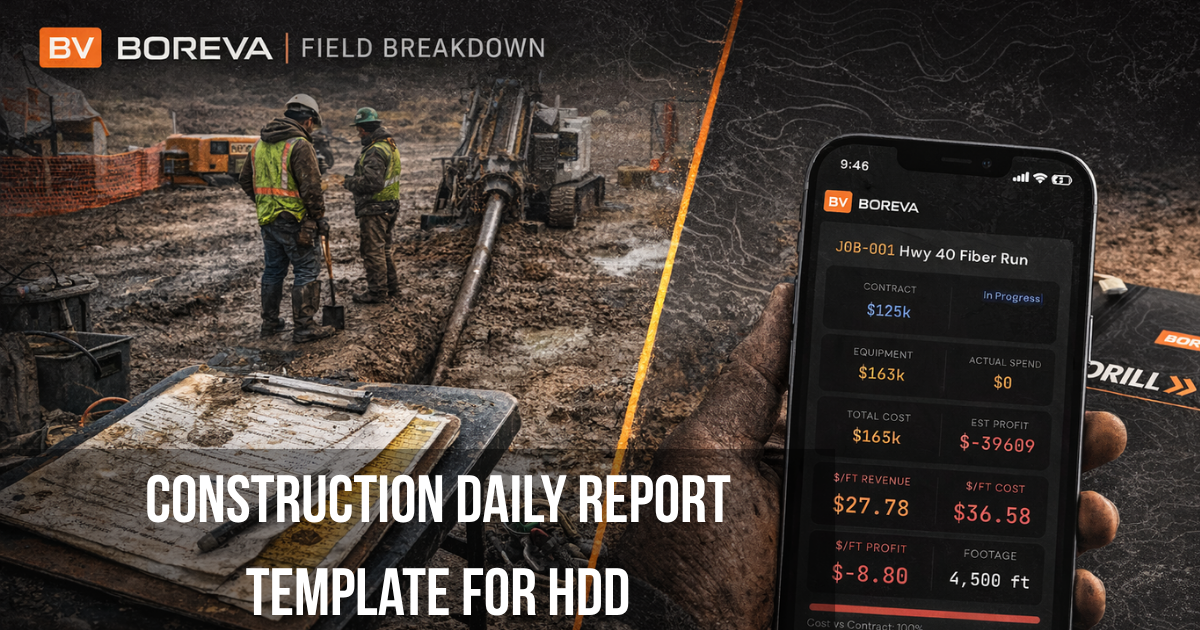
A daily report is supposed to show what actually happened on the job, not what someone remembers at the end of the day.
Most templates fail for one simple reason:
They get filled out after the work is done.
And once that happens, the report stops being a record and becomes a reconstruction.
That’s where everything starts breaking:
- Details get missed
- Problems get forgotten
- Numbers get rounded
- Times get estimated
- Conditions get generalized
- Notes get vague
Now the daily report isn’t a defense document. It’s a summary based on memory.
And memory is the weakest form of documentation you can bring into a dispute.
This is exactly why HDD contractors get burned:
- The bore log says one thing
- The daily report says another
- The inspector’s notes say something else
- The GC chooses the version that benefits them
A daily report only protects you when it is built during the work, not after it.
That’s the shift Boreva was designed to create.
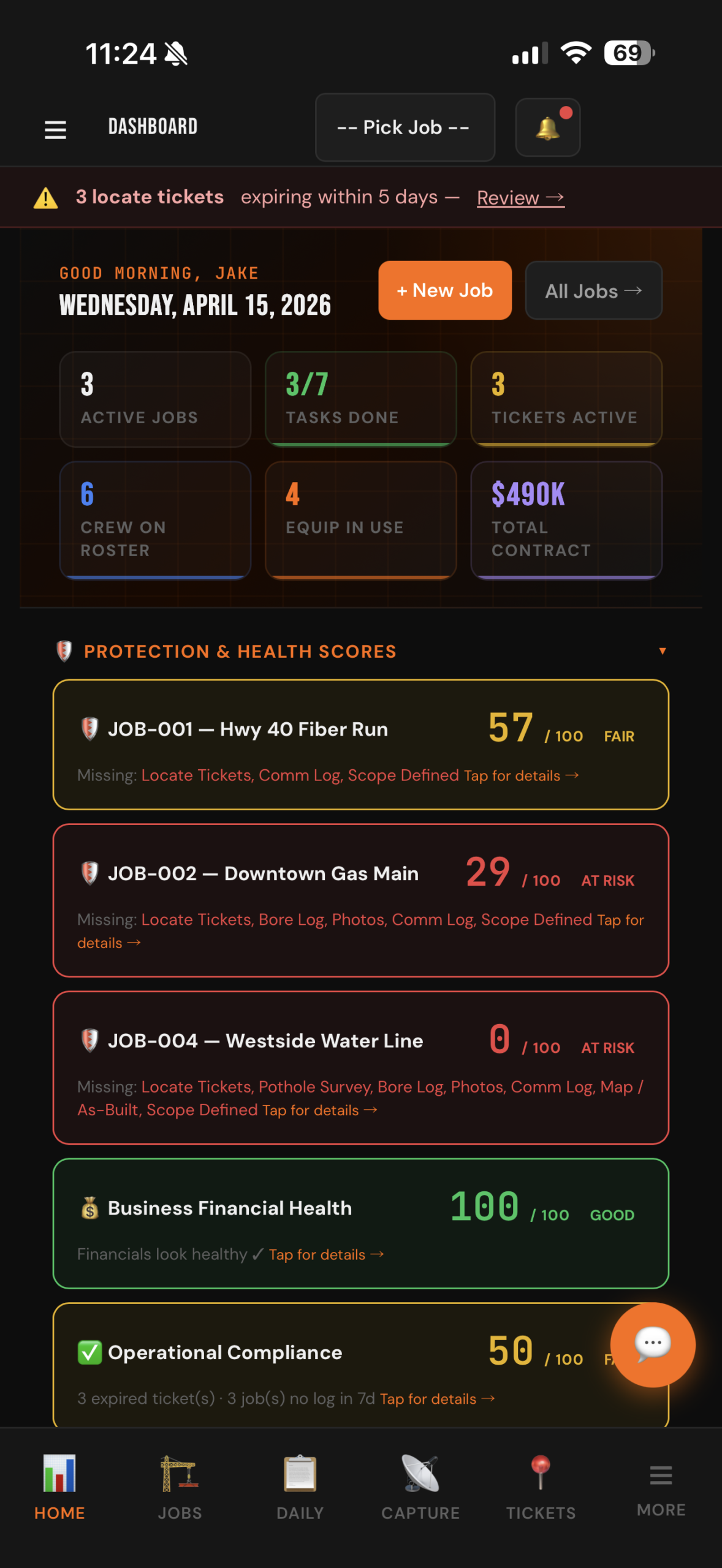
Instead of trying to remember the day, the system captures the day as it happens, shot by shot, issue by issue, note by note.
By the time the crew clocks out, the report already exists.
Nothing needs to be reconstructed. Nothing needs to be guessed. Nothing needs to be “filled in later.”
This is what a real field‑ready daily reporting system looks like.
What a Construction Daily Report Needs to Capture
A daily report only has one job:
Show exactly what happened on the job today.
Not what the foreman remembers. Not what the inspector thinks. Not what the GC assumes. Not what someone reconstructs at 5:30 PM in the truck.
A real daily report is a record, not a recap.
And for HDD, that record must capture the five things that determine production, delays, and billing:
1. Work Completed
This is the backbone of the report.
It must show:
- Bore shots completed
- Footage installed
- Areas worked
- What was started
- What was finished
- What was partially completed
If this section is vague, the GC will assume:
- Your production was low
- Your hours were high
- Your footage is questionable
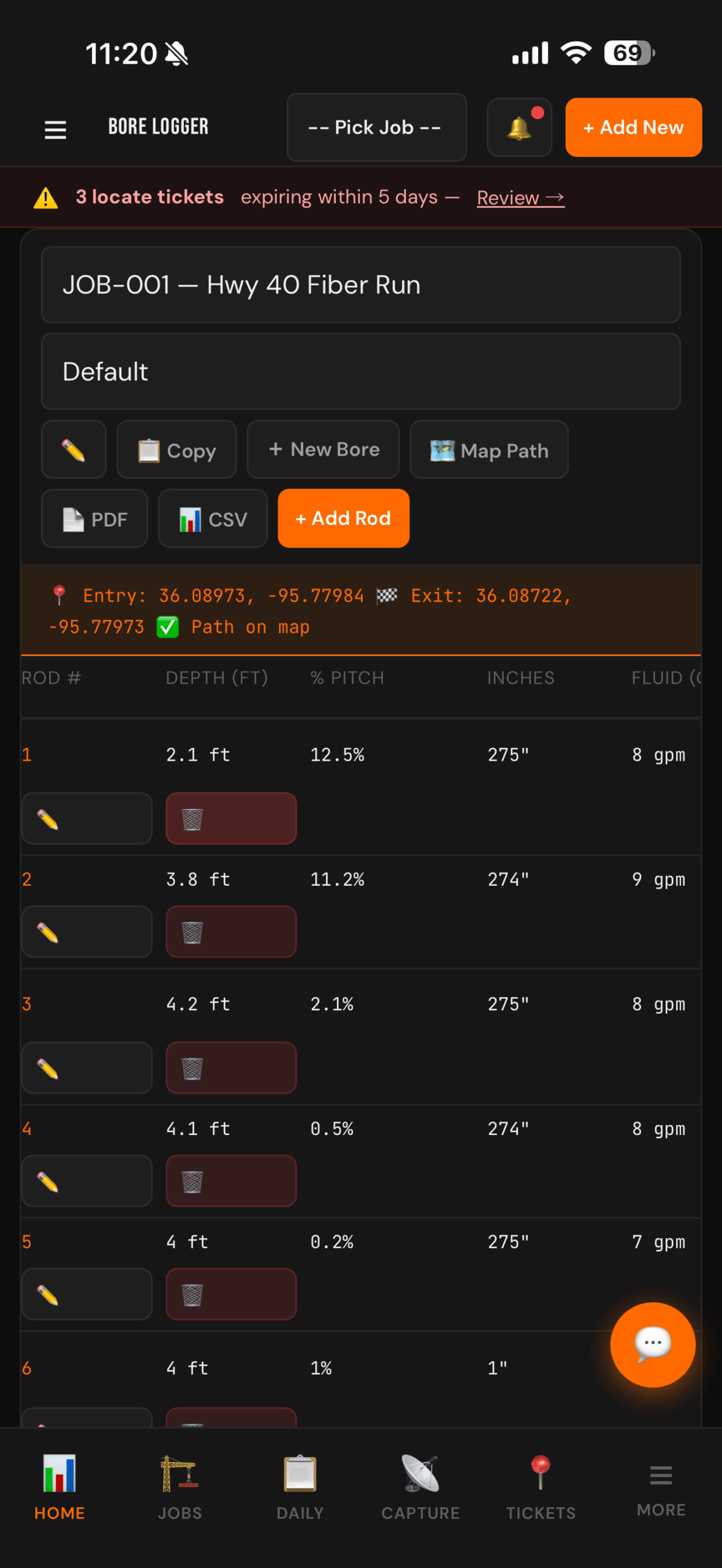
This is why Boreva ties the daily report directly to the bore log.
When a shot is logged in the field, it automatically feeds the daily report. No rewriting. No re‑entering. No forgetting.
The work completed section becomes exact, not estimated.
2. Crew and Equipment
The GC wants to know:
- Who was on site
- What equipment was used
- What equipment failed
- What equipment slowed production
This section protects:
- Labor hours
- Equipment hours
- Standby time
- Delay justification
If a drill went down for 42 minutes, that must be documented when it happens, not guessed later.
Boreva captures:
- Crew on site
- Equipment used
- Equipment issues
- Timestamps
…so the daily report reflects the real day, not the remembered day.
3. Conditions
Conditions explain production.
If the ground changes, the production changes. If access changes, the timeline changes. If traffic changes, the pace changes.
Conditions must capture:
- Ground conditions
- Site access
- Traffic or environment
- Weather impacts
- Utility congestion
Without conditions, the GC assumes:
- Your crew was slow
- Your hours are inflated
- Your footage is padded
With conditions, your production makes sense.
Boreva forces condition notes at the shot level, not as an afterthought.
4. Delays and Problems
This is the section that protects your hours.
If something slows the job down, it must be logged:
- Utility conflicts
- Equipment downtime
- Weather delays
- Waiting on approvals
- Missing locates
- Inspector delays
- Traffic control issues
The GC will not accept:
- “We had delays.”
- “We lost time.”
- “We had issues.”
They want:
- What happened
- When it happened
- How long it lasted
- What caused it
- What the crew did
Boreva logs delays with:
- Timestamps
- Descriptions
- Photos (if needed)
- Automatic placement in the daily report
This is what protects you later.
5. Notes
Notes are where the context lives.
This is where you capture:
- Inspector conversations
- Customer interactions
- Scope changes
- Verbal approvals
- Safety issues
- Unexpected events
Notes are the difference between:
“Why did this happen?” and “Oh, that makes sense.”
Boreva lets crews add notes in real time, not at the end of the day when details are fuzzy.
Construction Daily Report Template
Most daily report templates are built for the office. This one is built for the field.
A real HDD daily report must follow the flow of the work, not the flow of a spreadsheet. It needs to match how drilling actually happens:
- Crews arrive
- Equipment gets set
- Shots get drilled
- Problems occur
- Conditions change
- Notes get made
- Work gets completed
A good template mirrors that sequence.
A great system captures that sequence automatically.
This is the difference between a template you fill out and a system that builds the report for you.
Below is the field‑proven layout, the structure that works on real HDD jobs, with real crews, under real pressure.
And this is exactly the structure Boreva is built around.
1. Job Information
This section sets the context for the day.
It must include:
- Job name
- Location
- Date
- Weather
Weather matters because it affects:
- Ground conditions
- Production rate
- Access
- Safety
- Delays
Boreva captures weather automatically, so crews don’t have to guess or skip it.
2. Crew and Equipment
This section protects your labor and equipment hours.
It must show:
- Crew members on site
- Equipment used
- Equipment issues
If a drill goes down, if a vac truck fails, if a locator stops working, it must be documented.
This is where most contractors lose money:
- Equipment downtime isn’t logged
- Crew changes aren’t recorded
- Standby time isn’t documented
Boreva logs:
- Who was on site
- What equipment was used
- What equipment failed
- When it failed
- How long it affected production
This is what makes your hours defensible.
3. Work Completed
This is the heart of the daily report.
It must show:
- Bore shots completed
- Footage installed
- Areas worked
And here’s the critical part:
This section must match your bore log exactly.
If the bore log says 742 ft and the daily report says 800 ft, the GC will assume:
- Your documentation is inconsistent
- Your footage is inflated
- Your hours are questionable
Boreva eliminates this problem by pulling footage directly from the bore log entries made in the field.
No rewriting. No re‑entering. No mismatches.
The daily report becomes a reflection of the bore log, not a separate document.
4. Conditions
Conditions explain production.
They must capture:
- Ground conditions
- Site access
- Traffic or environment
If production slows, conditions must explain why.
If the path changes, conditions must explain why.
If the timeline shifts, conditions must explain why.
Boreva forces condition notes at the shot level, so the daily report always has the context needed to defend your production.
5. Delays and Problems
This section protects your hours and your schedule.
It must include:
- Utility conflicts
- Equipment downtime
- Weather delays
- Waiting on approvals
- Missing locates
- Inspector delays
If it slows the job down, it goes here.
And it must be logged when it happens, not after.
Boreva logs delays with:
- Timestamps
- Descriptions
- Photos (optional)
- Automatic placement in the daily report
This is what protects you when the GC asks:
“Why did this take so long?”
6. Notes
Notes are where the story of the day lives.
They capture:
- Inspector conversations
- Customer interactions
- Scope changes
- Verbal approvals
- Safety issues
- Unexpected events
These notes often become the deciding factor in a dispute.
Boreva lets crews add notes instantly, not at the end of the day when details are fuzzy.
Why This Layout Works
This layout works because it follows the natural flow of HDD work.
It doesn’t force the crew to think like office staff. It lets them document the day the same way they live it.
And Boreva takes it one step further:
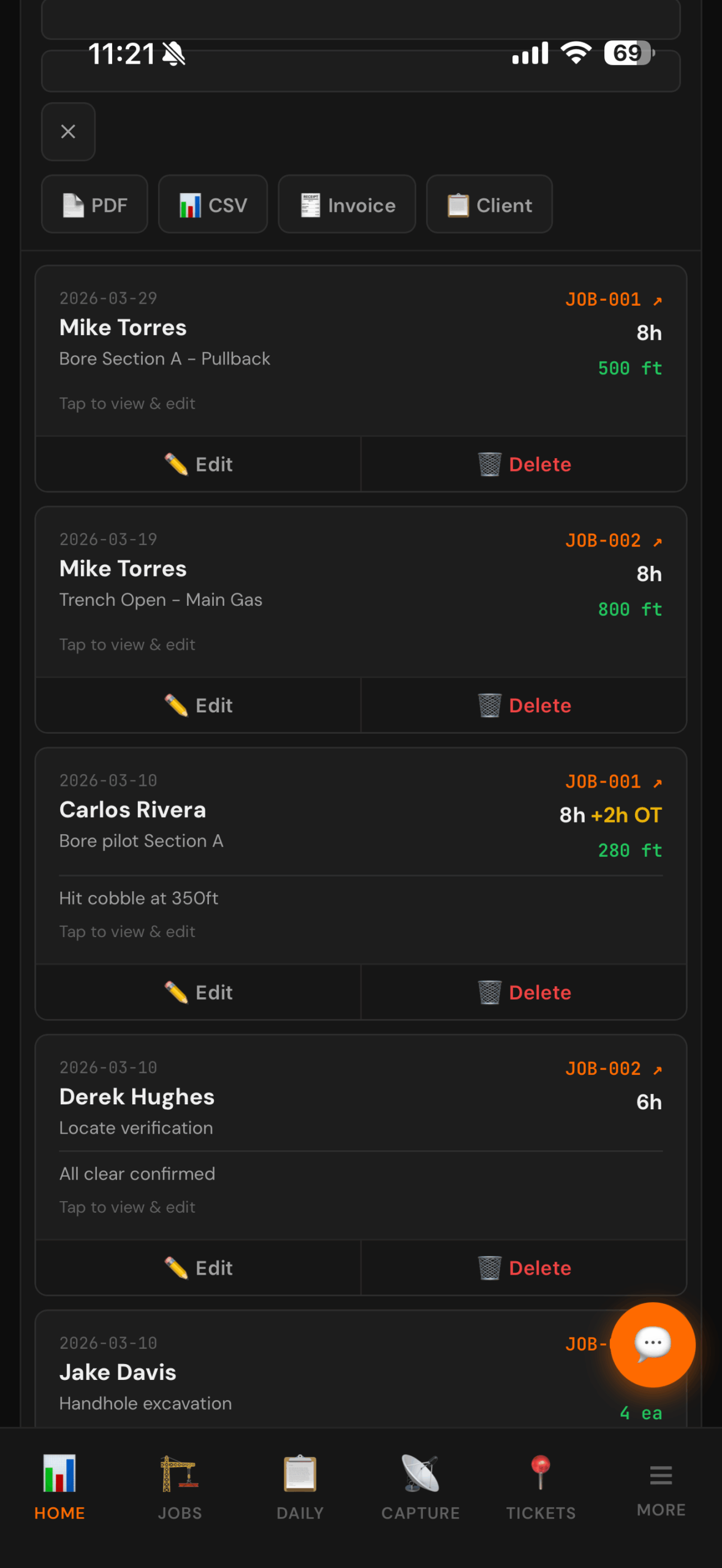
- The bore log feeds the daily report
- The delay log feeds the daily report
- The notes feed the daily report
- The equipment log feeds the daily report
By the time the crew clocks out, the daily report is already built.
No reconstruction. No guessing. No gaps.
Just a clean, defensible record of the day.
Job Information
Job information seems basic, almost too basic to matter.
But this is the section that:
- anchors the report
- ties it to the correct job
- establishes the conditions
- sets the context for production
- protects you when the GC compares days
When job information is wrong, missing, or inconsistent, the GC immediately questions the rest of the report.
This is why the first section of a daily report must be clean, accurate, and consistent every single day.
Here’s what it needs to capture and why Boreva makes this effortless.
1. Job Name
This is the identifier that ties the report to the correct project.
If the job name is wrong or inconsistent:
- reports get mixed
- quantities get misapplied
- delays get questioned
- production gets misaligned
Crews often abbreviate or shorten job names differently each day:
- “AT&T 12th St”
- “ATT 12th”
- “12th St AT&T”
GCs hate this because it creates ambiguity.
Boreva eliminates this by pulling the job name directly from the project setup. Crews don’t type it. They select it.
No variations. No mistakes. No confusion.
2. Location
Location matters because:
- inspectors change by location
- conditions change by location
- access changes by location
- utilities change by location
- production changes by location
If the GC asks:
“Where exactly was the crew working on this day?”
Your daily report must answer that instantly.
Boreva logs the location automatically based on the job and the shot entries. The daily report always reflects the correct work area.
3. Date
This seems obvious, until it isn’t.
Crews sometimes:
- forget to change the date
- reuse yesterday’s template
- enter the wrong day
- fill out the report the next morning
When the date is wrong, the GC assumes:
- the report wasn’t filled out in real time
- the details may not be accurate
- the hours may not match the work
- the footage may not match the day
Boreva timestamps every entry automatically. The date is never wrong because the system records the day as the work happens.
4. Weather
Weather is not a filler field. It’s a production field.
Weather affects:
- ground conditions
- drilling speed
- mud performance
- access
- safety
- downtime
If production slows and the weather section is blank, the GC assumes:
- the slowdown was the crew
- not the conditions
If weather is logged accurately, the GC sees:
- rain
- mud
- freezing temps
- wind
- heat
- lightning delays
Boreva pulls weather automatically based on the job location and timestamp.
No guessing. No skipping. No “sunny” written on a day it rained.
Why This Section Matters More Than People Think
Job information is the foundation of the daily report.
If this section is sloppy:
- the GC questions the entire report
- the report looks like it was filled out later
- the report loses credibility
- the report loses defensive value
If this section is clean and consistent:
- the report looks professional
- the GC trusts the documentation
- the rest of the report carries more weight
- your hours and footage become easier to defend
Boreva ensures this section is always accurate because the system fills it in automatically as the day unfolds.
The crew doesn’t have to think about it. The system handles it.
Crew and Equipment
If the GC is going to challenge your hours, this is the section they use to do it.
Most contractors think the “Crew & Equipment” section is just a roll call. It’s not.
It’s the section that:
- justifies your labor hours
- justifies your equipment hours
- explains your production
- explains your delays
- protects your standby time
- ties your costs to the work performed
If this section is incomplete or inaccurate, the GC immediately questions:
- your hours
- your production
- your delays
- your invoice
This is why the Crew & Equipment section must be clean, exact, and captured in real time, not reconstructed at the end of the day.
Here’s what it needs to include, and how Boreva makes it bulletproof.
1. Crew Members on Site
This is not just a list of names. It’s the foundation of your labor hours.
It must show:
- who was on site
- when they were on site
- what role they performed
- when they left
- any crew changes
If the GC sees:
- a 4‑man crew listed
- but only 3 people in the inspector’s notes
…they assume your hours are inflated.
If the GC sees:
- a locator listed
- but no locating activity documented
…they assume your labor is padded.
Boreva eliminates this by letting crews:
- check in
- check out
- log roles
- track changes
…all from the field.
The daily report reflects the actual crew, not the remembered crew.
2. Equipment Used
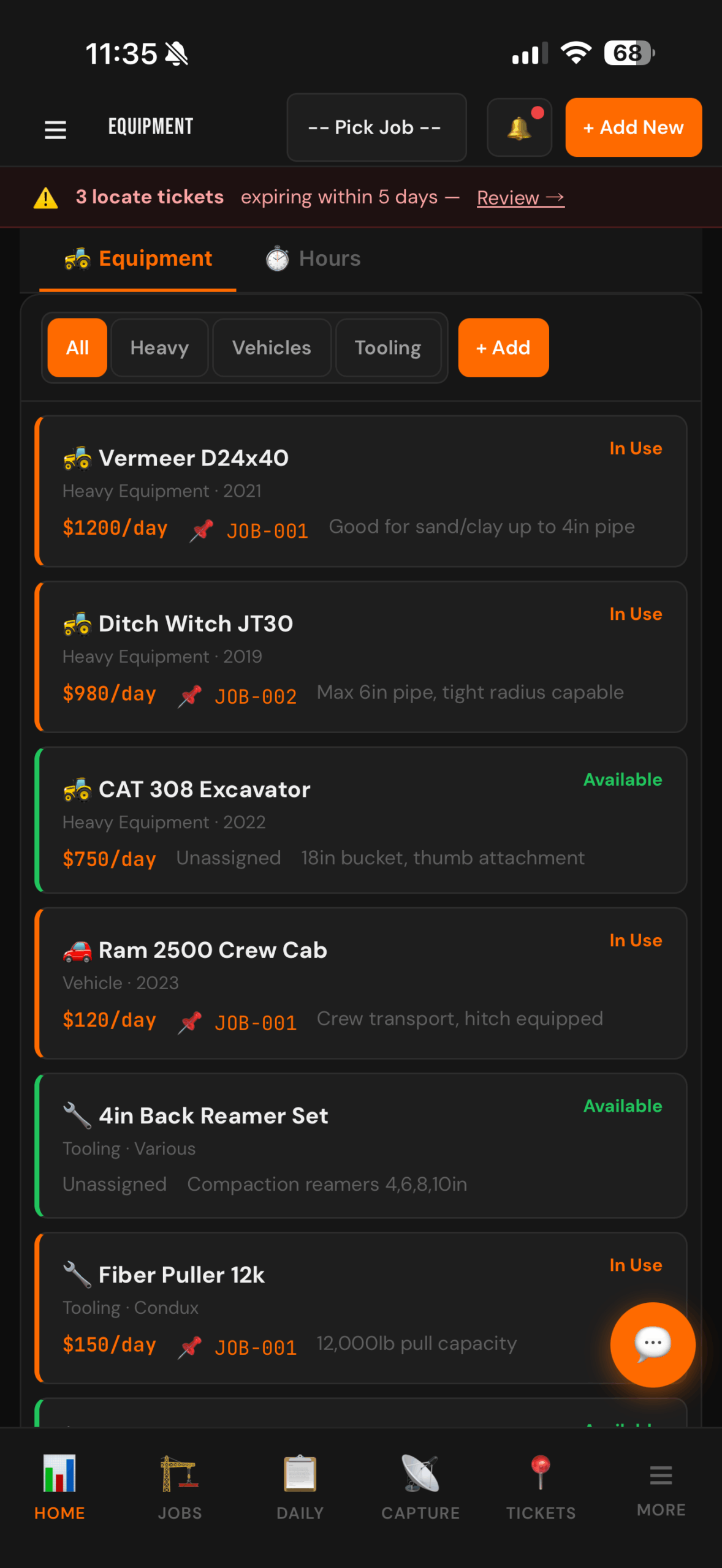
Equipment hours are money.
If equipment is on site, the GC wants to know:
- what equipment
- when it was used
- how it was used
- whether it was productive
- whether it was down
- whether it was on standby
This protects:
- drill hours
- vac truck hours
- locator hours
- support equipment hours
If equipment is listed but not tied to the work, the GC questions the hours.
Boreva ties equipment usage directly to:
- bore shots
- delays
- notes
- timestamps
The equipment section becomes a record, not a guess.
3. Equipment Issues
This is where most contractors lose money.
If equipment goes down and it isn’t documented:
- the GC will not pay standby
- the GC will not accept delays
- the GC will not justify lost production
Equipment issues must capture:
- what failed
- when it failed
- how long it was down
- what caused it
- what the crew did
- how it affected production
Examples:
- “Locator battery failure — 14 minutes downtime”
- “Drill head packed with clay — 22 minutes to clear”
- “Vac truck hose split — 38 minutes repair”
If this isn’t logged in real time, it becomes:
- “We had some downtime.”
- “The drill was acting up.”
- “We lost about an hour.”
GCs don’t pay for vague.
Boreva logs equipment issues with:
- timestamps
- descriptions
- optional photos
- automatic placement in the daily report
This is what makes your downtime defensible.
Work Completed
This is the section the GC looks at first.
It’s the section they compare against:
- their inspector’s notes
- their expectations
- the schedule
- the bore log
- the as‑built
- your hours
If this section is vague, incomplete, or inconsistent, the GC immediately questions:
- your footage
- your production
- your hours
- your delays
- your invoice
This is why the “Work Completed” section must be exact, not estimated and it must match your bore log perfectly.
Here’s what it needs to capture, and how Boreva makes it airtight.
1. Bore Shots Completed
This is the backbone of HDD production.
It must show:
- each shot completed
- the order they were drilled
- the footage for each shot
- the area or alignment
- any partial shots
If the GC sees:
- 3 shots in the daily report
- but 4 shots in the bore log
…they assume your documentation is unreliable.
If the GC sees:
- a 310‑ft shot
- but the inspector wrote 280 ft
…they assume your footage is inflated.
Boreva eliminates this by pulling shot data directly from the bore log entries made in the field.
When a shot is logged:
- the footage
- the conditions
- the notes
- the timestamps
…all flow into the daily report automatically.
No rewriting. No re‑entering. No mismatches.
2. Footage Installed
This is the number that gets challenged the most.
Footage must be:
- exact
- traceable
- tied to shots
- tied to rig readings
- tied to rod count
- tied to the as‑built
If the daily report says:
- 742 ft installed
…but the bore log says:
- 700 ft drilled
…the GC will reduce your quantity to the lowest number.
If the daily report says:
- “About 800 ft”
…you’ve already lost.
Boreva removes the guesswork by:
- pulling exact footage from the bore log
- tying it to timestamps
- tying it to the shot sequence
- tying it to the rig readings
The daily report becomes a mathematically defensible record, not a rounded estimate.
3. Areas Worked
This section shows:
- where the crew worked
- what alignment they were on
- what segment was completed
- what segment was started
- what segment is next
This matters because:
- inspectors change by area
- utilities change by area
- conditions change by area
- access changes by area
- production changes by area
If the GC asks:
“Where exactly did the crew work today?”
Your daily report must answer that instantly.
Boreva ties each shot to a location, so the daily report always reflects the correct work area.
Why This Section Must Match the Bore Log
This is the #1 rule of HDD documentation:
The daily report and the bore log must match exactly.
If they don’t, the GC assumes:
- the report was filled out later
- the numbers were estimated
- the footage is inflated
- the hours are padded
- the delays are questionable
Boreva eliminates this risk by making the bore log the source of truth.
The daily report is not a separate document. It is a reflection of the bore log.
This is what makes your documentation defensible.
Why Boreva Makes This Section Unbreakable
Boreva turns “Work Completed” into a real‑time record by:
- capturing shots as they happen
- pulling footage directly from the field
- tying everything to timestamps
- aligning the daily report with the bore log
- eliminating end‑of‑day reconstruction
- removing human error
- preventing mismatches
By the time the crew clocks out, the “Work Completed” section is already finished and it’s accurate.
No guessing. No rounding. No rewriting. No inconsistencies.
Just a clean, defensible record of the day’s production.
Conditions
Conditions are the why behind your production.
If the GC is going to challenge your footage, your hours, or your timeline, this is the section they look at to understand:
- why production slowed
- why the path changed
- why the footage increased
- why the timeline shifted
- why the crew needed more time
Most daily reports fail here because conditions get written at the end of the day and by then, the details are gone.
Crews write things like:
- “Hard ground”
- “Bad access”
- “Wet”
- “Slow drilling”
These notes don’t explain anything. They don’t defend anything. They don’t justify anything.
Conditions must be specific, timed, and tied to the work.
Here’s what this section needs to capture and how Boreva makes it automatic.
1. Ground Conditions
Ground conditions directly affect:
- penetration rate
- steering difficulty
- tool wear
- mud performance
- production speed
If the ground changes, the production changes.
Examples of strong ground condition notes:
- “Transition from clay to cobble at 110 ft — slowed penetration rate.”
- “Wet sand pocket caused sloughing — required clearing.”
- “Hardpan seam at 62 ft — reduced drilling speed.”
Examples of weak notes:
- “Hard ground.”
- “Slow drilling.”
Weak notes look like excuses. Strong notes look like documentation.
Boreva forces condition notes at the shot level, so the daily report always reflects the real conditions that shaped the day.
2. Site Access
Access affects:
- setup time
- equipment movement
- safety
- production rate
If access is restricted, production slows and the GC needs to see that.
Examples:
- “Traffic control delayed setup by 18 minutes.”
- “Equipment staging limited, required additional repositioning.”
- “Narrow easement slowed vac truck movement.”
These details matter because they explain why the day unfolded the way it did.
Boreva lets crews log access issues instantly, not hours later.
3. Traffic or Environment
Traffic and environmental factors can:
- slow movement
- delay setup
- restrict equipment
- impact safety
- reduce production
Examples:
- “Heavy traffic on 4th St — slowed vac truck repositioning.”
- “Pedestrian congestion required spotter — reduced drilling pace.”
- “Wind gusts required slower rod handling.”
These aren’t excuses, they’re conditions.
And conditions explain production.
Why Conditions Matter So Much
Conditions are the bridge between:
- the footage you drilled
- the hours you logged
- the production you achieved
- the delays you recorded
If conditions are vague, the GC assumes:
- your crew was slow
- your hours are inflated
- your footage is padded
- your delays are questionable
If conditions are detailed, the GC sees:
- the environment
- the challenges
- the adjustments
- the impact
This is what makes your daily report defensible.
Why Boreva Makes This Section Bulletproof
Boreva captures conditions:
- at the shot level
- in real time
- tied to timestamps
- tied to footage
- tied to delays
- tied to production
This eliminates:
- end‑of‑day guessing
- vague notes
- missing details
- mismatched reports
By the time the crew clocks out, the conditions section is already complete and it’s accurate.
No reconstruction. No memory. No gaps.
Just a clean, defensible record of the conditions that shaped the day.
Delays and Problems
If there is one section that protects your hours more than any other, it’s this one.
Delays are the difference between:
- getting paid for the time you spent
- or eating the cost because the GC says “we don’t see it in your report”
Most contractors lose delay disputes for one simple reason:
Delays get logged at the end of the day.
And when delays are logged at the end of the day:
- times get rounded
- durations get estimated
- causes get simplified
- details get forgotten
- context gets lost
- credibility disappears
The GC doesn’t need to prove your delay didn’t happen. They only need to prove your documentation is weak.
This is why the “Delays and Problems” section must be:
- specific
- timestamped
- tied to the work
- tied to the conditions
- tied to the equipment
- logged in real time
Here’s what this section must capture and how Boreva makes it bulletproof.
1. Utility Conflicts
Utility conflicts are one of the most common and most expensive, sources of delay.
Examples:
- “Unmarked gas service encountered at 42 ft — drilling paused 31 minutes.”
- “Fiber line depth inconsistent — required potholing before continuing.”
- “Unknown duct bank — alignment shifted 6 ft right.”
If this isn’t logged when it happens, the GC will say:
- “We didn’t see that.”
- “Our inspector didn’t note it.”
- “We can’t justify the delay.”
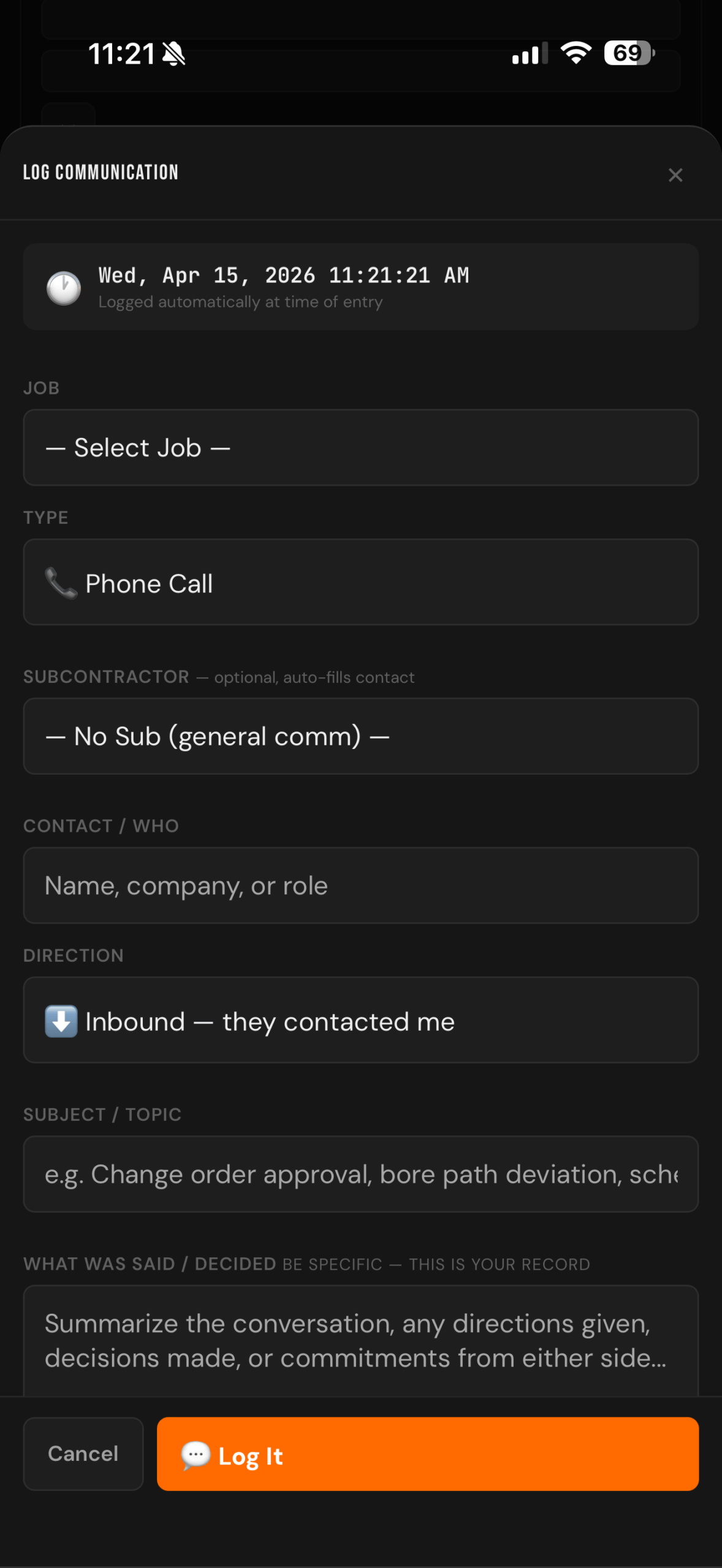
Boreva logs utility conflicts with:
- timestamps
- descriptions
- optional photos
- automatic placement in the daily report
This is what makes your utility delays defensible.
2. Equipment Downtime
Equipment downtime is money, but only if it’s documented.
If the drill goes down for 42 minutes and it isn’t logged, the GC will not pay for it.
Downtime must capture:
- what failed
- when it failed
- how long it was down
- what caused it
- what the crew did
- how it affected production
Examples:
- “Drill head packed with clay — 22 minutes to clear.”
- “Vac truck hose split — 38 minutes repair.”
- “Locator battery failure — 14 minutes downtime.”
If this is logged at the end of the day, it becomes:
- “We had some downtime.”
- “The drill was acting up.”
- “We lost about an hour.”
GCs don’t pay for vague.
Boreva logs downtime in real time with exact timestamps.
3. Weather Delays
Weather delays are legitimate, but only if they’re documented correctly.
Examples:
- “Lightning delay — 27 minutes.”
- “Heavy rain — drilling paused 18 minutes.”
- “Wind gusts required slower rod handling — reduced production.”
If weather delays aren’t logged when they happen, the GC assumes:
- the crew was slow
- not the conditions
Boreva automatically pulls weather data and ties it to the delay.
4. Waiting on Approvals
This is one of the most common and most disputed, delays.
Examples:
- “Waiting on inspector approval — 19 minutes.”
- “Waiting on traffic control — 26 minutes.”
- “Waiting on locate verification — 34 minutes.”
If this isn’t logged in real time, the GC will say:
- “We don’t see that delay.”
- “Our inspector didn’t note it.”
- “We can’t justify the time.”
Boreva timestamps these delays automatically.
5. Any Event That Slows the Job Down
If it slows the job down, it belongs in this section.
Examples:
- mud pump issues
- vac truck repositioning delays
- traffic congestion
- site access restrictions
- safety stand‑downs
- material delivery delays
If it costs you time, it must be documented.
If it isn’t documented, it didn’t happen, at least in the GC’s eyes.
Why This Section Is the Most Important for Protecting Your Hours
Delays are where contractors lose the most money.
Not because the delays didn’t happen. Because the delays weren’t documented correctly.
A delay that is:
- vague
- estimated
- rounded
- written later
- missing timestamps
- missing context
…is a delay the GC will deny.
A delay that is:
- specific
- timestamped
- tied to the work
- tied to the equipment
- tied to the conditions
- logged in real time
…is a delay the GC cannot argue with.
This is the difference between:
- getting paid
- or getting reduced
Boreva makes this section unbreakable by capturing delays:
- in real time
- with timestamps
- with descriptions
- with optional photos
- automatically inserted into the daily report
By the time the crew clocks out, the delay log is already complete and it’s accurate.
No reconstruction. No guessing. No gaps.
Just a clean, defensible record of every delay that affected the day.
Notes
Notes are the most underrated part of a daily report.
Most crews treat notes like an optional field, something they fill in if they remember, or if something “big” happened.
But in HDD, notes are the difference between:
- a report that explains the day
- and a report that leaves the GC guessing
Notes are where the context lives. Context is what makes your documentation defensible.
Without notes, your report is just numbers. With notes, your report becomes a story the GC can follow and verify.
Here’s what this section must capture, and how Boreva makes it effortless.
1. Inspector Conversations
This is one of the most important things to document.
Inspectors:
- give approvals
- give instructions
- change expectations
- request adjustments
- confirm footage
- confirm alignment
- confirm delays
If you don’t document these conversations, the GC will default to the inspector’s version, not yours.
Examples of strong notes:
- “Inspector approved alignment shift at 10:42 AM.”
- “Inspector confirmed depth at 162 ft mark.”
- “Inspector requested pothole before continuing — 19‑minute delay.”
These notes protect you when the GC asks:
“Who told you to do that?”
Boreva lets crews log these notes instantly, not hours later.
2. Customer Interactions
Customer interactions matter because they often:
- change the plan
- change the sequence
- change the alignment
- change the timeline
Examples:
- “Customer requested bore start moved 12 ft east.”
- “Customer asked for additional pothole before continuing.”
- “Customer approved extended working hours.”
If you don’t document these, the GC will say:
- “We didn’t authorize that.”
- “We didn’t request that.”
- “We didn’t approve that.”
Boreva timestamps these notes so you always have proof.
3. Scope Changes
Scope changes are money, but only if they’re documented.
Examples:
- “Added second shot due to obstruction.”
- “Extended bore path 48 ft to avoid duct bank.”
- “Changed exit point per customer request.”
If scope changes aren’t documented, the GC will say:
- “That wasn’t part of the plan.”
- “We didn’t approve additional footage.”
Boreva makes scope changes easy to log in real time.
4. Safety Issues
Safety issues affect:
- production
- delays
- crew movement
- equipment use
Examples:
- “Safety stand‑down due to lightning — 27 minutes.”
- “Spotter required due to pedestrian traffic.”
- “Restricted access due to nearby excavation.”
These notes explain why the day unfolded the way it did.
5. Unexpected Events
This is the catch‑all category for anything that doesn’t fit neatly into the other sections but still matters.
Examples:
- “City inspector arrived late — 14‑minute delay.”
- “Traffic control arrived without proper signage — slowed setup.”
- “Material delivery delayed — crew staged equipment.”
These notes often become the deciding factor in a dispute.
Why Notes Matter So Much
Notes are the glue that holds the daily report together.
They explain:
- why production changed
- why delays happened
- why decisions were made
- why the timeline shifted
- why the footage is what it is
Without notes, the GC fills in the blanks with their own assumptions.
With notes, the GC sees the full picture.
Why Boreva Makes Notes Unbreakable
Boreva captures notes:
- in real time
- tied to shots
- tied to delays
- tied to conditions
- tied to timestamps
- tied to the daily report
This eliminates:
- forgotten details
- vague summaries
- end‑of‑day guessing
- missing context
- mismatched reports
By the time the crew clocks out, the notes section is already complete and it’s accurate.
No reconstruction. No memory gaps. No “I think this happened around noon.”
Just a clean, defensible record of the day’s context.
Why Most Daily Reports Fail
Most daily reports don’t fail because the crew doesn’t care. They fail because the process is broken.
The traditional daily report depends on one thing:
Memory.
And memory is the weakest, most unreliable, most inconsistent documentation method you can bring into a construction dispute.
Here’s the truth:
Crews don’t forget because they’re lazy. They forget because the job moves fast.
- Shots get drilled
- Conditions change
- Problems happen
- Equipment fails
- Inspectors show up
- Customers call
- Traffic shifts
- Utilities surprise you
By the time the crew sits down to fill out the daily report, the details are already fading.
This is why most daily reports fail and why they can’t defend anything when the GC starts asking questions.
Let’s break down the real reasons.
1. They’re Filled Out at the End of the Day
This is the #1 failure.
End‑of‑day reporting creates:
- rounded numbers
- vague notes
- missing delays
- incorrect times
- mismatched footage
- forgotten conversations
- incomplete conditions
The GC can spot an end‑of‑day report instantly.
It looks like a summary, not a record.
Boreva eliminates this by building the report during the work, not after.
2. Details Get Missed Because the Day Moves Too Fast
A foreman juggling:
- drilling
- locating
- traffic
- inspectors
- customers
- equipment
- safety
- crew questions
…is not going to remember:
- the exact time a delay started
- the exact moment conditions changed
- the exact footage at each shot
- the exact conversation with the inspector
It’s not realistic.
Boreva captures these details in real time, so nothing depends on memory.
3. Problems Get Forgotten Because They Don’t Seem Big at the Time
Most delays don’t feel like delays when they happen.
Examples:
- clearing a packed drill head
- swapping locator batteries
- waiting for a vac truck to reposition
- potholing an unexpected utility
- waiting for an inspector to walk over
Each one feels small.
But add them up and you’ve lost:
- 30 minutes
- 45 minutes
- an hour
- more
If these aren’t logged, the GC will say:
“We don’t see any delays in your report.”
Boreva logs delays with timestamps the moment they occur.
4. Numbers Get Rounded Because Exact Numbers Aren’t Written Down
When crews fill out reports later, they write:
- “About 300 ft”
- “Roughly 800 ft today”
- “Around 4 hours drilling”
Rounded numbers destroy credibility.
GCs assume:
- the report wasn’t filled out in real time
- the footage is inflated
- the hours are padded
Boreva pulls exact numbers from the bore log and rig readings — no rounding, no guessing.
5. Daily Reports Don’t Match the Bore Log
This is the GC’s favorite leverage point.
If the bore log says:
- 742 ft
…but the daily report says:
- 800 ft
…the GC will reduce your quantity to the lowest number.
If the bore log says:
- 3 shots
…but the daily report says:
- 2 shots
…the GC will question your documentation.
Boreva eliminates this because the bore log feeds the daily report automatically.
No mismatches. No inconsistencies. No leverage for the GC.
6. Notes Are Added Later and Lose Their Meaning
Notes written at the end of the day become:
- vague
- generic
- incomplete
- inaccurate
Examples of weak notes:
- “Talked to inspector.”
- “Had some issues.”
- “Slow drilling.”
These notes don’t defend anything.
Boreva captures notes in real time, tied to:
- shots
- delays
- conditions
- timestamps
Now the notes actually explain the day.
7. The Report Doesn’t Tell a Story
A daily report must tell a clear, traceable story:
- what happened
- when it happened
- why it happened
- how it affected production
Most reports don’t tell a story. They list numbers.
Numbers without context are easy to challenge.
Boreva builds the story automatically because it captures the day as it unfolds.
What Real Daily Reporting Looks Like in the Field
Daily reporting fails when it’s treated like paperwork.
Daily reporting works when it’s treated like part of the work.
The job doesn’t happen at the end of the day. It happens throughout the day, minute by minute, shot by shot, problem by problem.
A daily report should be built the same way.
Real daily reporting is not:
- sitting in the truck at 5:30 PM
- trying to remember what happened
- guessing at times
- rounding footage
- summarizing problems
- filling in blanks
Real daily reporting is:
- capturing the day as it unfolds
- logging shots when they’re drilled
- logging delays when they occur
- logging conditions when they change
- logging notes when conversations happen
This is the difference between:
a summary and a record
A summary can be questioned. A record cannot.
This is exactly why Boreva exists.
How Real Daily Reporting Works in the Field
Here’s what it looks like when a crew uses a real‑time system instead of a template.
1. Bore Shots Get Logged as They Happen
The moment a shot is completed:
- footage is entered
- conditions are noted
- notes are added
- timestamps are captured
This becomes the backbone of the daily report.
No rewriting. No re‑entering. No mismatches.
2. Problems Get Recorded When They Occur
When something slows the job down:
- equipment failure
- utility conflict
- weather delay
- inspector delay
- access issue
…it gets logged immediately.
Not later. Not “when we get a minute.” Not “we’ll remember it.”
Real‑time logging turns delays into defensible documentation.
3. Notes Get Added in Real Time
When the inspector says something important, the crew logs it.
When the customer gives direction, the crew logs it.
When the alignment changes, the crew logs it.
These notes become the context that protects your hours and footage.
4. The Daily Report Builds Itself
By the time the crew clocks out:
- the bore log is complete
- the delays are logged
- the conditions are documented
- the notes are captured
- the footage is exact
- the timeline is accurate
And the daily report is already built.
Nothing needs to be remembered. Nothing needs to be reconstructed. Nothing needs to be guessed.
This is what real daily reporting looks like.
Why Boreva Makes This Possible
Boreva isn’t a template. It’s a field system.
It captures:
- shots
- footage
- conditions
- delays
- notes
- equipment issues
- timestamps
…as the work happens.
The daily report isn’t something the crew fills out. It’s something the system builds automatically from the day’s activity.
This is why Boreva reports hold up when the GC challenges them.
They aren’t summaries. They’re records.