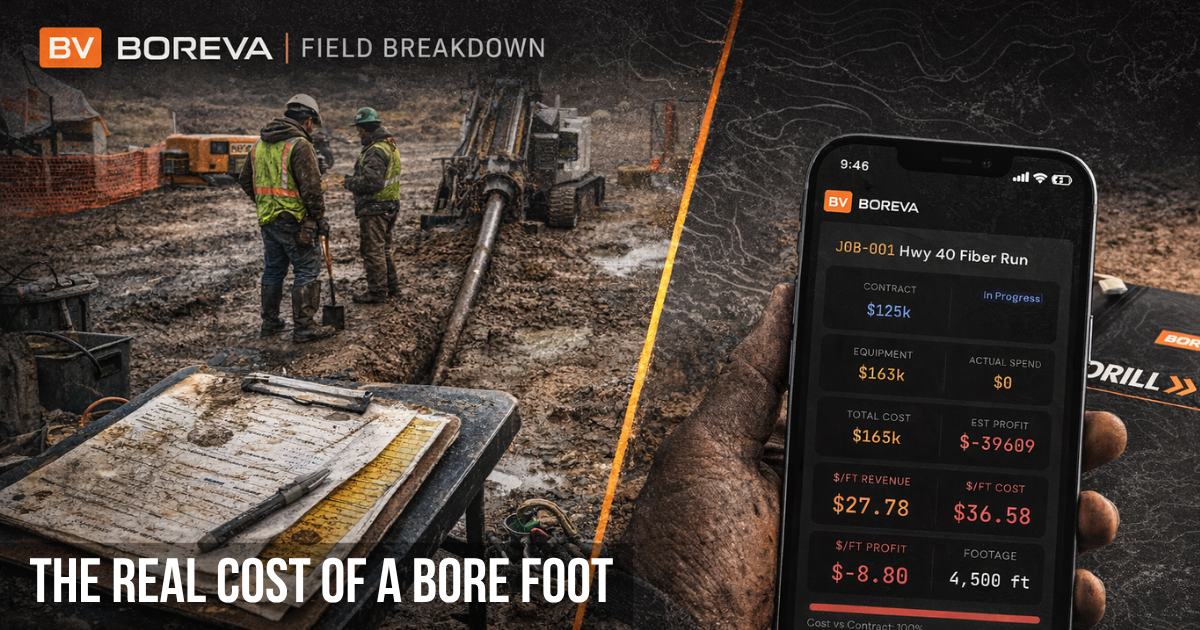
Too many HDD contractors price jobs one of two ways.
- They either use what they charged last time.
- Or they use what they think the market will bear.
Neither of those is your actual cost per foot.
And if you don’t know your actual cost per foot; loaded with real labor, real equipment, real materials, and real production rates, then every bid you write is a guess with a dollar sign attached.
Some guesses come in profitable. Some don’t. And you won’t know which is which until the job closes.
That’s not a business. That’s a lottery.
Here’s how to get off it.
What “Cost Per Foot” Actually Means
Cost per foot is the total dollars it costs your operation to drill one foot of bore, fully loaded. Not just the drill operator’s wage. Every dollar that touches the job divided by every foot that came out of it.
The formula is simple:
Total Job Cost ÷ Total Footage = Cost Per Foot
The hard part isn’t the math. It’s knowing your total job cost with any accuracy. Most contractors undercount it because they’re only tracking the obvious stuff, labor and fuel, and ignoring the costs that eat them quietly: equipment depreciation, drill fluid, downtime hours, subcontractors, mobilization, and overhead allocation.
The Four Cost Buckets You Have to Track
1. Labor Cost
This is the one everyone thinks they track. But do you know your fully-loaded labor cost, not just wage, but what each crew member actually costs your business per hour?
That number includes the wage, yes. But it also includes payroll taxes, workers comp, and any benefits. For most crews that’s 25-35% on top of the base hourly rate.

2. Equipment Cost
Your drill, your mix system, your locating equipment, your support trucks. Every piece of iron has a daily cost whether it’s running or sitting.
The most honest way to calculate it: take your total annual equipment cost (payments, insurance, maintenance, fuel budget) and divide it by your annual working days. That’s your daily equipment cost. Divide by your average daily footage and you have your equipment cost per foot.
Most contractors are surprised by this number.

3. Direct Job Costs
Drill fluids. Conduit. Fittings. Bore head wear. Pull-back equipment rental. Permit fees. Traffic control. Any sub you brought in for vacuum excavation or concrete restoration.
These are the line items that vary by job and rarely get fully captured on a cost-per-foot basis. They get absorbed into “the job” without being tied to the footage that required them.

4. Overhead Allocation
This is the one almost nobody does and it’s the one that turns a “profitable” job into a break-even.
Overhead is every cost your business carries that isn’t tied to a specific job. Office. Insurance. Truck payments on vehicles not assigned to jobs. Admin time. Software. Accounting. Your own salary if you’re drawing one.
To allocate overhead to a job: take your monthly overhead total, divide by monthly revenue, and you get an overhead percentage. Add that percentage to every job’s total cost before you calculate your margin.
A typical underground utility contractor carries 12-18% overhead. Ignoring it means you think a 20% margin job is profitable when the real margin is closer to 4%.
The Production Rate Variable You’re Probably Ignoring
Here’s where cost per foot gets complicated and where most bids go wrong.
Your cost per foot is not a fixed number.
It changes with soil conditions. It changes with bore diameter. It changes with depth. It changes with site access, traffic control requirements, and how far your crew has to travel.
A 300-foot bore in sandy loam at 8 feet deep costs your operation a very different number per foot than a 300-foot bore in cobble at 18 feet deep.
If you’re bidding both jobs at the same price per foot, one of them is making you money and one of them is costing you money. You just don’t know which.

How to Calculate Your Number From Real Data
This is where Boreva does the work.
After you’ve logged three or four jobs end to end, daily entries, equipment hours, cost tracker, bore logger, the data exists. Here’s how to pull it:
Step 1: Pull the job P&L from the Financials page.

Step 2: Cross-reference against the bore footage from the Bore Logger.

Step 3: Do the math.
If Job MN-3162 cost $47,200 to deliver and produced 2,800 feet of bore, your fully-loaded cost on that job was $16.86 per foot.
Run that across five jobs. Look at the variance. The jobs with good soil conditions and efficient production will show a lower number. The jobs with conflicts, hard material, or equipment issues will show a higher one.
That variance is your pricing intelligence.
What to Do With the Number
Once you know your range, say $14/ft on favorable conditions to $24/ft on difficult conditions, you can price jobs based on what the specific job looks like, not what you charged last time.
A bore bid in sandy soil with clean locates, clear ROW, and 10-foot depth gets priced at the low end of your range plus margin.
A bore bid in unknown soil, near a highway, with multiple utility crossings and tight staging gets priced at the high end of your range with extra contingency built in.
That’s not guessing. That’s data-driven pricing.

The Crew Variable: Your Cost Per Foot Isn’t Just About the Job
One more thing most contractors never look at.
Your cost per foot varies by crew, not just by job conditions.
A crew that produces 320 feet per day has a fundamentally different cost structure than a crew that produces 200 feet per day. Same labor cost, same equipment cost, same materials. But 60% more footage in the denominator means 60% lower cost per foot.

The Number You Should Know Cold
After running Boreva for a full job cycle, 90 days, three to four jobs, you should be able to answer these without looking anything up:
What is your average fully-loaded cost per foot in normal conditions?
What is your average fully-loaded cost per foot in difficult conditions?
What is your production rate per day per crew in each condition type?
If you know those three numbers, you can price any job accurately in five minutes.
If you don’t, you’re still guessing.
And somewhere in that guess is the job that’s going to hurt.
Start With One Job
You don’t need six months of perfect data to get started.
Pick the next job. Set up the price sheet before day one. Log daily entries to tasks every day. Log equipment hours every day. Log every expense in the cost tracker as it happens. Log the bore rod by rod.
When the job closes, go to the Financials page. Pull the total cost. Pull the footage from the bore logger. Divide.
That’s your first real number.
It won’t be perfect. But it will be more accurate than anything you’ve been working with.
And the job after that will be better. And the one after that.
That’s how you build the kind of cost intelligence that stops you from guessing and starts getting you paid what the work is actually worth.