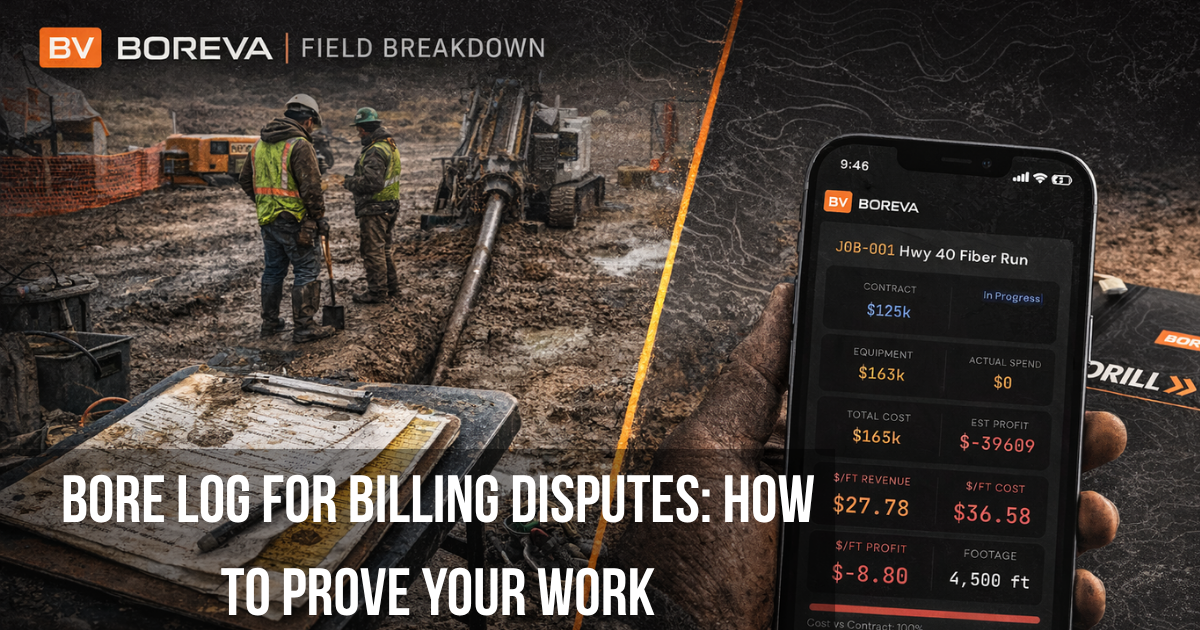
When a contractor thinks about a billing dispute, they usually think in terms of effort:
- “We drilled the footage.”
- “We fought through bad ground.”
- “We dealt with utilities and delays.”
- “We stayed on the job until it was done.”
All of that may be true. None of it wins the dispute by itself.
A billing dispute is not a conversation about how hard the job was. It is a conversation about what you can prove.
That’s the part most contractors miss.
You can have:
- The best crew on the job
- The toughest conditions on the project
- The longest days and the hardest pushes
…but if the only record of that is what people remember, you’re walking into a dispute with no weapon.
The GC, PM, or auditor on the other side of the table is not interested in stories. They are interested in documentation:
- What was drilled
- When it was drilled
- How long it took
- What changed the plan
- What slowed production
- What caused delays
- What justified extra cost
If you can’t show those things in writing, they assume they didn’t happen.
That’s where the bore log comes in.
The bore log is not just a technical record of drilling. In a billing dispute, it becomes the primary evidence file:
- It shows the exact footage you’re billing for.
- It shows the conditions that explain why production changed.
- It shows the problems and delays that justify extra time and cost.
- It shows the sequence of events that backs up your story.
Without that, your invoice is just a number and your explanation is just an opinion.
With it, your invoice is tied to a documented record of work.
That’s why, in a dispute, it’s not an exaggeration to say:
The bore log decides who gets paid.
Not because the log is magic, but because it’s the only thing in the room that can turn:
“We did the work.”
into:
“Here is the proof of the work, shot by shot, with conditions, problems, and time documented as they happened.”
Everything else in the article builds on that idea.
Section 2: What Happens During a Billing Dispute
A billing dispute doesn’t start with conflict. It starts with a question.
And that question is always the same:
“Can you show me where this number came from?”
That’s the moment the entire conversation shifts. It stops being about the work you performed and becomes about the documentation you can produce.
Here’s how the process actually unfolds — step by step — and why the bore log becomes the center of the discussion.
1. The Contractor Explains What Happened
Every dispute begins with the contractor giving their version of the job:
- “We drilled the footage.”
- “Production slowed because of rock.”
- “We had to adjust for utilities.”
- “We lost time waiting on approvals.”
- “The ground conditions changed.”
All of this may be accurate. None of it is enough.
Verbal explanations don’t carry weight in a dispute. They’re treated as opinions, not evidence.
2. The GC or PM Asks for Documentation
This is the turning point.
The GC, PM, or auditor will ask:
- “Where is this shown in your bore log?”
- “Do you have documentation of the delay?”
- “Can you show the exact footage per shot?”
- “Where did production slow down?”
- “What conditions caused the change?”
- “Do you have timestamps?”
They’re not trying to be difficult. They’re following their process.
If you can’t produce documentation, the conversation is already moving against you.
3. Memory-Based Explanations Lose Credibility Immediately
If your response sounds like:
- “I think it was around 300 feet.”
- “We hit rock somewhere in the middle.”
- “We had a delay but I don’t remember the exact time.”
- “The crew said they slowed down because of utilities.”
…you’ve already lost leverage.
Memory is not admissible in a billing dispute. Documentation is.
The GC will default to:
- The contract
- The plan sheets
- Their own inspector notes
- Their own assumptions
Without documentation, your version of events carries no weight.
4. A Detailed Bore Log Changes the Entire Tone of the Conversation
When you present a bore log that shows:
- Exact footage per shot
- Entry and exit points
- Depth changes
- Ground transitions
- Steering corrections
- Utility conflicts
- Lost returns
- Equipment issues
- Time stamps
- Production slowdowns
- Real-time notes
…the conversation shifts instantly.
You’re no longer explaining. You’re demonstrating.
You’re no longer defending. You’re presenting evidence.
You’re no longer hoping they believe you. You’re showing them why they have to.
A strong bore log removes doubt. And removing doubt removes pushback.
5. The GC or PM Cross-Checks Your Documentation
Once you provide the bore log, they compare it against:
- Their inspector’s notes
- Their daily reports
- Their schedule
- Their expectations
- Their cost model
- Their footage assumptions
If your bore log is:
- Detailed
- Consistent
- Time-stamped
- Shot-separated
- Condition-specific
…it aligns with their process and becomes the authoritative record.
If your bore log is:
- Vague
- Rounded
- Missing details
- Filled out late
- Inconsistent
…it becomes ammunition against your invoice.
6. The Decision Is Made Based on Documentation, Not Discussion
At the end of the dispute, the GC or PM doesn’t decide based on:
- How hard the job was
- How good your crew is
- How convincing your explanation sounds
They decide based on:
- What is documented
- What is verifiable
- What is defensible
- What matches their records
- What holds up under audit
The bore log becomes the deciding factor because it is the only document that shows:
- What happened
- When it happened
- Why it happened
- How it affected production
- How it affected cost
That’s why the bore log is not paperwork, it is your primary defense file.
How a Bore Log Defends Your Invoice
A bore log doesn’t defend your invoice because it exists. It defends your invoice because of what it contains and how it answers the exact questions raised in a dispute.
When a GC or PM challenges your billing, they’re not looking for a story. They’re looking for a technical record that explains:
- What was drilled
- How it was drilled
- What changed the plan
- What slowed production
- What justified additional time or cost
A strong bore log does this automatically because it captures the job in a way that aligns with how disputes are evaluated.
Here’s how a bore log becomes your strongest piece of evidence.
1. It Shows Exact Footage, Shot by Shot
Billing disputes almost always start with footage.
The GC wants to know:
- “How did you get this total?”
- “Where is each shot documented?”
- “Why does this number differ from the plan?”
A strong bore log answers all of that without debate.
It shows:
- The planned length
- The actual length
- The entry and exit points
- The rod count
- The footage per shot
- The total footage for the day
There’s no guessing. No rounding. No “about 300 feet.”
It’s precise.
And precision is what makes your footage defensible.
2. It Explains Why Production Changed
Production never drops for no reason. But if you don’t document the reason, the GC assumes the crew slowed down.
A strong bore log shows:
- Where ground conditions changed
- Where steering became difficult
- Where utilities forced a path adjustment
- Where returns were lost
- Where the crew had to back up or re‑drill
- Where the bore slowed due to rock, cobble, or wet clay
This is the context behind your numbers.
Without context, production looks inconsistent. With context, production looks justified.
3. It Documents Delays in Real Time, Not After the Fact
Delays are the most expensive part of any HDD job.
They include:
- Waiting on locates
- Waiting on inspectors
- Waiting on traffic control
- Waiting on approvals
- Utility conflicts
- Equipment issues
- Weather impacts
If these delays aren’t logged as they happen, they become your responsibility.
A strong bore log:
- Time‑stamps the delay
- Describes the cause
- Shows the impact
- Connects the delay to the production change
This is the difference between:
“We lost time.” and “At 10:42 AM, drilling stopped due to unmarked gas service. Inspector notified. Clearance confirmed at 11:28 AM. Total delay: 46 minutes.”
One is an excuse. The other is evidence.
4. It Creates a Timeline That Matches the Job
A billing dispute is ultimately a timeline review.
The GC wants to know:
- What happened
- When it happened
- How long it took
- Why it took that long
A strong bore log creates a clear, chronological record:
- Start time
- End time
- Time per shot
- Time lost to conditions
- Time lost to delays
- Time spent adjusting the path
- Time spent resolving conflicts
This timeline is what auditors and PMs rely on when validating your invoice.
If your timeline is clear, your invoice is clear. If your timeline is vague, your invoice is vulnerable.
5. It Connects the Technical Work to the Billing Number
This is the part most contractors never think about.
Your invoice is a number. Your bore log is the explanation behind that number.
A strong bore log ties the two together:
- Footage → Billing
- Conditions → Production rate
- Problems → Delays
- Delays → Time
- Time → Cost
When the GC asks:
“Why does this day cost more?”
You don’t explain it. You show it.
The bore log becomes the bridge between the work performed and the money owed.
6. It Removes Doubt And Doubt Is What Causes Pushback
GCs don’t push back because they think you’re lying. They push back because they don’t have enough information to approve the invoice confidently.
A strong bore log removes:
- Ambiguity
- Guessing
- Assumptions
- Memory gaps
- Inconsistencies
When the log is clear, the GC has no reason to question the invoice.
When the log is weak, they have every reason to.
What Your Bore Log Must Show to Hold Up
A bore log doesn’t win a billing dispute because it exists. It wins because it contains the specific, verifiable details that eliminate doubt and answer every question the GC, PM, or auditor will raise.
A weak bore log creates uncertainty. Uncertainty creates questions. Questions create pushback.
A strong bore log removes uncertainty. Removing uncertainty removes pushback.
To hold up in a billing dispute, your bore log must show exactly what happened — not the simplified version, not the “we’ll fill it out later” version, and not the rounded‑off version.
Here’s what a dispute‑ready bore log must include.
1. Exact Footage for Every Shot, No Rounding, No Estimating
Footage is the foundation of your invoice. If the footage is questionable, the invoice is questionable.
Your bore log must show:
- Rod count per shot
- Actual measured length
- Planned vs actual length
- Entry and exit points
- Total footage for the day
- Total footage for the job
This is the first thing the GC checks.
If your footage is rounded, estimated, or inconsistent, they assume the rest of the log is unreliable.
Precision is non‑negotiable.
2. Entry and Exit Points That Match the Plan and the Field
Billing disputes often involve:
- Alignment questions
- Path deviations
- Unexpected changes
- Conflicts with utilities
- Differences between plan sheets and field reality
Your bore log must show:
- Exact entry point location
- Exact exit point location
- Any adjustments made
- Why adjustments were required
- How adjustments affected footage or time
This is how you prove the bore was completed where and how you said it was.
3. Time Spent Per Shot, The Timeline That Justifies Cost
Auditors and PMs think in timelines.
They want to know:
- When drilling started
- When drilling stopped
- When production slowed
- When delays occurred
- How long each shot took
- How long each problem lasted
Your bore log must include:
- Start time
- End time
- Time per shot
- Time lost to conditions
- Time lost to delays
- Time spent adjusting the path
This is what ties your labor and equipment hours to the work performed.
Without a timeline, your hours look inflated.
4. Ground Conditions, The Context Behind Every Production Change
Production doesn’t change randomly. It changes because the ground changes.
Your bore log must document:
- Soil transitions
- Rock encounters
- Wet clay
- Sand pockets
- Cobbles
- Mixed conditions
- Hardpan
- Ground instability
- Loss of returns
These details explain:
- Why footage slowed
- Why drilling took longer
- Why the crew had to adjust
- Why the job cost more
Without conditions, production looks inconsistent. With conditions, production looks justified.
5. Problems and Delays, Logged When They Happen, Not After
This is the most important part of the entire bore log.
Delays are where disputes happen.
Your bore log must show:
- Utility conflicts
- Unmarked services
- Incorrect locates
- Lost returns
- Steering issues
- Equipment failures
- Weather impacts
- Traffic control delays
- Waiting on inspectors
- Waiting on approvals
- Material delays
And it must show them in real time, not reconstructed at the end of the day.
A delay logged at the moment it happens is evidence. A delay written down later is a story.
Auditors approve evidence. They challenge stories.
6. Notes That Explain Decisions, Not Just Data
A bore log is not just numbers. It’s the narrative behind the numbers.
Your notes must show:
- Why the crew changed the path
- Why drilling slowed
- Why a shot took longer
- Why the bore deviated
- Why production dropped
- Why the crew stopped
- Why the crew waited
These notes are what connect the technical data to the operational reality.
Without notes, the GC fills in the blanks. And they never fill them in your favor.
7. Consistency, The Silent Factor That Makes or Breaks Your Case
A bore log can be detailed, accurate, and honest and still fail, if it’s inconsistent.
Consistency means:
- Same format every day
- Same level of detail every shot
- Same terminology
- Same structure
- Same accuracy
- No gaps
- No “light days”
- No missing entries
Inconsistency creates doubt. Doubt creates pushback.
A consistent bore log looks credible. A credible bore log gets approved.
Why Most Contractors Lose Billing Disputes
Contractors rarely lose billing disputes because they drilled the wrong footage or performed the wrong work. They lose because their documentation collapses under pressure.
A billing dispute is not a test of effort. It’s a test of accuracy, consistency, and detail.
When the GC or PM reviews your invoice, they’re not comparing your work to other contractors — they’re comparing your documentation to their internal standards. If your bore log doesn’t meet those standards, the GC has every reason to push back.
Here’s why most contractors lose disputes, even when they’re right.
1. Logs Filled Out at the End of the Day: Details Are Lost
End‑of‑day logging is the single biggest reason contractors lose disputes.
When logs are filled out hours after the work:
- Footage gets rounded
- Conditions get forgotten
- Problems get minimized
- Delays get blurred
- Times get estimated
- Sequence gets mixed up
The GC can spot this instantly.
A log filled out later reads like a summary. A log filled out in real time reads like evidence.
When the GC sees vague entries like:
- “Hit rock”
- “Slow production”
- “Utility issue”
…they know the log wasn’t written when the event happened.
And if the log wasn’t written in real time, they assume the details are unreliable.
2. Rounded Footage: The Fastest Way to Lose Credibility
Rounded numbers are a red flag.
If your bore log shows:
- 300 ft
- 250 ft
- 200 ft
- 100 ft
…on every shot, the GC knows the footage wasn’t measured.
Rounded numbers tell them:
- Rod count wasn’t tracked
- Actual length wasn’t recorded
- The log was filled out later
- The totals may be inflated
Once the GC doubts your footage, they doubt your entire invoice.
Footage is the foundation of billing. If the foundation is shaky, everything built on it collapses.
3. Missing Conditions: Production Looks Unexplained
Production never changes without a reason.
But when conditions aren’t documented, the GC sees:
- A slow day
- A short day
- A low‑footage day
- A day that doesn’t match expectations
Without conditions, the GC assumes:
- The crew slowed down
- The crew was inefficient
- The contractor overbilled
- The invoice doesn’t match the work
Missing conditions don’t just weaken your case — they make your numbers look suspicious.
4. Unrecorded Problems: Delays Become Your Fault
Problems are the justification behind:
- Extra time
- Extra labor
- Extra equipment hours
- Extra cost
If problems aren’t logged:
- They didn’t happen
- They didn’t slow you down
- They didn’t justify extra time
- They didn’t justify extra cost
In the GC’s eyes, unlogged problems become:
Your responsibility.
And if the problem is your responsibility, the cost is your responsibility.
This is how contractors lose thousands of dollars in disputes — not because the problem didn’t happen, but because it wasn’t documented.
5. Inconsistent Entries: The GC Questions Everything
Inconsistency is the silent killer of credibility.
Examples of inconsistency:
- One day detailed, one day vague
- One shot documented, the next skipped
- One delay logged, the next ignored
- One day with times, one day without
- One day with conditions, one day blank
Inconsistency tells the GC:
- The process isn’t controlled
- The data isn’t reliable
- The log wasn’t taken seriously
- The contractor can’t defend the numbers
Even if the work was done perfectly, inconsistent documentation makes it look sloppy.
And sloppy documentation loses disputes.
6. Logs That Don’t Match Daily Reports: The GC Assumes Error
When the bore log and daily report don’t align:
- Footage doesn’t match
- Times don’t match
- Conditions don’t match
- Problems don’t match
- Delays don’t match
The GC doesn’t assume the GC’s records are wrong. They assume your records are wrong.
Mismatch = doubt. Doubt = pushback.
This is why the bore log and daily report must support each other — not contradict each other.
7. Logs That Look Like Paperwork: Not Documentation
A bore log that looks like it was filled out “because the office wants it” is easy to challenge.
A bore log that looks like it was filled out to protect the contractor is hard to challenge.
The GC can tell the difference immediately.
Weak logs:
- Short
- Vague
- Rounded
- Missing details
- Missing times
- Missing conditions
- Missing problems
Strong logs:
- Detailed
- Precise
- Time‑stamped
- Condition‑specific
- Problem‑documented
- Shot‑separated
- Consistent
Weak logs invite negotiation. Strong logs shut it down.
Real Example of How a Bore Log Changes the Outcome
Two contractors can drill the exact same job, encounter the exact same conditions, lose the exact same production, and still end up with completely different billing outcomes.
The difference isn’t the work. The difference is the documentation.
Here’s a real‑world scenario that shows exactly how this plays out.
The Job
- Planned footage: 1,200 ft
- Mixed ground with known rock pockets
- Multiple utilities crossing the path
- Tight schedule with daily production expectations
Both contractors hit the same rock layer around the same location. Both lose production. Both need additional time to complete the shot.
But the way they document the day determines who gets paid for that time.
Contractor One: Weak Documentation
Contractor One submits an invoice with a short note:
“Drilled 1,200 ft. Delayed due to conditions.”
This is the kind of entry that shows up in thousands of disputes.
Here’s what the GC sees:
- No footage per shot
- No record of where production slowed
- No documentation of the rock layer
- No time stamps
- No delay duration
- No explanation of impact
- No evidence the delay wasn’t caused by the crew
- No connection between the delay and the cost
The GC has no reason to approve additional time or cost.
From their perspective:
- The contractor drilled the footage
- The contractor claims a delay
- The contractor provided no proof
- The contractor wants more money
This is how disputes start and how invoices get cut.
Contractor Two: Strong Documentation
Contractor Two submits a bore log with real‑time entries:
Shot 3 — Planned: 260 ft / Actual: 287 ft
- 10:14 AM: Drilling slowed at 110 ft due to rock transition.
- 10:22 AM: Steering corrections required to maintain clearance from marked gas service.
- 10:41 AM: Lost returns for 7 minutes; mud adjustments made.
- 11:03 AM: Progress resumed at reduced rate due to hard formation.
- Total delay: 2 hours, 6 minutes.
- All entries logged at time of occurrence.
This is not a story. This is evidence.
Here’s what the GC sees:
- Exact footage
- Exact location of the slowdown
- Exact conditions that caused it
- Exact time lost
- Exact operational impact
- Exact adjustments made
- Exact sequence of events
- Exact justification for additional cost
The GC doesn’t have to guess. They don’t have to assume. They don’t have to question.
The documentation answers every question before it’s asked.
How the GC Responds
Contractor One: “Your invoice doesn’t match your documentation. We can’t approve the additional time.”
Contractor Two: “Your bore log clearly shows the delay, the cause, the impact, and the timeline. Approved.”
Same job. Same conditions. Same production loss. Different outcome.
The difference is not the drilling. The difference is the documentation.
Why This Example Matters
This scenario repeats itself across the industry every day.
Contractors think disputes are about:
- Who’s right
- Who worked harder
- Who had the tougher job
They’re not.
Disputes are about:
- What’s documented
- What’s verifiable
- What’s defensible
- What aligns with the GC’s process
Contractor One loses because the GC has no evidence to support the claim. Contractor Two wins because the GC has no evidence to deny it.
That’s the power of a strong bore log.
The Role of Consistency in Disputes
Consistency is the quiet factor that decides whether your bore log is trusted or challenged. It’s not dramatic. It’s not technical. It’s not complicated.
But it is the difference between:
- A GC approving your invoice
- A GC questioning your invoice
- An auditor validating your documentation
- An auditor flagging your documentation
Consistency is what makes your bore log look like a controlled process instead of a collection of guesses.
Here’s why consistency matters — and how it directly affects the outcome of a billing dispute.
1. Consistency Shows Control: Inconsistency Shows Chaos
When a GC reviews your bore log, they’re not just looking at the numbers. They’re evaluating the process behind the numbers.
A consistent bore log tells them:
- The contractor has a system
- The crew follows the system
- The data is captured the same way every day
- The documentation is reliable
- The numbers can be trusted
An inconsistent bore log tells them:
- The contractor logs when they remember
- The crew fills it out differently each day
- The data is incomplete
- The documentation is unreliable
- The numbers may be inflated
GCs don’t approve invoices based on trust. They approve invoices based on confidence.
Consistency creates confidence.
2. Consistency Eliminates Doubt And Doubt Is What Causes Pushback
A GC doesn’t need proof you’re wrong to push back. They only need doubt.
Inconsistency creates doubt instantly:
- One day has detailed notes, the next day has none
- One shot has exact footage, the next shot is rounded
- One delay is documented, the next delay is missing
- One day has time stamps, the next day doesn’t
- One day shows conditions, the next day is blank
When the GC sees inconsistency, they assume:
- The log was filled out late
- The details are unreliable
- The numbers may be inaccurate
- The invoice may be inflated
They don’t need proof. They only need a reason to question you.
Inconsistency gives them that reason.
3. Consistency Makes Your Story Match the Data
A billing dispute is a comparison between:
- What you say happened
- What your documentation shows happened
If your bore log is consistent, your story and your data align. If your bore log is inconsistent, your story and your data conflict.
When the GC sees a conflict, they assume:
- The story is wrong
- The log is wrong
- The invoice is wrong
Even if the work was done perfectly, inconsistent documentation makes it look like you’re hiding something — or worse, guessing.
4. Consistency Makes Your Log Match the Daily Report
The bore log and daily report must support each other.
If the bore log says:
- “Hit rock at 110 ft, slowed production.”
…but the daily report says:
- “Normal production, no issues.”
You’ve just created a contradiction.
Contradictions kill credibility.
A consistent bore log:
- Matches the daily report
- Matches the timeline
- Matches the conditions
- Matches the delays
- Matches the inspector notes
When everything aligns, the GC has no angle to challenge you.
5. Consistency Makes Your Documentation Audit‑Ready
Auditors don’t look for fraud. They look for inconsistency.
Inconsistency is the trigger that makes them dig deeper.
A consistent bore log:
- Uses the same format every day
- Uses the same terminology
- Uses the same structure
- Uses the same level of detail
- Has no gaps
- Has no missing shots
- Has no missing times
- Has no missing conditions
This is what makes your documentation “clean” in an audit.
Clean documentation gets approved. Messy documentation gets flagged.
6. Consistency Protects You Months Later
Billing disputes rarely happen the same week. They happen:
- At the end of the month
- At the end of the job
- During closeout
- During audit
- During retention release
- During legal review
By then:
- The crew doesn’t remember
- The foreman doesn’t remember
- The PM doesn’t remember
- The inspector doesn’t remember
The only thing that remembers is the documentation.
If your documentation is consistent, it holds up. If it’s inconsistent, it collapses.
How to Build a Bore Log That Holds Up
You don’t win billing disputes by fixing documentation later. You win them by building the bore log correctly while the work is happening.
A dispute‑ready bore log isn’t complicated. It’s disciplined.
It’s built on habits, not memory. On real‑time entries, not end‑of‑day summaries. On specifics, not generalities.
Here’s the exact structure and behavior required to build a bore log that holds up under scrutiny — every time.
1. Log Every Shot Immediately: Real-Time or Nothing
The single most important rule:
If it’s not logged in real time, it’s not reliable.
Real-time logging captures:
- Exact rod count
- Exact footage
- Exact conditions
- Exact problems
- Exact delays
- Exact timestamps
- Exact sequence of events
When logs are filled out later:
- Footage gets rounded
- Conditions get blurred
- Problems get minimized
- Times get estimated
- Details get lost
- The sequence gets mixed up
GCs and auditors can spot “end-of-day logs” instantly. They read like summaries, not evidence.
A dispute-ready bore log is built as the work happens, not after.
2. Record Exact Footage: No Rounding, No Estimating
Footage is the backbone of your invoice.
To make it defensible, you must:
- Count rods
- Record actual length
- Document planned vs actual
- Capture entry and exit points
- Log total footage per shot
- Log total footage per day
Every shot must have its own line. Every line must have exact numbers.
Rounded footage is the fastest way to lose credibility.
Exact footage is the fastest way to gain it.
3. Capture Conditions Honestly: Even When They Make You Look Slow
Crews sometimes avoid logging conditions because they think it makes them look inefficient.
In reality, conditions are what justify your production.
Document:
- Rock transitions
- Wet clay
- Sand pockets
- Cobbles
- Hardpan
- Lost returns
- Steering difficulty
- Ground instability
- Congested utilities
Conditions explain:
- Why production slowed
- Why drilling took longer
- Why the shot deviated
- Why the job cost more
If you don’t document conditions, the GC assumes the crew slowed down.
Honest conditions protect you. Missing conditions expose you.
4. Write Down Problems as They Happen, Not After
Problems are the justification behind:
- Extra time
- Extra labor
- Extra equipment hours
- Extra cost
But only if they’re documented when they occur.
Log:
- Utility conflicts
- Unmarked services
- Incorrect locates
- Lost returns
- Equipment failures
- Weather impacts
- Traffic control delays
- Waiting on inspectors
- Waiting on approvals
- Material delays
A problem logged in real time is evidence. A problem logged later is a story.
Evidence wins disputes. Stories lose them.
5. Keep Entries Consistent, Same Format, Same Detail, Every Day
Consistency is what makes your bore log look controlled and credible.
Use the same:
- Format
- Structure
- Terminology
- Level of detail
- Shot separation
- Time tracking
- Condition categories
Every day. Every shot. Every crew.
Inconsistency creates doubt. Doubt creates pushback.
A consistent bore log looks like a system. A system is hard to challenge.
6. Document the Timeline, Start, Stop, Slowdowns, Delays
A billing dispute is ultimately a timeline review.
Your bore log must show:
- Start time
- End time
- Time per shot
- Time lost to conditions
- Time lost to delays
- Time spent adjusting the path
- Time spent resolving conflicts
This timeline is what ties your labor and equipment hours to the work performed.
Without a timeline, your hours look inflated. With a timeline, your hours look justified.
7. Write Notes That Explain Decisions, Not Just Data
Numbers alone don’t win disputes. Numbers with context do.
Your notes should explain:
- Why drilling slowed
- Why the path changed
- Why a shot took longer
- Why the crew stopped
- Why the crew waited
- Why the bore deviated
- Why production dropped
These notes connect the technical data to the operational reality.
They turn your bore log from a spreadsheet into a defensible record.
8. Use a System That Forces Real-Time Accuracy
Paper logs fail because they rely on memory. Memory fails because the job moves too fast.
Digital systems like Boreva solve this by:
- Forcing real-time entries
- Standardizing format
- Eliminating rounding
- Capturing timestamps automatically
- Syncing with daily reports
- Preventing missing data
- Creating a consistent record
You don’t fix disputes later. You prevent them with a system that removes human error.
Where Daily Reports Fit In
A bore log is the technical record of drilling. A daily report is the operational record of the job.
Individually, each document tells part of the story. Together, they create the complete, defensible narrative that billing disputes are decided on.
Most contractors treat these documents as separate tasks. In a dispute, they function as a linked evidence chain.
Here’s how daily reports support the bore log and why you need both to protect your invoice.
1. The Bore Log Shows the Drilling: The Daily Report Shows the Day
A bore log answers technical questions:
- How much footage was drilled
- Where production slowed
- What conditions were encountered
- What problems occurred
- How long each shot took
A daily report answers operational questions:
- Who was on site
- What equipment was used
- What the weather was
- What access issues existed
- What inspections occurred
- What conversations happened
- What delays affected the crew
When the GC reviews your invoice, they don’t just want to know what was drilled. They want to know what happened on the job.
The bore log gives them the drilling. The daily report gives them the context.
2. Daily Reports Validate the Timeline in the Bore Log
A bore log may show:
- A slowdown at 10:14 AM
- A delay at 11:03 AM
- A restart at 11:28 AM
But without a daily report, the GC can still question:
- Why the crew stopped
- Why the delay occurred
- Whether the delay was justified
- Whether the crew was actually working
A strong daily report confirms:
- The weather that caused the slowdown
- The inspector who caused the delay
- The utility conflict that required a pause
- The equipment issue that needed repair
- The traffic control that arrived late
When the timeline in the bore log matches the timeline in the daily report, the GC has no angle to challenge your hours.
3. Daily Reports Document the Delays That Bore Logs Reference
A bore log might say:
“Lost 46 minutes waiting on inspector.”
A daily report should show:
- Inspector arrival time
- Inspector departure time
- Notes from the conversation
- Any direction given
- Any approvals or rejections
- Any safety or compliance checks
This is what turns a delay from:
“We waited.” into “Here is the documented delay, the cause, the duration, and the impact.”
The bore log identifies the delay. The daily report proves it.
4. Daily Reports Capture Events That Don’t Belong in the Bore Log
A bore log is not the place for:
- Customer conversations
- Scope changes
- Visitor logs
- Safety meetings
- Traffic control issues
- Material shortages
- Crew changes
- Equipment swaps
But these events absolutely affect:
- Production
- Cost
- Schedule
- Billing
The daily report captures everything that influences the job but doesn’t belong in the technical drilling record.
This is why the two documents must be used together — they cover different parts of the same story.
5. Daily Reports Protect You When the GC’s Records Don’t Match Yours
GC inspectors often keep their own notes. Sometimes those notes are incomplete. Sometimes they’re wrong. Sometimes they’re written hours later. Sometimes they’re written by someone who wasn’t present for the entire day.
When your bore log and daily report match each other — and the GC’s notes don’t — your documentation becomes the authoritative record.
Two aligned documents beat one incomplete document every time.
6. Daily Reports Make Your Bore Log Look Intentional, Not Accidental
A bore log by itself can look like:
- A technical form
- A crew habit
- A requirement
- A task
But when paired with a daily report, it looks like:
- A controlled process
- A consistent documentation system
- A deliberate method of tracking work
- A professional standard
GCs trust systems. They question isolated documents.
Daily reports turn your bore log into part of a system — and systems are hard to challenge.
7. Together, They Create a Complete Defense File
In a billing dispute, the GC is looking for:
- Footage
- Time
- Conditions
- Problems
- Delays
- Decisions
- Conversations
- Inspections
- Weather
- Access issues
- Crew presence
- Equipment usage
A bore log covers some of these. A daily report covers the rest.
Together, they create a complete, defensible record that answers every question before it’s asked.
This is how you win disputes:
- Not with explanations
- Not with arguments
- Not with memory
But with documentation that matches, supports, and reinforces itself.
The Real Outcome
When a billing dispute finally reaches the decision point, the outcome has nothing to do with how hard the job was or how confident you are in your explanation. It comes down to one thing:
What can be proven.
Not what the crew remembers. Not what the foreman intended. Not what the PM believes. Not what “everyone knows” happened.
The GC, the auditor, or the owner reviewing the invoice is not evaluating your effort — they’re evaluating your record.
Here’s how the decision is actually made.
1. The Reviewer Looks for Documentation, Not Explanations
When the GC opens your invoice packet, they’re looking for:
- Footage
- Time
- Conditions
- Problems
- Delays
- Notes
- Sequence
- Consistency
They’re not looking for:
- Stories
- Verbal explanations
- Memory-based details
- “We think”
- “We remember”
- “The crew said”
If the documentation is strong, the explanation doesn’t matter. If the documentation is weak, the explanation doesn’t help.
The decision is made on paper, not in conversation.
2. The Bore Log Becomes the Primary Evidence File
In disputes involving directional drilling, the bore log becomes the central document because it contains the technical truth:
- Exact footage
- Exact conditions
- Exact problems
- Exact delays
- Exact timestamps
- Exact sequence of events
If the bore log is detailed, consistent, and real-time, it becomes the authoritative record.
If the bore log is vague, inconsistent, or filled out late, it becomes a liability.
The GC doesn’t need to prove you’re wrong — they only need to show your documentation is incomplete.
3. The Daily Report Confirms or Contradicts the Bore Log
The reviewer checks:
- Do the times match?
- Do the delays match?
- Do the conditions match?
- Do the notes match?
- Do the events match?
If the daily report and bore log support each other, the GC has no angle to challenge your invoice.
If they contradict each other, the GC has every reason to question it.
Alignment = approval. Contradiction = pushback.
4. The Decision Is Made Based on Confidence, Not Sympathy
GCs and auditors don’t approve invoices because:
- They feel bad
- They trust you
- They know the job was tough
- They like your crew
- They believe your explanation
They approve invoices because:
- The documentation is clear
- The timeline is consistent
- The footage is exact
- The delays are justified
- The conditions are documented
- The notes are specific
- The records match
Confidence is what gets invoices approved. Documentation is what creates confidence.
5. The Contractor With the Stronger Record Wins
In every dispute, one contractor has:
- A detailed bore log
- A consistent daily report
- Real-time entries
- Exact footage
- Documented conditions
- Logged delays
- Clear notes
- A defensible timeline
The other contractor has:
- A summary
- Rounded numbers
- Missing details
- Memory-based explanations
- Gaps in the record
- Contradictions
- Vague notes
- Inconsistent entries
The first contractor gets paid. The second contractor gets questioned.
The difference is not the work. The difference is the documentation.
6. Documentation Decides the Money, Every Time
When the dispute is closed, the GC doesn’t say:
- “Who worked harder?”
- “Who had the tougher day?”
- “Who drilled the most rock?”
- “Who had the best crew?”
They say:
- “Which contractor has the clearest record?”
- “Which documentation aligns with our standards?”
- “Which timeline is verifiable?”
- “Which log is defensible?”
The contractor with the strongest documentation wins the dispute — even if both contractors did the same work.
That’s the real outcome.
Crew Takeaway
A bore log isn’t paperwork. It’s not a form the office wants. It’s not something you fill out because “that’s the process.”
A bore log is the document that decides whether the work you did gets paid for — or written off.
Here’s what every crew member needs to understand, clearly and without interpretation.
1. Billing Disputes Are Won With Proof, Not Explanations
When a GC questions your invoice, they don’t want to hear:
- “We drilled it.”
- “We had problems.”
- “The ground was bad.”
- “We lost time.”
They want to see:
- Footage
- Conditions
- Problems
- Delays
- Times
- Notes
If it’s not written down, it doesn’t exist in the dispute.
Your bore log is the proof — not your memory.
2. Every Missing Detail Becomes a Problem Later
A missing note today becomes:
- A questioned delay tomorrow
- A reduced invoice next week
- A denied change order next month
- A dispute during closeout
- A loss during audit
The GC doesn’t assume missing details were honest mistakes. They assume missing details mean the event didn’t happen.
Every blank line is leverage for the other side.
3. Real-Time Logging Protects Your Invoice
End‑of‑day logging is where disputes are born.
When logs are filled out later:
- Footage gets rounded
- Conditions get forgotten
- Problems get minimized
- Times get estimated
- Delays get blurred
- Sequence gets mixed up
Real-time entries eliminate all of that.
If it happened at 10:14 AM, it needs to be logged at 10:14 AM — not at 4:30 PM in the truck.
Real-time logging is not a preference. It’s protection.
4. Consistency Builds Credibility
A bore log that looks different every day looks unreliable.
Consistency means:
- Same format
- Same detail
- Same terminology
- Same structure
- Same accuracy
- No gaps
- No “light days”
- No missing shots
When your log is consistent, the GC sees a controlled process. When it’s inconsistent, they see a guessing game.
Credibility is built through repetition — not explanation.
5. The Bore Log Is Your Defense, Not Paperwork
When a dispute happens, the bore log becomes:
- Your timeline
- Your evidence
- Your justification
- Your record
- Your protection
It’s the only document that shows:
- What happened
- When it happened
- Why it happened
- How it affected production
- How it affected cost
If the bore log is strong, the dispute is short. If the bore log is weak, the dispute is long and expensive.
Leave a Reply