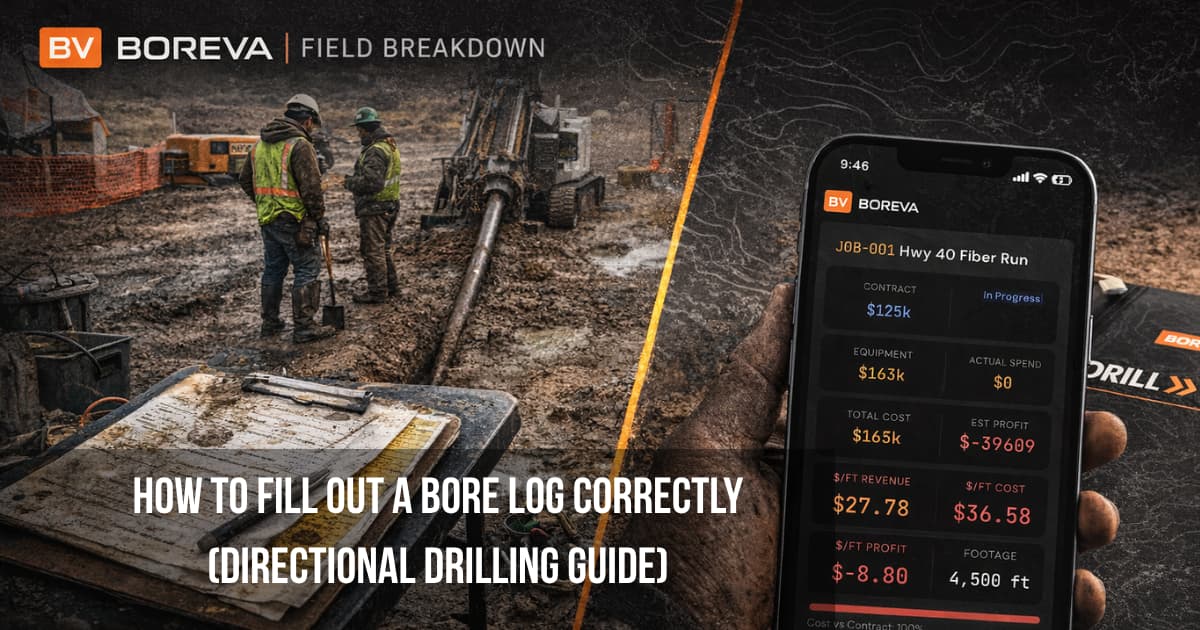
Alot crews treat the bore log like paperwork.
Something you fill out at the end of the day. Something you “get to when you get to it.” Something that doesn’t feel urgent because the drill is already in the ground and the footage is already drilled.
That mindset is exactly why contractors lose money.
A bore log is not a recap. It’s not a memory test. It’s not a summary of what you think happened.
A bore log is the real‑time record of the job, the only written proof of what actually happened underground.
And underground is where all the arguments happen.
When a GC questions your footage… When an inspector asks why production slowed… When a utility claims you hit something you didn’t… When billing gets challenged…
Your bore log becomes the only thing standing between you and a dispute you can’t win.
If you fill it out at the end of the day, you’re not logging, you’re guessing. And guessing is expensive.
This guide shows you exactly how to fill out a bore log the right way, step by step, shot by shot, in a way that protects your work, your production, and your money.
What You Are Actually Doing When You Fill Out a Bore Log
Crews think they’re “writing things down.”
They’re not.
When you fill out a bore log, you are creating legal, defensible, time‑stamped proof of what happened underground, the part of the job nobody can see, nobody can verify, and everybody argues about later.
A bore log is not a diary. It’s not a worksheet. It’s not a checklist.
It is evidence.
Every number you write… Every depth you record… Every condition you note… Every problem you document…
All of it becomes part of the story you may have to defend in front of:
- A GC
- An inspector
- A city official
- A utility owner
- A project manager
- Or your own boss
And here’s the part most crews never think about:
If it’s not written down, it never happened.
Not in the eyes of the GC. Not in the eyes of the inspector. Not in the eyes of the city. Not in the eyes of your own company.
Your memory doesn’t count. Your opinion doesn’t count. Your “I swear that’s what happened” doesn’t count.
Only the log counts.
That’s why accuracy matters more than speed. That’s why real‑time logging matters more than end‑of‑day summaries. That’s why consistency matters more than convenience.
When you fill out a bore log, you are not just documenting the job, you are protecting the job.
You are building the only written record that proves:
- What you drilled
- How you drilled it
- What slowed you down
- What conditions you faced
- Why production changed
- Why footage took longer
- Why the bill is the bill
A bore log is your shield.
If you treat it like paperwork, you lose money. If you treat it like proof, you protect money.
Step 1: Start Before the First Shot
A bore log starts before the first shot, before the first rod, before the locator even turns the box on. If you wait until drilling begins, you’ve already lost the most important context the log needs.
A bore log is not just a record of drilling, it’s a record of the job.
And a job is more than footage.
Before anything happens in the ground, you need to anchor the log to the real world. That means documenting the details that tie every shot, every foot, and every problem back to a specific crew on a specific day doing a specific job.
This is the foundation. If you skip it, everything else floats.
Here’s what must be logged before the first shot:
• Job Name
This connects the log to the contract. If a GC or inspector pulls your paperwork later, this is the first thing they look for.
• Location
Street, intersection, address, or stationing. If you can’t prove where the work happened, the rest of the log loses credibility.
• Date
Simple, but critical. Production, weather, delays, and billing all tie back to the date.
• Crew Members
Who drilled it. Who located it. Who mixed mud. Who was responsible for what.
If something goes wrong, this is the first question asked: “Who was on the crew that day?”
• Equipment Being Used
Drill model, locator model, tooling, reamers, rods, anything that affects production.
Why? Because equipment explains performance.
A 20,000‑lb drill doesn’t produce like a 40,000‑lb drill. A worn bit doesn’t cut like a new one. A mismatched reamer slows everything down.
When you document equipment up front, you create a baseline for the entire day.
This first step is simple, but it’s the one that separates amateurs from professionals.
Pros don’t start drilling until the log is already alive. Amateurs start drilling and try to remember everything later.
Step 2: Log Every Bore Shot Immediately
This is the part of the bore log that separates disciplined crews from sloppy ones.
Every bore shot is its own event. Its own decision. Its own risk. Its own cost.
And because of that, every shot deserves its own entry, clean, separate, and logged the moment it happens.
Too many crews don’t do this. They drill three, four, five shots… then try to remember them later. That’s how details get blurred. That’s how numbers get rounded. That’s how production gets misrepresented. That’s how disputes start.
Real‑time logging eliminates all of that.
Here’s what must be logged immediately after each shot:
• Shot Number
This is the anchor. It keeps the entire log organized and prevents confusion when reviewing the job later.
• Entry Point
Where the drill head started. This matters for mapping, for inspectors, and for proving you followed the plan.
• Exit Point
Where the shot ended. If the exit point changes, even slightly, it affects footage, path, and production.
• Planned Length
This is the expectation. It’s what the GC, PM, or engineer believes the shot should be.
When you compare planned length to actual length, you reveal:
- Steering adjustments
- Utility avoidance
- Path corrections
- Ground condition changes
- Real‑world deviations from the print
This is the story behind the footage.
Why You Log Immediately
Because memory is unreliable.
After a few shots, everything blends together:
- “Was that the one where we hit clay?”
- “Did we adjust depth on that shot or the next one?”
- “Was that the 180‑footer or the 220‑footer?”
When you log in real time:
- You capture the truth
- You eliminate guesswork
- You protect your production
- You create a clean, defensible record
A bore log filled out later is a story. A bore log filled out immediately is evidence.
Step 3: Record Actual Bore Length
If there is one number on the bore log that gets crews in trouble more than anything else, it’s this one.
Actual footage.
Not planned footage. Not estimated footage. Not “close enough” footage. Not “we’ll round it later” footage.
Actual, measured, real‑world footage.
This is the number that turns into billing. This is the number that gets audited. This is the number inspectors check. This is the number GCs challenge. This is the number that determines whether you made money or lost it.
And because of that, it must be exact.
Where Crews Go Wrong
They round. They guess. They assume. They copy the planned length. They write what “feels right.” They fill it in at the end of the day when everything blends together.
But here’s the truth:
Every time you round, you lose accuracy. Every time you guess, you lose credibility. Every time you estimate, you lose money.
A 10‑foot mistake doesn’t seem like much… until you multiply it across 20 shots. Or across a 3‑week job. Or across a year.
Small errors stack into big losses.
How to Log Actual Bore Length Correctly
Right after each shot:
- Measure the actual rod count or footage drilled
- Confirm it with the locator
- Write it down immediately
- Double‑check before moving to the next shot
This takes seconds, but it protects thousands of dollars.
Why Actual Footage Matters
Because actual footage tells the real story:
- Did the crew stay on path?
- Did they have to steer around something?
- Did the shot run long because of utilities?
- Did the ground conditions force adjustments?
- Did the print match reality?
Planned length is theory. Actual length is truth.
And the bore log is supposed to record truth.
Step 4: Track Depth and Path Conditions
Depth and ground conditions are the silent killers of production. They’re the invisible forces that determine whether a shot goes smooth, slows down, or turns into a fight.
Most crews don’t log this well. Some skip it entirely. And then they wonder why their production numbers don’t make sense later.
Depth and conditions explain everything.
They explain why a 200‑foot shot drilled in 45 minutes yesterday takes 90 minutes today. They explain why mud pressure changed. They explain why steering got tight. They explain why the drill started working harder. They explain why the locator had to adjust path.
If you don’t track depth and conditions, your bore log becomes a list of numbers with no story and numbers without a story get questioned.
What You Must Log for Every Shot
• Average Depth
This shows whether you stayed on plan or had to adjust. Depth affects steering, pressure, and production, it’s one of the first things inspectors look at.
• Changes in Depth
Did you drop? Did you climb? Did you hold steady?
A sudden depth change often signals:
- Utilities
- Rock
- Soft pockets
- Steering corrections
- Print deviations
These changes matter because they explain why the shot didn’t go exactly as planned.
• Ground Type
Clay drills differently than sand. Sand drills differently than rock. Mixed ground drills differently than all of them.
Log what you’re actually drilling through:
- Clay
- Sand
- Rock
- Mixed
- Wet
- Dry
This is the context behind production. It’s the reason two identical shots can have completely different drilling times.
• Wet or Dry Conditions
Moisture changes everything:
- Steering
- Pressure
- Tool wear
- Mud performance
- Production rate
A wet day and a dry day are not the same job, your log needs to show that.
Why This Section Matters More Than Crews Realize
When a GC or PM asks:
- “Why did production slow down?”
- “Why did this shot take longer?”
- “Why is the footage different from the print?”
- “Why did the mud usage spike?”
- “Why did the drill pressure increase?”
Depth and conditions are the answer.
Without this information, you look unprepared. With it, you look professional.
This is the difference between:
“I don’t know, that’s just how it went.” and “We hit mixed ground at 140 ft and had to adjust depth to avoid utilities, here’s the log.”
One gets questioned. One gets respected.
Capture Time and Production
Footage tells you what happened. Time tells you why it happened.
Without time, your bore log is just a list of distances. With time, it becomes a production record, something you can defend, explain, and bill from.
Time is the connector. It ties the entire job together.
And yet, it’s one of the most commonly skipped or sloppily recorded parts of the bore log.
Most crews don’t track time because they think it’s “extra.” But time is not extra, it’s essential.
Why Time Matters
Time reveals:
- Production rate
- Slowdowns
- Delays
- Efficiency
- Ground impact
- Equipment performance
- Crew performance
- Billing justification
If someone asks:
- “Why did this shot take longer?”
- “Why did production drop in the afternoon?”
- “Why did mud usage spike?”
- “Why did the drill pressure increase?”
Time is the answer.
Without time, you can’t explain anything. With time, you can explain everything.
What You Must Log for Every Shot
• Start Time
The moment drilling begins. This is your baseline.
• End Time
The moment the shot is completed. This is your finish line.
• Total Time Per Shot
This is where the story lives.
Two shots with identical footage can have completely different drilling times and that difference is what inspectors, GCs, and PMs care about.
Time shows:
- When the ground changed
- When steering got tight
- When mud thickened
- When the drill started working harder
- When the locator had to adjust path
- When utilities slowed progress
- When weather affected production
Time is the truth behind the footage.
How Time Protects You
When billing gets challenged, you can say:
“We drilled 180 feet in 1 hour 42 minutes because we hit mixed ground at 120 feet, here’s the log.”
That is a defensible statement. It’s factual. It’s documented. It’s undeniable.
Without time, all you can say is:
“It took longer.”
And that answer gets crews steamrolled.
Step 6: Document Problems Immediately
This is the section that makes or breaks the entire bore log.
Not the footage. Not the depth. Not the time.
The problems.
Because problems are where the money is. Problems are where delays come from. Problems are where disputes start. Problems are where production gets questioned. Problems are where contractors get burned.
And here’s the truth most crews don’t want to admit:
If you don’t log the problem when it happens, it doesn’t exist later.
Not to the GC. Not to the inspector. Not to the city. Not to your own office.
If it’s not written down, it’s gone.
Why Problems Must Be Logged Immediately
Because details evaporate.
Five minutes after a problem, you remember everything. Five hours later, you remember half. At the end of the day, you remember the big stuff. Tomorrow, you remember almost nothing. Next week, you remember whatever makes you look the best.
That’s not logging, that’s storytelling.
Real‑time documentation is the only way to capture the truth.
What You Must Log the Moment It Happens
• Utility Conflicts
The #1 cause of delays and disputes. If you had to steer around something, slow down, or adjust depth, write it down.
• Equipment Breakdowns
Even small breakdowns matter. A 10‑minute fix repeated three times becomes half an hour of lost production.
• Steering Issues
If the head stopped responding, pulled left, pulled right, or fought the locator, log it.
• Mud Problems
Thick mud, thin mud, lost returns, pressure spikes, these explain production changes instantly.
• Weather Delays
Rain, lightning, cold, heat, anything that slows the crew or affects the ground.
These aren’t excuses. They’re explanations. And explanations protect you.
Why This Section Protects Your Money
When billing gets challenged, the GC will say:
“Why did production slow down here?”
If your log says nothing, you lose. If your log says “steering issues due to rock at 120 ft,” you win.
When an inspector asks:
“Why did you deviate from the print?”
If your log says nothing, you lose. If your log says “utility conflict at 80 ft required path adjustment,” you win.
When your own office asks:
“Why did this job take longer than expected?”
If your log says nothing, you look sloppy. If your log shows documented problems, you look professional.
Step 7: Add Notes That Explain the Story
Numbers tell you what happened. Notes tell you why it happened.
A bore log without notes is like a map without labels, you can see the path, but you have no idea what anything means.
This is where most crews fall short. They think the footage, depth, and time are enough. They think the numbers speak for themselves. They think “everyone knows what happened.”
But here’s the truth:
Numbers without context get questioned. Numbers with context get respected.
Notes are the bridge between the raw data and the real story of the job.
Why Notes Matter
Notes turn your bore log into a narrative, a clear, defensible explanation of the day.
They answer the questions you will get asked:
- Why did production slow down?
- Why did the shot run long?
- Why did you adjust depth?
- Why did the path change?
- Why did mud usage spike?
- Why did the locator make a correction?
Without notes, you’re left explaining everything verbally later and verbal explanations don’t hold up.
With notes, the log speaks for itself.
What Good Notes Look Like
Good notes are:
- Short
- Clear
- Factual
- Written in real time
- Focused on what changed or mattered
You’re not writing a paragraph. You’re capturing the key moment.
Examples of strong notes:
- “Hit rock at 120 ft, slowed drilling pace.”
- “Locator adjusted path due to existing utility.”
- “Mud returns dropped at 90 ft, thickened mix.”
- “Steering pulled right, corrected depth by 1.5 ft.”
- “Weather delay — heavy rain for 20 minutes.”
- “Drill pressure increased in clay pocket.”
These notes do three things:
- Explain the numbers
- Protect the crew
- Strengthen billing
What Bad Notes Look Like
- “Hard ground.”
- “Slow shot.”
- “Had issues.”
- “Adjusted path.”
- “Equipment problem.”
These notes say nothing. They don’t explain. They don’t defend. They don’t help you later.
Bad notes create doubt. Good notes create clarity.
Why Notes Protect You Later
When someone challenges your production, you can point to the log and say:
“We slowed down because we hit rock at 120 ft, it’s documented.”
When someone questions your footage, you can say:
“We adjusted path due to a utility conflict, here’s the note.”
When someone asks why the job took longer, you can say:
“Weather delay at 2:40 PM, logged in real time.”
Notes turn arguments into facts. Facts win every time.
Step 8: Stay Consistent Every Day
A single good bore log doesn’t protect you. A single detailed day doesn’t prove anything. A single clean entry doesn’t build credibility.
Consistency does.
Consistency is what turns your bore log from “paperwork” into a reliable, defensible, professional record of the job. It’s what separates disciplined crews from chaotic ones. It’s what makes your logs believable, not just to you, but to anyone who reads them later.
Most crews don’t lose money because they drill poorly. They lose money because their documentation is inconsistent.
One day they log everything. The next day they log half. The next day they forget. The next day they round numbers. The next day they skip conditions. The next day they fill it out at the end of the shift.
That inconsistency creates doubt. And doubt is the enemy.
Why Consistency Matters
When your bore log is consistent:
- Every shot is documented the same way
- Every day looks like the day before
- Every number has context
- Every problem has notes
- Every deviation has an explanation
- Every entry follows the same structure
This creates a pattern and patterns build trust.
When a GC, inspector, PM, or auditor looks at your logs, they’re not just looking at the numbers. They’re looking at the crew behind the numbers.
A consistent log says:
- This crew is disciplined
- This crew pays attention
- This crew documents in real time
- This crew can be trusted
- This crew’s numbers are reliable
An inconsistent log says the opposite.
What Consistency Looks Like in the Field
• Same format every day
Don’t reinvent the wheel. Use the same structure, same order, same fields, same flow.
• Same level of detail
Don’t go deep one day and shallow the next. If you log conditions today, log them tomorrow.
• Same timing
Real‑time logging must be real‑time every day, not just when things go wrong.
• Same accuracy
No rounding today and measuring tomorrow. No guessing one day and recording precisely the next.
• Same discipline
Every shot. Every time. Every day.
Why Inconsistency Hurts You
Inconsistency creates openings for doubt:
- “Why is this day detailed and this day isn’t?”
- “Why did they log conditions here but not here?”
- “Why did they round footage on this shot?”
- “Why did they skip notes on this day?”
- “Why did they stop tracking time halfway through the job?”
Doubt weakens your position. Doubt weakens your billing. Doubt weakens your credibility.
What a Completed Bore Log Should Look Like
At the end of the day, a completed bore log should read like a clean, chronological story of the job, not a puzzle, not a guessing game, not a collection of half‑filled boxes.
A good bore log is simple: Anyone should be able to pick it up and understand exactly what happened without asking a single question.
That’s the standard.
If your PM, GC, inspector, or even another crew member can read your log and instantly see the full picture, you’ve done it right. If they have to ask you what happened, something is missing.
Here’s what a complete, professional bore log includes every single day:
• Every Shot Completed
No combining. No skipping. No “we’ll fill that one in later.”
Every shot stands alone with:
- Shot number
- Entry point
- Exit point
- Planned length
This creates structure and prevents confusion.
• Exact Footage Drilled
Not rounded. Not estimated. Not “close enough.”
Actual measured footage for each shot.
This is the number that affects billing, production, and disputes — it must be precise.
• Conditions Encountered
This is the context behind the footage.
Your log should clearly show:
- Ground type
- Depth changes
- Wet/dry conditions
- Any unusual drilling behavior
This explains why production changed from shot to shot.
• Time Spent
Start time. End time. Total time.
This is what turns your footage into a production rate and production rate is what gets questioned the most.
Time is the backbone of your explanation.
• Problems Documented
This is where most crews fall short, and it’s the part that protects you the most.
Your log should show:
- Utility conflicts
- Steering issues
- Equipment breakdowns
- Mud problems
- Weather delays
If it slowed you down, it belongs in the log.
• Notes That Tell the Story
Short, clear explanations that connect the dots:
- “Hit rock at 120 ft, slowed drilling pace.”
- “Adjusted path due to existing utility.”
- “Lost returns at 90 ft, thickened mud.”
These notes turn raw data into a defensible narrative.
What a Good Bore Log Feels Like
When you look at a completed bore log, it should feel:
- Clean
- Organized
- Consistent
- Detailed
- Easy to follow
- Impossible to argue with
A good bore log doesn’t need you standing next to it explaining anything. It explains itself.
That’s the goal.
Where Most Crews Get It Wrong
If you’ve been in this industry long enough, you already know the truth:
Most crews don’t fail because they can’t drill. They fail because they can’t document.
The mistakes are predictable. They happen on almost every job. And they cost contractors money every single day.
Not because the crew is lazy. Not because they don’t care. But because nobody ever taught them how to log correctly and the industry treats bore logs like an afterthought instead of a financial tool.
Here are the four biggest mistakes crews make, and why each one hurts more than they realize.
1. They Log at the End of the Day
This is the #1 mistake.
When you log at the end of the day, you’re not recording, you’re reconstructing. You’re trying to remember:
- Which shot hit clay
- Which shot slowed down
- Which shot needed a path correction
- Which shot had steering issues
- Which shot ran long
- Which shot had mud problems
Memory blends everything together.
By the time you’re filling out the log, you’re guessing. And guessing is how you lose disputes, lose credibility, and lose money.
2. They Round Footage
Rounding is the silent killer of accuracy.
Crews round because:
- It’s faster
- It “looks cleaner”
- They think it doesn’t matter
- They assume the GC won’t notice
- They’re trying to finish paperwork quickly
But here’s the reality:
Every rounded number is a small lie. And small lies add up.
A few feet here, a few feet there, multiplied across dozens of shots, becomes real money.
When billing gets challenged, rounded numbers fall apart instantly.
3. They Skip Conditions
This is the mistake that destroys production explanations.
If your log doesn’t show:
- Rock
- Clay
- Sand
- Mixed ground
- Wet conditions
- Depth changes
…then your production numbers look random.
You drilled 200 feet in 45 minutes yesterday. Today it took 90 minutes.
Without conditions, it looks like the crew slowed down. With conditions, it looks like the ground changed.
One gets questioned. One gets respected.
4. They Forget Problems
This is the most expensive mistake.
If you don’t log problems when they happen, they disappear.
And when they disappear, so does your justification for:
- Delays
- Extra time
- Extra footage
- Path changes
- Production drops
- Billing adjustments
You can’t defend a problem that isn’t written down.
And when the GC says:
“I don’t see anything in the log about that.”
…you’re done.
Why These Mistakes Matter
Because every one of them shows up later:
- In billing
- In inspections
- In disputes
- In audits
- In production reviews
- In conversations with the GC
- In conversations with your own office
A sloppy bore log makes you look sloppy. A clean bore log makes you look professional.
This is exactly why the Boreva approach exists, to force real‑time tracking instead of memory‑based logging.
It removes the guesswork. It removes the excuses. It removes the gaps.
And it protects the contractor every single day.
Crew Takeaway
At the end of the day, a bore log isn’t about paperwork. It isn’t about forms. It isn’t about checking boxes.
A bore log is about protecting the crew.
It protects your work. It protects your production. It protects your time. It protects your decisions. It protects your paycheck. It protects your reputation.
Most crews think the bore log is something the office needs. But the truth is simple:
The bore log protects the people in the field.
Because when something goes wrong, when a GC questions your footage, when an inspector challenges your path, when a PM asks why production slowed, when the city wants proof of depth, when billing gets audited……the only thing that stands between you and the argument is the log you filled out.
Not your memory. Not your opinion. Not your explanation. Not your “I swear that’s what happened.”
Just the log.
What the Crew Should Remember
1. Log in real time
Not later. Not at lunch. Not at the end of the day. Real time is the only time accuracy exists.
2. Be exact, not approximate
No rounding. No guessing. No “close enough.” Precision protects you.
3. Document every shot
Every shot is its own event. Every event needs its own entry.
4. Record conditions and problems
If it slowed you down, changed your path, or cost you time — write it down.
5. Add notes that explain the story
Short, clear, factual. Notes turn numbers into truth.
6. Stay consistent
A bore log is only as strong as its weakest day.
This Matters for the Crew
Because when the job is over and the questions start flying, the bore log becomes your voice.
A clean, consistent, real‑time bore log says:
- “We did the job right.”
- “We documented everything.”
- “We followed the plan.”
- “We adjusted when needed.”
- “We can prove every decision we made.”
That’s how you earn respect. That’s how you avoid blame. That’s how you protect your work. That’s how you protect your crew.
A bore log isn’t paperwork. It’s insurance. And the crew benefits from it more than anyone.
Contractor Takeaway
If the crew takeaway is about protecting the people in the field, the contractor takeaway is about protecting the business.
Because here’s the truth:
A bore log is not paperwork — it’s a financial document.
It’s the record that determines:
- What you can bill
- What gets approved
- What gets denied
- What gets disputed
- What gets escalated
- What gets audited
- What gets paid
A sloppy bore log costs money. A clean bore log protects money.
And contractors who understand this treat the bore log as seriously as they treat payroll, invoicing, and safety documentation.
What Contractors Need to Understand
1. The Bore Log Is Your Proof
When a GC challenges your footage, your time, or your production, the bore log is the only thing that stands between you and a denied invoice.
If it’s not documented, it didn’t happen. If it’s not clear, it gets questioned. If it’s inconsistent, it gets doubted.
A clean bore log is your evidence. A sloppy bore log is a liability.
2. The Bore Log Protects Your Margins
Directional drilling is a margin‑sensitive business.
Fuel, mud, tooling, labor, equipment wear, everything costs money.
If your bore log doesn’t capture:
- Delays
- Ground changes
- Utility conflicts
- Steering issues
- Weather impacts
- Production slowdowns
…then you eat those costs.
A good bore log doesn’t just record the job, it protects the profitability of the job.
3. The Bore Log Protects You in Disputes
Every contractor eventually faces:
- A GC who claims your footage is wrong
- An inspector who questions your depth
- A PM who challenges your production
- A city who wants proof of path
- An auditor who wants documentation
When that happens, you don’t want opinions. You don’t want memories. You don’t want “I think we did…”
You want a bore log that shuts the conversation down.
A bore log that says:
“Here’s the data. Here’s the time. Here are the conditions. Here are the notes. Here’s the story.”
Disputes disappear when documentation is undeniable.
4. The Bore Log Protects Your Reputation
Contractors get judged on two things:
- The quality of their work
- The quality of their documentation
You can drill perfectly, but if your paperwork is sloppy, you look sloppy.
A clean bore log shows:
- Professionalism
- Discipline
- Consistency
- Accuracy
- Accountability
It tells the GC, the city, and your own PMs:
“This contractor knows what they’re doing.”
That reputation leads to more work, better relationships, and fewer headaches.
5. The Bore Log Protects Your Future Jobs
When you have a clean record of:
- Ground conditions
- Production rates
- Delays
- Problems
- Path changes
- Equipment performance
…you can estimate future jobs with far more accuracy.
Better estimates = better bids. Better bids = better margins. Better margins = a healthier company.
The bore log isn’t just a record of the past, it’s a tool for the future.
Final Thoughts
A bore log is one of the simplest documents on a directional drilling job and one of the most powerful.
It’s not complicated. It’s not technical. It’s not something that requires special training or certifications.
But it does require discipline. It does require consistency. It does require accuracy. It does require real‑time attention.
And that’s exactly why most crews struggle with it.
Not because they can’t drill. Not because they don’t care. Not because they’re unskilled.
But because the industry has treated bore logs like an afterthought for decades, a piece of paperwork instead of a financial safeguard.
This article flips that mindset.
It shows the crew how to protect themselves. It shows the contractor how to protect the business. It shows the GC and PM how to trust the documentation. It shows the inspector how to verify the work. It shows the auditor how to confirm the numbers.
A clean bore log is more than a record. It’s a shield. It’s a story. It’s a defense. It’s a tool. It’s a competitive advantage.
And when you fill it out correctly, consistently, accurately, and in real time — it becomes one of the most valuable documents on the entire job.
The Bottom Line
If you want to protect:
- Your production
- Your billing
- Your reputation
- Your margins
- Your crew
- Your company
…then you must treat the bore log like the critical document it is.
Not paperwork. Not busywork. Not something you do later.
A bore log is the truth of the job, written down.
And truth is what protects you.
Leave a Reply